Protect What You Love
When the Verdict Arrives Before the Evidence
In 1973, a psychologist named David Rosenhan sent eight ordinary people into psychiatric hospitals. Each one claimed to hear a single word repeating in their head: “thud.” That was the only symptom. All eight were admitted. Once inside, they stopped reporting anything unusual and behaved completely normally. They socialized, answered questions, wrote in notebooks. Hospital staff never identified them as healthy. When they were finally discharged, several left with labels of “schizophrenia in remission.” The hospital acknowledged the illness had passed while refusing to consider it may never have existed.
Rosenhan’s paper was about diagnostic failure. But what he actually documented was something more basic and more durable: once a label is attached to a person, everything that follows gets read through it. Normal behavior becomes symptom. Calm becomes manipulation. The institution had stopped observing. It was confirming.
I grew up in Israel. I served in the IDF as a paratrooper. I have been in situations where the difference between reading something correctly and reading it through a pre-existing frame carries real consequences. Not theoretical consequences. Physical ones. I know what it costs when someone has already decided what they are looking at before they look. I have spent years in New York watching how Israel gets discussed in rooms where people do not expect to be challenged. What I keep recognizing is not hatred, though that exists too. It is something closer to what Rosenhan described. The conclusion arrived before the observation began. The observation is now just confirming it.
October 7th happened. More than twelve hundred people were killed in a single morning. Families, elderly people, children, young people at a music festival. More than two hundred taken into Gaza as hostages. I am not using this as rhetorical leverage. It is the factual starting point for the military campaign that followed. A country that had just absorbed the largest massacre of Jews since the Holocaust mobilized to respond. What followed was a war, and war is not clean. I have never argued that it is, and this article is not an argument that it is.
Gaza’s civilian population has suffered. Buildings destroyed, hospitals damaged, entire neighborhoods displaced, children killed who had no part in any of what was planned and executed by Hamas. None of that needs to be minimized for Israel’s right to defend itself to be legitimate. These things coexist in reality. What I keep watching is how rarely they coexist in the conversation.
When Israel warns civilians to evacuate before a strike, the warning is called theater. When it identifies military targets, the identification is assumed to be fabricated. When hostages are recovered alive, the rescue is characterized as provocation. When civilians flee, Israel is responsible. When they stay, Israel is also responsible. The behavior changes. The verdict stays fixed. That is not analysis. That is what analysis looks like when the label was already in place.
I want to be direct about something. No serious person should argue that Israel has made every decision in this war correctly. It has not. There are choices that deserve scrutiny and accountability, and that scrutiny is legitimate and necessary. Criticism of Israeli military and political decisions is not the problem I am writing about. The problem is the absence of something more basic: the assumption of complexity. Most countries conducting military operations receive at least some acknowledgment of real constraints, real information limits, real adversary behavior. Israel consistently does not. It is evaluated against a standard applied to no one else in a comparable situation.
Hamas built its military infrastructure inside and underneath civilian areas. Tunnels beneath hospitals. Weapons stored in residential buildings. Command positions embedded in densely populated neighborhoods. This is documented. It is not seriously disputed by people who have looked at the evidence. It is also a deliberate strategy, designed specifically to produce a situation in which every Israeli military decision either becomes impossible or generates the images and arguments that followed. When you build your military inside a civilian population, you are not being careless. You are weaponizing that population and the conversation that will follow. When international commentary proceeds as though that reality does not exist, the omission is doing work. It is constructing the frame.
There is an institutional dimension to this that is hard to explain away. After Russia invaded Ukraine, the United Nations voted to suspend Russia from the Human Rights Council. The reasoning was clear: a country actively committing documented atrocities against civilians should not hold oversight authority over human rights. That principle exists. In 2023, Iran chaired the UN Human Rights Council Social Forum. Iran, a government that executes political dissidents, funds armed groups operating across multiple countries, and has its own documented record of civilian harm. I am not raising this to change the subject. I am raising it because a principle applied only in certain directions is not a principle. It is a direction.
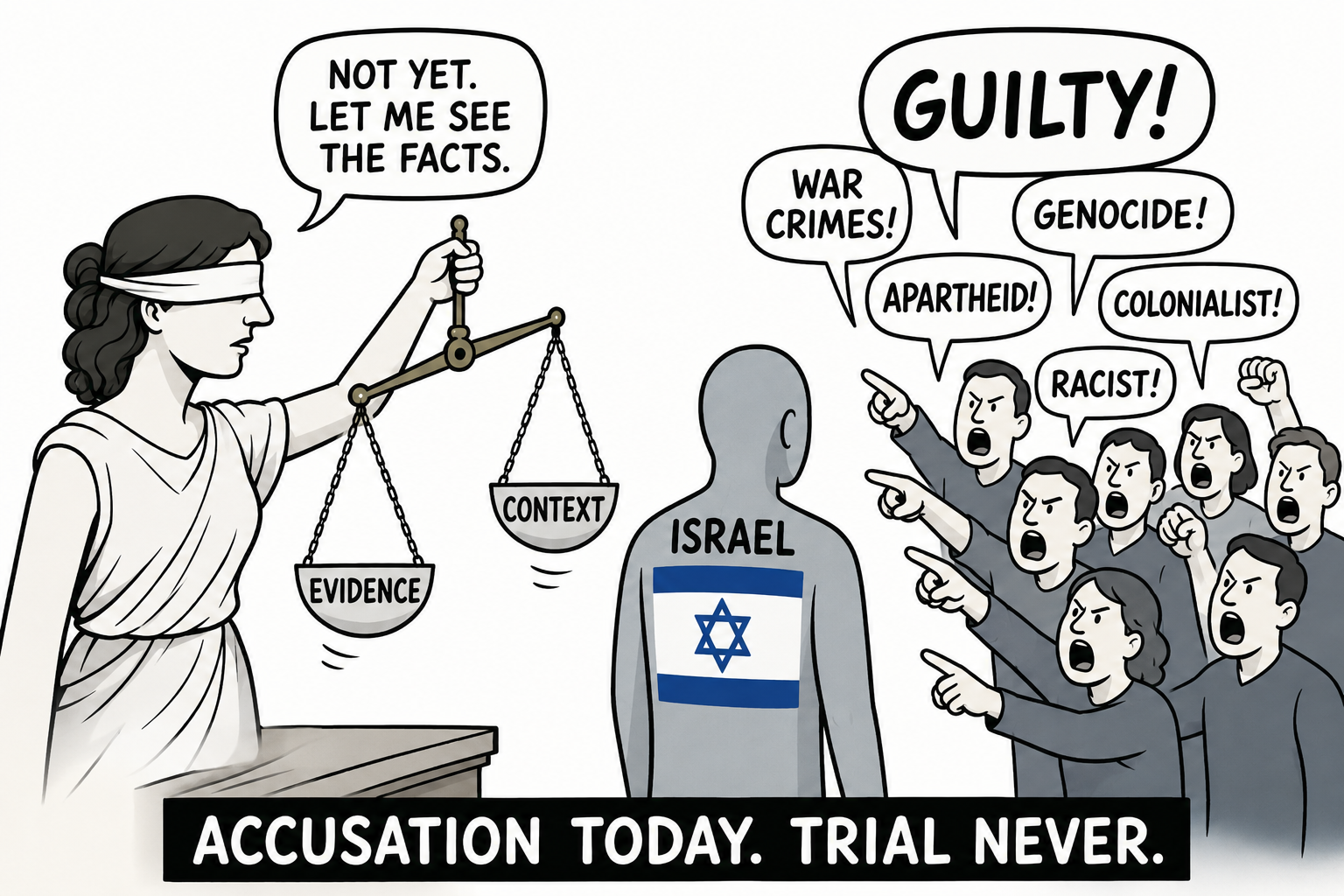
What concerns me most goes beyond Israel’s treatment in any specific debate. It is about what happens to human judgment when the verdict arrives before the trial. History is full of examples of intelligent, institutionally supported people organizing reality around a predetermined conclusion. The Salem accusers were not operating in ignorance. McCarthyism had real institutional infrastructure behind it. Soviet psychiatrists were credentialed professionals. The problem in each case was not the absence of intelligence. It was a prior commitment to a conclusion that then organized every incoming fact around itself. From the inside of that process, certainty feels indistinguishable from accuracy. That is what makes it dangerous.
I watch thoughtful people who genuinely care about Palestinian civilians apply this same process to Israel in real time. The care is real. But the label was set before the evidence was reviewed, and now everything gets sorted. Each military action, each political statement, each civilian casualty goes directly into confirmation rather than evaluation. That is a closed system, and closed systems are not capable of protecting the people they claim to care about. They can only confirm what they already believe.
There is an honest version of this conversation that most people are not yet willing to have. It holds civilian suffering as real and requiring accountability. It holds that Israel makes mistakes and those mistakes deserve examination. It holds all of that while also sitting with a harder question: what is a country supposed to do the morning after twelve hundred of its citizens are murdered, with more than one hundred still held hostage? That question does not have a clean answer. Sitting with it honestly requires accepting that no answer available to Israel in that situation was going to be clean. That is what the situation created by Hamas actually looked like.
The pseudopatients in Rosenhan’s study were never helped by their diagnoses. They were contained by them. The institution was certain. The certainty was the problem. A society that decides the verdict before it observes has not built a more just system. It has built a more efficient mechanism for confirming what it already believes. The cost of that is not abstract. It is paid by actual people, on all sides of actual conflicts, who deserve to be looked at clearly before anyone decides what they are.
Do something amazing,
Tsahi Shemesh
Related Topics
Related Posts