A Mermaid in Jerusalem
When the world jumped the shark
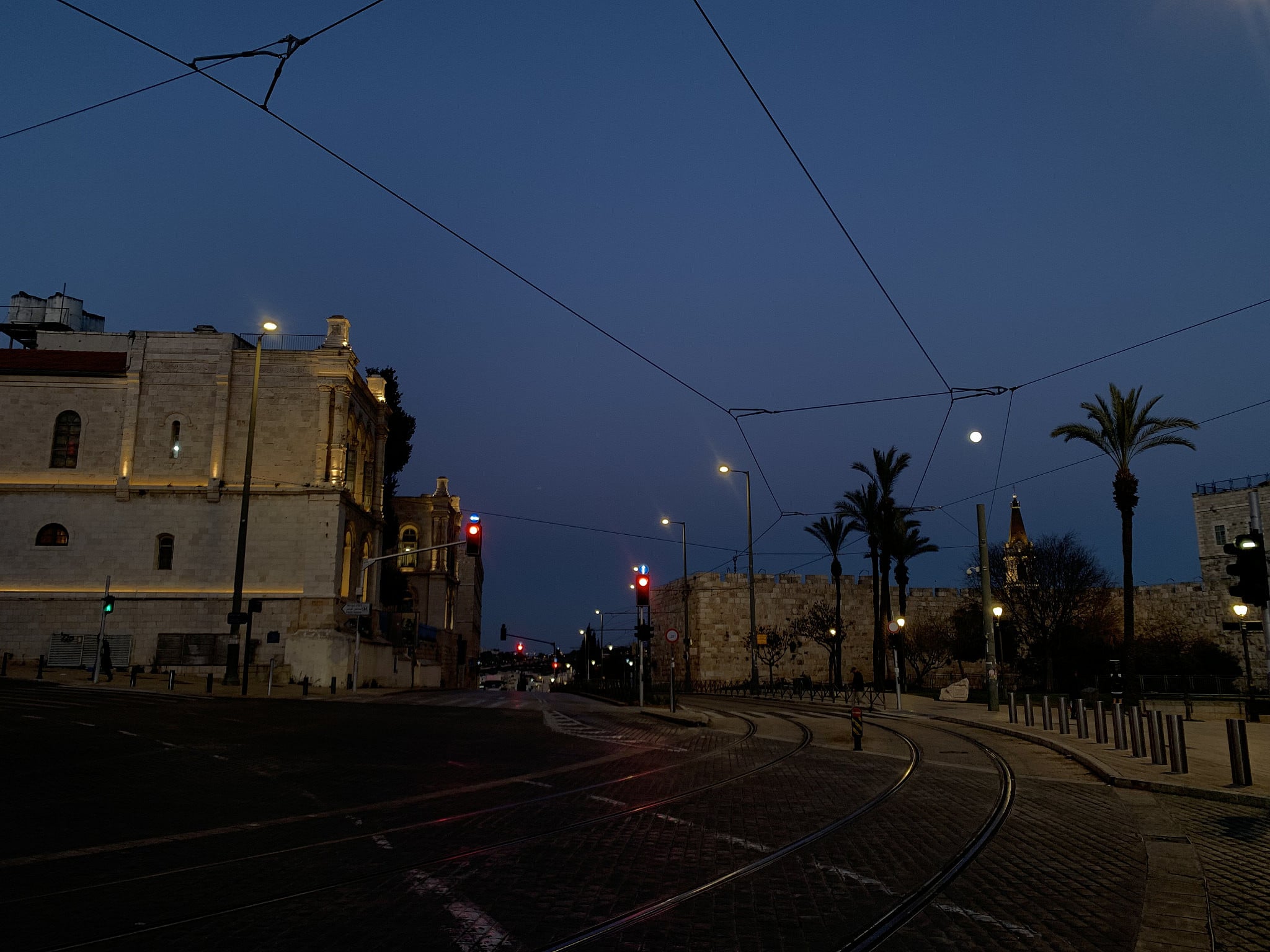
Photo: courtesy of the author
It feels like the world jumped the shark in 2020.
Before COVID, most of us carried a quiet assumption that the world was basically stable. Not perfect, but stable. Institutions functioned. Daily life had its own rhythm. Even crises felt contained.
Then suddenly the entire planet went into a kind of suspended animation.
Lockdowns. Empty streets. Masks. Distance. The constant drumbeat of numbers and warnings. Governments making sweeping decisions about movement, work, school, even family contact.
Whether one agreed with the policies or not, the experience itself was a profound psychological rupture. Human beings are social animals, and almost overnight we were asked to treat one another as potential vectors of danger.
Isolation on that scale does something to the nervous system.
People often underestimate how physical the experience was. Loneliness and uncertainty are not just emotional states — they are biological ones. They alter stress hormones, sleep cycles, and cognitive processing. Researchers are now studying the neurological and psychological aftereffects of the pandemic: anxiety spikes, attention fragmentation, lingering fatigue, social mistrust — from lockdowns and from the virus itself Which we now know is deeply neurological and left many sufferers profoundly lost with no road map.
It was a collective trauma.
And unlike most traumas, it happened simultaneously to billions of people.
Before society really had time to metabolize it, the world lurched into a series of new shocks: war, geopolitical instability, economic stress, political polarization.
Here in Jerusalem — where the rhythms of life already include sirens and sheltering — the overlap can feel especially surreal.
One moment you are told to isolate because of a virus. Another moment you are sheltering because of missiles. Both involve the same bodily posture: waiting, listening, bracing.
And still the ordinary demands of life continue: groceries, laundry, work deadlines, family logistics. Sometimes even boredom — the strange sensation of moving through thick mud while the world buzzes with tension somewhere in the background.
It’s not surprising that people feel disoriented.
The nervous system expects recovery after crisis. But the past few years have felt more like waves — just as one recedes, another arrives.
And in Israel, those waves have been relentless.
Before the pandemic was even fully behind us, the country was already convulsing over the judicial reform crisis — months of protests, counter-protests, strikes, reservists threatening not to report for duty, families arguing across dinner tables about the future of the country. Week after week, hundreds of thousands of Israelis filled the streets. Something foundational about the state itself felt contested.
Then came October 7.
A rupture so violent and shocking that it shattered assumptions many Israelis had carried for decades about deterrence and security.
And since then, the country has moved into something stranger still.
Not a single war.
Wars.
Plural.
Gaza.
The northern front.
Iran and its proxies.
Wars.
Plural.
The bonkers thing about living here is that it begins to feel almost routine. Sirens. Reserve duty. Evacuations. Group chats asking who is safe.
Children learn the geography of shelters before they learn multiplication tables.
It shouldn’t be normal.
And yet it is our normal.
So when people say the world feels disoriented right now, Israelis often feel that disorientation in stereo: political crisis, national trauma, and multiple wars unfolding at the same time.
And still — every morning — the buses run, cafés open, children go to school, and someone somewhere argues loudly about politics.
Life insists on itself here.
Meanwhile our windows have also become our screens.
We see far too much — and yet only what the algorithm feeds us.
War arrives not just through sirens but through endless video clips. Grief is measured in pixels. Outrage scrolls past between advertisements. The most horrifying events on earth appear inches from our faces, sandwiched between vacation photos and recipes.
We are exposed to far more of the world’s suffering than any generation before us — but rarely with enough context, distance, or quiet to process it.
The human brain was not built for this much information, this much alarm, this much immediacy.
So we scroll. We absorb fragments. We brace again.
That doesn’t necessarily mean the world has gone mad — though it can feel that way. It may simply mean we are living through a historically dense period of change, and our minds are still trying to catch up.
Humans are very good at surviving upheaval.
We are slower at understanding what it does to us.
Part of that understanding may begin with acknowledging a quiet feeling many of us now carry:
The world tilted a few degrees off its axis.
The illusion of stability vanished.
The systems we trusted turned out to be more fragile than we imagined. The rhythms we relied on disappeared almost overnight.
And now we move through our days with a new awareness:
The ground beneath us was never as solid as we thought.
Related Topics