CEO of Time to Stand Up for Israel
When Truth Becomes the Enemy of Israel
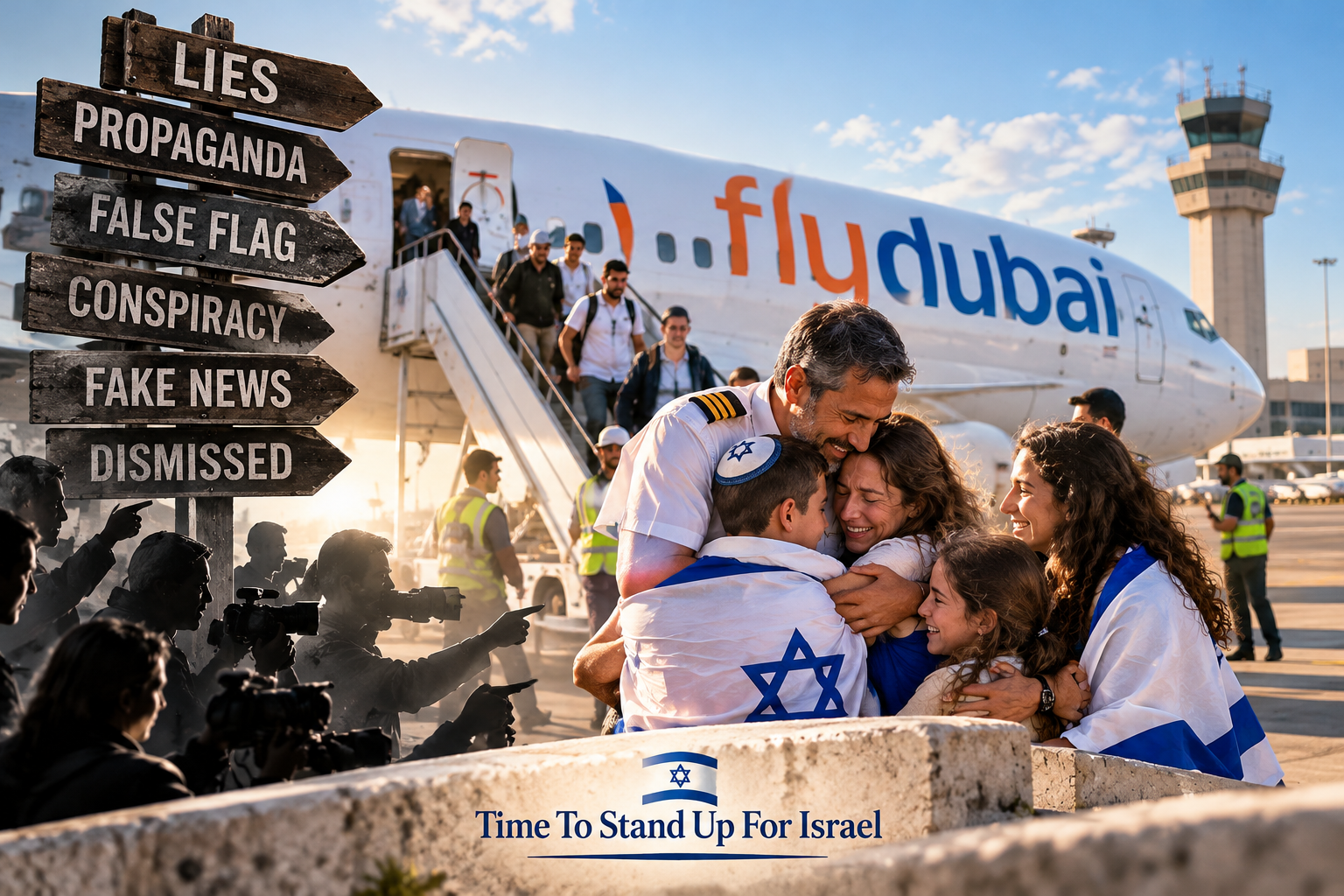
Photo credits: Sabine Sterk (AI)
Trust is one of the most precious foundations of human civilization. Without it, relationships collapse, societies become divided, international agreements lose their meaning and even the most convincing evidence becomes worthless. Trust requires honesty, consistency and a willingness to acknowledge reality, even when that reality challenges our personal convictions. Yet when it comes to Israel, I increasingly wonder whether much of the world has lost not only its trust in the Jewish state, but also its willingness to recognize the truth whenever that truth happens to portray Israel or Israelis positively.
For more than twelve years, I have dedicated an enormous part of my life to advocating for Israel, defending its right to exist, explaining its history and challenging misinformation. During those years, I have witnessed something deeply disturbing. The standards by which Israel is judged have become so distorted that almost every situation seems to produce the same verdict. When Israel makes a mistake, the accusation is immediately accepted as undeniable truth. When Israel does something admirable, the evidence is questioned, the motives are attacked and the entire event is frequently dismissed as propaganda. Apparently, for some people, Israel is guilty when something goes wrong and suspicious when something goes right. How can trust possibly survive when the outcome of the judgment has already been decided before the facts are examined?
The recent events surrounding Flydubai Flight 1073 illustrate this disturbing phenomenon. On September 30, 2026, a passenger aircraft traveling from Dubai to Tel Aviv became the scene of a terrifying attack when the copilot assaulted the captain with an axe and attempted to seize control of the aircraft. The plane, carrying more than 170 passengers and crew, many of them Israeli, plunged dramatically before passengers and crew intervened. The wounded captain, the courageous passengers and the reserve pilots who eventually landed the aircraft in Saudi Arabia helped prevent a catastrophe. Authorities in the United Arab Emirates subsequently described the incident as an attempted terrorist attack. Investigators reported that the copilot intended to crash the aircraft into Ben Gurion Airport, potentially murdering not only everyone aboard but also innocent people on the ground.
One might expect such an extraordinary escape from disaster to unite people in relief and admiration. After all, human lives were saved. Courage prevailed over terror. Passengers who boarded an ordinary commercial flight expecting to arrive safely at their destination were suddenly confronted with the possibility of death and responded with remarkable determination. Yet the incident also became the subject of accusations of fabrication, propaganda and an Israeli false flag operation. Instead of celebrating survival, some preferred to search for a conspiracy. Instead of acknowledging courage, they questioned whether the event had even happened as reported. This is where distrust becomes something far more sinister than ordinary skepticism. It becomes a deliberate refusal to accept reality whenever reality interferes with an established ideological narrative.
And I cannot help asking an uncomfortable question. How many of those who dismissed the incident as propaganda would have reacted very differently had the copilot succeeded? Would they have expressed genuine horror at the murder of Israeli passengers, or would some have celebrated another deadly attack against Israelis as an act of resistance? We cannot know how every individual would have reacted, and it would be dishonest to pretend otherwise. But we have already witnessed people celebrating the atrocities of October 7, 2023, and that alone should make us deeply concerned about the moral boundaries that have disappeared in certain circles. When the attempted murder of civilians becomes something people are unwilling to condemn unequivocally, humanity itself is in serious trouble.
The problem extends far beyond a single aviation incident. Israeli humanitarian organizations save lives without asking about religion or nationality. Israeli researchers contribute to medical breakthroughs that benefit patients across the world. Israeli emergency workers respond to disasters, Israeli doctors treat people from communities openly hostile to their country, and Israeli technology improves countless aspects of everyday life. Yet positive stories frequently struggle to penetrate the enormous wall of suspicion surrounding Israel. An Israeli mistake can dominate headlines for days, while an Israeli achievement may be ignored, minimized or attributed to ulterior motives. Apparently, the Jewish state is expected to demonstrate moral perfection while receiving almost no recognition for the good it contributes to humanity.
Let me be absolutely clear. Trust does not mean unquestioning loyalty, and supporting Israel does not require defending every action of its government, military or citizens. Israel makes mistakes, sometimes serious ones, and accountability is essential. I have never believed that loving a country means pretending it is flawless. On the contrary, genuine love demands honesty. But honesty must work in both directions. If wrongdoing deserves condemnation, responsible conduct deserves recognition. If allegations require investigation, verified achievements deserve acknowledgment. If we demand evidence before accepting Israel’s explanations, we must demand the same evidence before accepting accusations against it. Anything less is not principled criticism. It is prejudice disguised as moral superiority.
What concerns me most is the psychological mechanism behind this phenomenon. Once people become emotionally invested in believing that Israel represents everything evil in the world, accepting anything positive about it becomes almost impossible. Every new fact must fit the existing belief, and anything that contradicts it is rejected. A photograph becomes manipulation. A rescue becomes public relations. An investigation becomes a coverup. A denial becomes proof of guilt. Even independent confirmation may be dismissed because the conclusion is simply too inconvenient. This is no longer a discussion about evidence. It is a closed belief system in which Israel has already been convicted and no amount of truth can secure an acquittal.
Social media has accelerated this dangerous development beyond anything I could have imagined when I began advocating for Israel. Millions of people consume headlines without reading articles, share accusations without checking sources and mistake repetition for confirmation. Artificial intelligence, manipulated images and deliberately misleading videos make the situation even more dangerous. But technology is only part of the problem. The greater danger lies in the human willingness to believe whatever confirms existing hatred. An outrageous accusation against Israel can spread across the world in minutes, while a correction may never reach even a fraction of the original audience. By the time the truth emerges, public opinion has already been shaped and the damage is often irreversible.
There is another dimension to trust that Israel cannot afford to ignore. The Jewish state depends on relationships, diplomatic cooperation and international agreements in a region where alliances can change rapidly. The Abraham Accords demonstrated that former adversaries can develop meaningful cooperation, and the emergency landing of Flight 1073 in Saudi Arabia showed how practical cooperation can help save lives even where formal diplomatic relations remain absent. These developments deserve recognition. Yet Israel must balance optimism with vigilance. Trust between nations should never be based merely on declarations of friendship or shared economic interests. It must be earned through consistent actions, mutual responsibility and the willingness to stand together when circumstances become difficult.
Perhaps the greatest tragedy is that the erosion of trust does not only harm Israel. It harms everyone. A society that refuses to recognize facts because they contradict political preferences gradually loses the ability to distinguish truth from fiction. A generation taught that Israeli suffering is suspicious while Israeli wrongdoing is automatically credible is not being educated to think critically. It is being conditioned to reach predetermined conclusions. And when moral judgment depends more on the identity of the victim than on the nature of the act, universal human rights become nothing more than selective political slogans.
After twelve years of almost daily advocacy, I sometimes wonder whether facts alone can still make a difference. I can present historical documents, photographs, eyewitness accounts, independent investigations and evidence from international sources, yet there will always be people who refuse to consider any of it. That is exhausting, but it also reinforces why advocacy remains necessary. We cannot allow the loudest voices, the most outrageous accusations or the most persistent conspiracy theories to determine what future generations believe about Israel.
Trust is not the obligation to believe Israel blindly. It is the intellectual honesty to judge Israel fairly.
It means having the courage to condemn an Israeli mistake without condemning an entire nation. It means recognizing an Israeli achievement without inventing a conspiracy to explain it away. It means acknowledging Israeli victims without first examining whether their nationality makes them worthy of sympathy. Above all, it means accepting that the truth does not become false simply because it is inconvenient.
Israel does not need the world to worship it, excuse it or place it above criticism. Israel deserves what every other nation deserves: fairness, context, honesty and the presumption that its people are human beings whose lives matter.
When people would rather believe that a rescue was staged than acknowledge that Israelis helped prevent a catastrophe, the real crisis is no longer a lack of trust in Israel. It is a crisis of integrity in those who refuse to believe anything good about it.
And perhaps that is the most uncomfortable truth of all.
Related Topics