
When Victory Is Subjective: Reflections on the Post-Agreement Reality
This week, we could finally breathe a little easier.
Finally, A circle has been closed, with a deal that saved the lives of the remaining live hostages and marked the beginning of the end of the war—and of what’s being called “the day after” in Gaza. After two years of war, it seems that Israel, with Trump’s push, is approaching something that begins to resemble a more “peaceful time.”
-
Did we win? It depends on your political identity.
It was fascinating to see how the distant wings of both the right and the left united in agreement about the outcome of the war: both believe we lost.From the right came the predictable claim that the price Israel paid—releasing 250 convicted terrorists serving life sentences and an additional 1,700 detainees arrested in Gaza since the start of the war—is far from the “total victory” promised by the right-wing government. The potential amnesty for Hamas terrorists and the fact that many tunnels and gaps still allow Hamas to govern and rebuild power in Gaza have led many on the right to cry out that we’ve returned to “the old conception” and that “we’ve learned nothing from the Shalit deal.”
From the left, almost identical claims were heard. We didn’t decisively defeat Hamas. We didn’t bring back all the hostages—do we even have any guarantee that all the fallen will be returned? —and the price of “the day after,” in which Turkish and Egyptian hands will hold strategic tools in Gaza (and throughout the region), endangers Israel’s future.
In my view, what is clear is the fact that their opinions were entirely predictable. Those who build their political ideology on the settlement of Gaza and the eradication of Hamas will never accept the reality that modern wars end with agreements. Israel—even though it possesses one of the strongest militaries in the world—depends on Western powers both militarily and diplomatically and cannot afford an eternal war that would cost the lives of the remaining hostages as well as the critical relationships with the U.S. and other nations that, in truth, sustain us through military aid and international legitimacy.
Debating those on the left is just as frustrating. Many groups within the left have one core ideology: Anyone but Bibi. There is no scenario in which they would ever give Netanyahu credit. Of course not. Even if Bibi were to bring the Messiah, they’d say it was actually someone else’s doing. The beeper attack? Fully Mossad’s. Israel struck Iran? The Americans finished the job. The Hostage deal? One hundred percent Trump. As long as disaster strikes, their immediate cry is always: “It was Bibi’s fault.”
If Bibi is responsible for October 7th, then he’s also responsible for the successes against Hezbollah, Iran, Yemen, Syria, and Hamas. If Bibi is to blame for the hostages captivity, then it’s fair to at least give him—or the negotiation team he appointed—some modest credit for their part in the return deal. This doesn’t contradict the fact that he must step down because of the October 7th failure, nor the fact that a state commission of inquiry should have been established long ago.
The disgraceful booing at Witkof in Hostage Square when he mentioned Netanyahu’s name, as well as the complete refusal to recognize the Israeli team’s role in reaching the deal, are signs of hysteria among certain parts of the Israeli left. Those who claim Netanyahu will manipulate, divide, and trample them in the next election campaign are, in fact, doing all his work for him.
It’s time for the real left to present a serious, detailed ideology. Beyond what they’re against, it’s time to say what they’re for. When the left’s hopes rest on soft right-wing figures like Bennett and Eizenkot, it’s quite clear they’re in trouble. It’s time—for the sake of Israeli political discourse itself—for true leadership to emerge on the left. That would be good not only for the left but for the entire Israeli political landscape.
-
Nope: There Is No Symmetry
The morning after the hostages were freed, The New York Times headline read: “Hostages and Prisoners Released.” The appalling comparison was not the first time international media had drawn moral symmetry between Israeli victims and Palestinian terrorists. Similar headlines appeared after the release of Gilad Shalit.
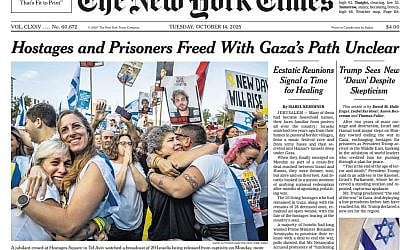
The very fact that we’ve grown accustomed to absorbing this false symmetry from the media is tragic. And it’s a shame we even have to say what everyone already knows: there is no symmetry.
There is no symmetry between a young man kidnapped from a music festival and a terrorist who stabbed a woman to death in front of her children. There is no symmetry between a man torn from his girlfriend, starved for months, and shackled for two years behind iron bars in a dark tunnel, and a terrorist who sat on a rooftop in Hebron and sniped a Jewish girl.
There is no symmetry between a society that sanctifies life and educates generations of soldiers on the purity of arms and human dignity, and a society that sanctifies death and raises children who dream of becoming martyrs (“Shahids”). There is no symmetry between a country that puts a soldier on trial for shooting a neutralized terrorist and a society that breeds barbarians who mutilated women’s bodies and played soccer with their remains.
There’s a reason Israelis are more moved by the return of the hostages than by images of destroyed Gaza—and there’s a reason Palestinians were more excited by the images of October 7th than by the release of their prisoners.
Golda Meir once said, “Peace will come when the Arabs love their children more than they hate us.” And while this agreement may finally bring a measure of calm and stability to the region, the road to genuine peace is still a long way to go.