When Virtue Signaling is a Good Thing
Years ago, Susan*, a remarkable woman who had certain physical disabilities would occasionally attend our shul. Every time she came, she would complain to me about all the things in our shul that were insensitive to people with disabilities. With time, our relationship grew to the point that I felt comfortable asking her why she kept on coming to our shul if there was so much that bothered her about what we do and don’t do. What she said really stuck with me: “I come because I have seen through your shul’s programming and messaging that you really care, and that your shul is trying to make a difference.”
Kol Echad, a department of the Orthodox Union, recently launched Makom Kavuah, an initiative that guides shuls on how to set up “Shul Mentors,” a responsible and caring adult to sit with the child of single parents who are on the other side of the mechitza. The reception has been overwhelming; mostly from single parents who appreciate how their sons or daughters normally feel so lost during davening, how coming to shul can be so painful to them, and how so many children of single parents simply stop coming to shul because they feel like they do not belong. Many shuls have embraced Makom Kavuah as well, reaching out to single parents to inform them of the project, and proudly placing flyers in their shul lobbies letting everyone know that this service is available.
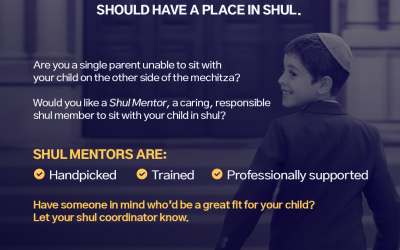
Some shuls, however, have hesitated, and for good reason. “We do not have any mothers or fathers who would benefit from such a program.” Or, “We don’t want to call attention to these children or parents; we try to find them someone to sit with but in a quieter fashion.” I understand where they are coming from; the creators of Makom Kavuah struggled with the potential insensitivity of such marketing, but Susan’s insight is worth reflecting on.
How does a single parent know that they are welcome in this shul? How does a single parent know that they are seen in this space?
We don’t wait until we have a shul member who is handicapped before placing a handicapped parking spot in our shul parking lot. We want to make sure they know they are welcome; we want to make sure they know we care. That’s what Susan was telling me; you are making so many mistakes, and you are not coming close to caring for all my needs, but the fact that you demonstrate that you care makes me feel welcomed in this shul.
Some might suggest that putting up a sign and offering unique services for singles is virtue signaling. Our Sages teach us that the first fruit offering, Bikkurim, was brought with much fanfare. They would be brought through the streets of Jerusalem with music, golden baskets, and everyone who saw them would stop and stand at attention. Bikkurim was a tool to bring about a culture change, to go from an ungrateful group of people to a nation who thanked G-d for everything. Though modesty and privacy are important values in Judaism, they had to be balanced with the great impact of doing something publicly and the impact doing so has on the entire community. The Mitzvah of Bikkurim reminds us that sometimes virtue signaling is a good thing; sometimes you have to make some noise.
Kol Echad’s mission is to change the culture of the Jewish community. Of course, we care deeply about those who are single, widowed, or divorced and their children. But are we letting them know how much we care?
Whether you and your shul participate in Makom Kavuah is not the point. And as Susan taught me, having all the answers and doing everything right is often not feasible. But we can demonstrate, through programs, messaging, and any other form of virtue signaling, that we do indeed care.