
When well-meaning activism causes antisemitism
For nearly a decade, I was viewed by many within the Ultra-Orthodox Jewish community as one of its sharpest critics because of my advocacy for secular education in yeshivas. Outside the Haredi world, however, including in the non-Haredi Jewish communities, I was often cheered on by those who saw my work as both necessary and courageous.
I later doubled down on that advocacy by launching a media outlet specifically designed to report critically on the Haredi community and examine systemic issues that my activist peers and I believed were being ignored or insufficiently addressed.
But after October 7th, I was forced to confront a deeply uncomfortable question: Could some of the advocacy meant to improve our community also be fueling the hatred directed against it?
October 7th came sparked a dramatic rise in online antisemitism, accelerated by social media platforms adopting far more permissive policies toward hateful content. At the same time, AI tools made it easier than ever for propaganda, conspiracy theories, and inflammatory narratives to spread globally, instantly translated, polished, and amplified.
The result has been staggering.
Today, virtually any story involving Jews online is flooded with comments invoking Hitler and suggesting he was right all along, celebrating Jewish suffering, or suggesting that Jewish persecution throughout history was somehow justified. If a Jewish person is attacked, people mockingly comment it was “promised to him 3,000 years ago.” Others openly hint that the days of Jewish presence in the US are numbered because society is supposedly “noticing” the “problem” Jews pose.
And disturbingly, many of these antisemites cite the very internal criticisms raised by Jewish activists and reformers.
The Haredi community is criticized on many fronts — some more legitimate than others. Among the issues frequently discussed are allegations of sexual abuse, Metzitza B’Peh, secular education in yeshivas, arranged marriages, get refusal, poverty, and dependence on government assistance.
Beyond the Haredi world, broader Jewish communal debates include the treatment of Palestinians in the West Bank and Gaza, the treatment of Christians in Jerusalem, military enlistment among Haredim in Israel, settler violence, and other contentious matters.
To be clear, there are legitimate concerns that deserve attention. But there is also a strong argument that some of these issues are exaggerated, even by well-meaning Jewish activists.
For example, while sexual abuse exists in Haredi communities, as it tragically does everywhere, it is not accurate to portray it as rampant or somehow endorsed by Haredi leadership. Likewise, arranged marriages are often caricatured by outsiders, yet many people observing the dysfunction and loneliness of modern secular dating have begun to view partially arranged systems more favorably.
Another potential pitfall with activism is that “social change” has become a buzzword for people who want to change everything they dislike or that simply does not sit well with them. But not every tradition is inherently oppressive, and not every uncomfortable practice constitutes an injustice. Not everything activists claim is a problem is, in fact, a problem. No, I do not believe Hasidic yeshivas need to teach children about LGBT matters, for instance. Conflating the importance of teaching English and math with teaching about LGBT identities rightly causes community leaders to harden their stance and oppose even discussing reform.
Even when it comes to the issue of secular education in yeshivas, a cause I spent a decade championing, I have increasingly acknowledged that, compared to the alarming state of education in many non-Haredi schools, the gap is not always as dramatic as critics suggest. Indeed, I believe in may ways Haredi Yeshivas do better than their public school counterparts.
But to antisemites, none of this matters. They do not engage with criticism thoughtfully or proportionally. They weaponize it.
Sunlight may be the best disinfectant, but when filtered through a magnifying glass wielded by bad-faith actors, it can also start a fire.
Take for example Metzitza B’Peh, a practice criticized by well-meaning activists after several children died as a result of contracting herpes from the mohel. It has become a favorite talking point among antisemites. Claims of rampant sexual abuse are routinely mentioned. Concerns about women’s rights, education, insularity, or welfare dependence get repurposed as evidence that Jews are uniquely corrupt or dangerous.
Several months ago, when Tucker Carlson began speaking extensively about the alleged mistreatment of Christians in Jerusalem, it was obvious that he was pursuing a broader agenda: creating a fissure between Jews and Christians. Sadly, he succeeded to some extent. Yet what made his narrative effective was that he could point to a real phenomenon that had first been brought to public attention by a well-meaning Jewish activist friend of mine who shared videos on social media of Haredi children spitting near Christian clergy in Jerusalem’s Old City.
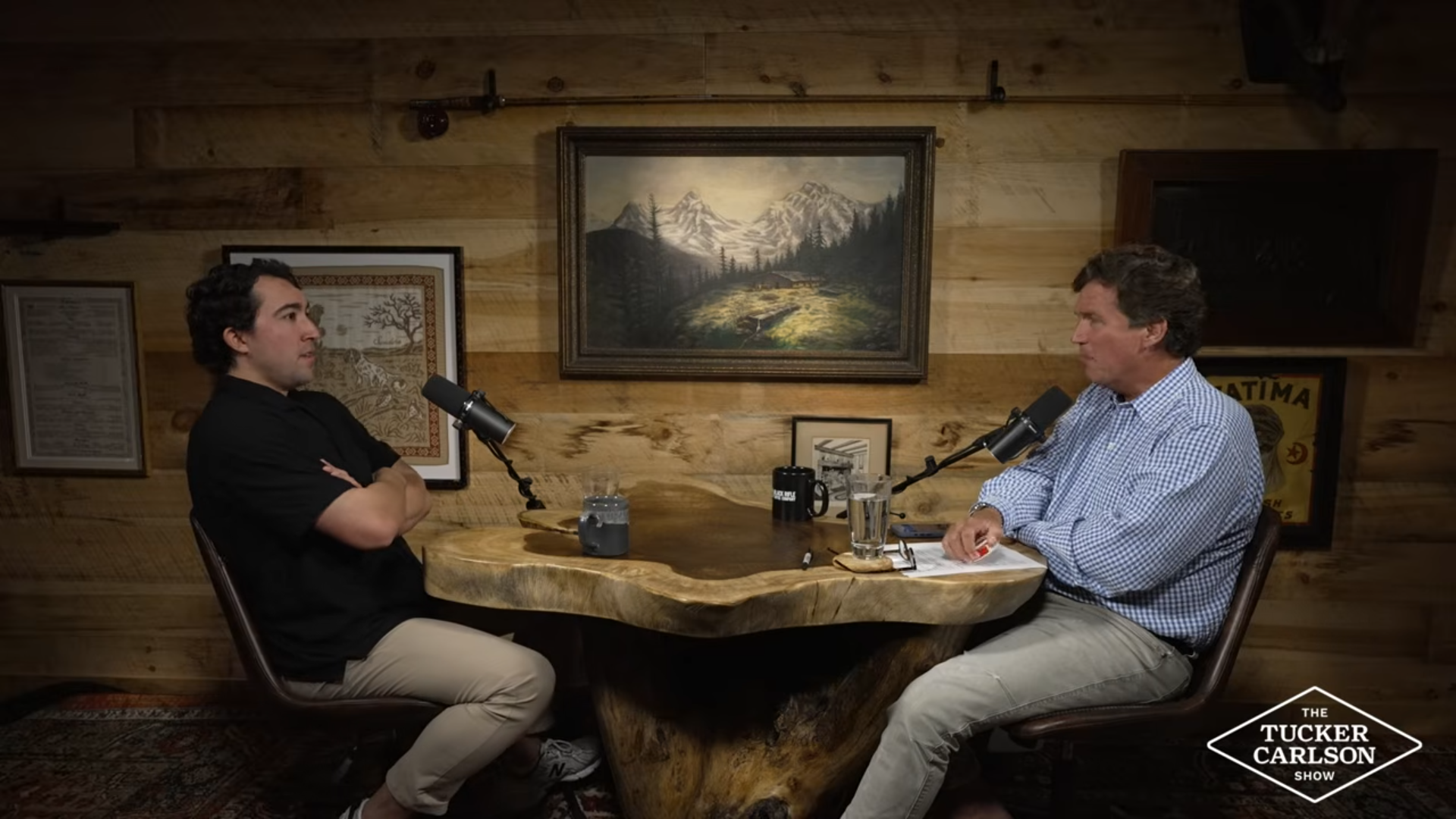
Likewise, when Carlson recently interviewed YouTuber Tyler Oliveira about his videos criticizing Jews in New York and New Jersey, both men referenced the fact that they’d met, or been contacted by, other Jews who harshly criticized elements within the Haredi community. That criticism from other Jews provided them with a sense of validation and permission to escalate their attacks on Jews more broadly.

Source: YouTube screenshot
This leaves us with a painful but necessary question:
In an era of rapidly rising antisemitism, what responsibility do Jewish activists have when our criticisms are appropriated and weaponized by people acting in bad faith?
Do we stop speaking out entirely? Do we ignore the growing hatred and continue exactly as before? Or do we adapt?
There is a concept in Judaism of U’biarta Hara Mikirbecha — “you shall remove evil from your midst.” I understand this not merely as a call to condemn and punish wrongdoing, but as a warning against allowing problems to fester and grow until they invite destructive outside intervention.
Communities, like individuals, can fall into unhealthy patterns. If internal problems are ignored long enough, they eventually become impossible to resolve internally.
We are currently observing this dynamic globally.
Most Gazans did not personally participate in the atrocities of October 7th. Many may genuinely wish to live peacefully alongside Israel. But Gazans did allow Hamas to become entrenched so deeply within Gaza — even building tunnels beneath homes, schools, and institutions — that it ultimately invited a devastating Israeli response.
The same is true for Lebanon. Hezbollah is not synonymous with the Lebanese people and doesn’t represent the official Lebanese military, yet the organization was permitted to operate and attack Israel from within Lebanese territory, resulting in enormous destruction in Lebanon as Israel responded militarily.
The pattern exists everywhere, including in American cities and institutions: when leadership ignores serious problems for too long, those problems become harder to address. Frustration then builds until the response becomes more disruptive, forceful, and uncontrollable.
That is why I do not believe the answer to the dilemma of antisemites weaponizing our activism is silencing activists or turning a blind eye to the problems in our midst.
The answer is responsibility.
Jewish communities must find ways to address legitimate internal concerns thoughtfully, sensitively, and humbly. Leaders should be willing to listen before frustration spills into public warfare. Activists, meanwhile, must become more conscious of how criticism is framed and how easily it can be manipulated by those seeking not reform, but hatred.
The goal should be to encourage accountability without providing ammunition to antisemites eager to portray Jewish communities in the darkest possible light. We need to find a way to foster a habit of confronting problems seriously within the family before outsiders exploit them to attack our family.