
When Women’s Bodies Become Battlefields.
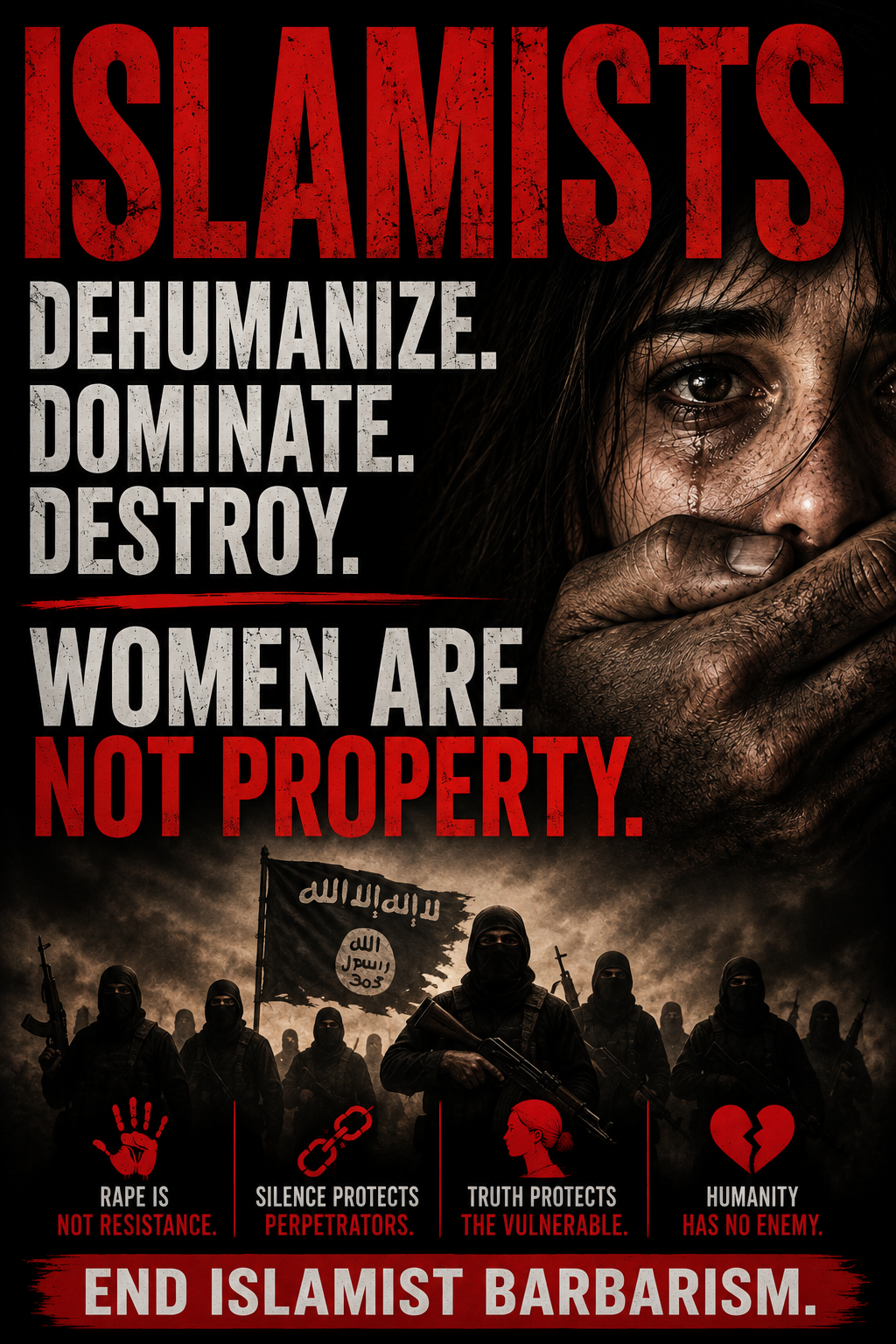
When Women’s Bodies Become Battlefields
As a Muslim, I have spent much of my life confronting uncomfortable truths.
One of the most uncomfortable is this: wherever Islamist extremism takes root, women are often among its first and most brutal victims.
This is not a coincidence.
It is not an unfortunate side effect of war.
It is a worldview.
Over the past decade, the world has watched ISIS enslave thousands of Yazidi women and girls. They were bought, sold, raped repeatedly, and traded like livestock. ISIS even published internal documents regulating the ownership and sale of female captives, attempting to cloak sexual slavery in religious language.
Then came October 7.
The world witnessed Hamas terrorists murder civilians on a scale unseen in Israel for generations. Subsequent investigations by the United Nations and independent experts found credible evidence that sexual violence, including rape and gang rape, occurred during the attacks and against hostages in captivity.
These were not random crimes committed by undisciplined individuals.
They reflected an ideology that strips victims of their humanity.
In Sudan, armed groups have been accused of systematically using rape as a weapon of war. Women and girls have been abducted, assaulted, and terrorized to destroy families and communities.
In Afghanistan, the Taliban have transformed misogyny into state policy. Girls are denied education. Women are erased from public life. Their voices, movement, employment, and even visibility have become matters for government control.
In Iran, women who refuse compulsory veiling have been beaten, imprisoned, tortured, and in some cases subjected to sexual violence while in detention simply for demanding basic human dignity.
In Pakistan, where I was born, countless Hindu and Christian girls have been abducted, forcibly converted, and married to older men. While every case deserves individual examination, human rights organizations have documented a recurring pattern in which vulnerable minority girls are failed by institutions meant to protect them.
Even outside the Muslim world, warning signs have emerged. Britain’s grooming gang scandals exposed years of horrific sexual exploitation of vulnerable girls while institutional failures, political sensitivities, and fear of inflaming racial tensions contributed to authorities failing many victims for far too long.
These cases differ in important ways. They involve different actors, different legal systems, and different conflicts. They should never be casually equated.
Yet they reveal a disturbing common lesson.
Whenever an ideology teaches that some human beings possess less inherent worth than others, sexual violence becomes easier to justify.
Whenever women cease being viewed as autonomous individuals and instead become symbols of family honor, religious purity, tribal revenge, or military conquest, their bodies become battlefields.
History repeatedly demonstrates this pattern.
The ideology changes.
The uniforms change.
The flags change.
The victims rarely do.
As Muslims, we must confront another uncomfortable reality.
Islamists have become extraordinarily skilled at borrowing the language of faith while abandoning its moral foundation.
The Qur’an teaches that every human being possesses inherent dignity.
Islamist movements often replace that principle with loyalty to the group.
Human dignity becomes conditional.
Compassion becomes selective.
Violence becomes sanctified.
Women become possessions.
Those outside the movement become expendable.
This is not merely terrorism.
It is moral dehumanization.
Many Muslims understandably worry that discussing these issues will fuel anti-Muslim prejudice.
That concern deserves respect.
Collective blame is both unjust and dangerous.
The overwhelming majority of Muslims reject rape, slavery, forced marriage, and terrorism.
But refusing to discuss how extremist ideologies manipulate religious concepts does not protect Muslims.
It protects extremists.
Silence has never defeated fanaticism.
Honest self-examination has.
As someone who proudly identifies as both a Muslim and a Zionist, I have often been told that criticizing Islamist extremism somehow betrays my faith.
I believe the opposite.
My faith demands that I defend the vulnerable.
It demands that I stand beside women whose voices have been silenced.
It demands that I reject anyone who invokes God’s name while committing crimes against His creation.
No political cause justifies rape.
No religious slogan excuses sexual slavery.
No grievance legitimizes forced marriage.
No ideology should ever convince us that another human being exists to be owned, humiliated, or conquered.
The true measure of any civilization is not how loudly it proclaims justice for its own people.
It is whether it recognizes the humanity of those with whom it disagrees.
Until we reject every ideology that reduces women to property and human beings to categories, women’s bodies will continue to serve as battlefields for men’s wars.
That is not merely a tragedy.
It is a moral failure that belongs to all of us who remain silent.