
Understanding Israel Beyond the Headlines
When You Are at War with a State: Do You Treat the Entire Population as the Enemy?
 Every day in Israel, sirens interrupt ordinary life. Families stop what they are doing and run to bomb shelters.
The missiles being launched toward Israeli cities are not aimed at military bases. They are aimed broadly at civilian areas, neighborhoods, homes, and communities.
Yet when Israel responds, it is expected to maintain strict distinctions between military targets and civilian populations.
This contradiction has sparked a growing debate inside Israeli society: when attacks come from sovereign states, how should responsibility be defined?
For years Israel’s wars were primarily fought against militant organizations rather than sovereign states. In those conflicts, the expectation was clear: militants are the enemy, civilians are not.
But the debate changes when the conflict involves states with governments, institutions, and territory from which attacks originate.
Iran is not a hidden terrorist network. Lebanon is not simply an underground organization. These are sovereign states with governments and borders from which attacks against Israel are launched.
This raises a question that many Israelis increasingly ask: if attacks against civilians are launched from within a sovereign state, should only specific militant groups be considered responsible, or does responsibility extend to the state that allows those attacks to occur from its territory?
The case of Lebanon illustrates the complexity of this question. Hezbollah is not only a militia. It is also a political actor that holds seats in the Lebanese parliament while maintaining a powerful armed force. The organization operates within Lebanon’s political system while simultaneously carrying out attacks against Israel.
International diplomacy often frames the conflict as Israel versus Hezbollah rather than Israel versus Lebanon. Yet Hezbollah’s presence inside Lebanon’s political structure blurs the line between militant organization and state responsibility.
For many Israelis, this raises a difficult question. If an organization that openly attacks Israel sits inside the parliament of a sovereign country and operates militarily from its territory, at what point does the distinction between the organization and the state begin to collapse?
Israel withdrew from Lebanon years ago, yet Hezbollah has continued to expand its military capabilities. The Lebanese state has had opportunities to dismantle the organization but has not done so.
Some Israelis therefore ask whether it remains realistic to treat Hezbollah as entirely separate from Lebanon itself.
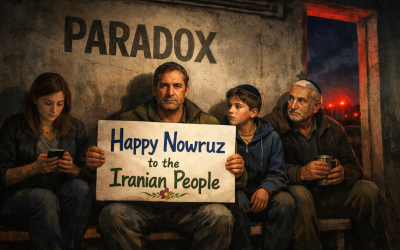
A similar debate exists regarding Iran. International leaders often emphasize that Israel’s conflict is with the Iranian regime rather than the Iranian people. Israeli officials themselves frequently send greetings to the Iranian public during holidays such as Nowruz and speak about the possibility of future friendship between the two nations.
At the same time, there are no reliable statistics showing how many Iranians support the regime and how many oppose it. Iran has been ruled by the Islamic Republic for nearly half a century, and entire generations have grown up under its system. The state controls powerful institutions including the Revolutionary Guards, religious authorities, media, and major parts of the economy.
Without reliable information about the level of internal opposition, some Israelis question whether national security decisions can realistically rely on assumptions about divisions within Iranian society.
Around the world, demonstrations sometimes show Israeli, American, and Iranian opposition flags waving together in solidarity. Politicians speak about future friendship between Israelis and Iranians.
Yet at the same time, Israelis are running into shelters as rockets and missiles launched by forces backed by Iran threaten their cities.
From my perspective, when a country repeatedly allows attacks against Israel from its territory, it becomes increasingly difficult to separate militant organizations from the state itself.
The rules of war may be written in books, but the reality of war is lived by the people who run to shelters when the sirens sound.
Related Topics
Related Posts