
Where is the responsibility of the Arab States?
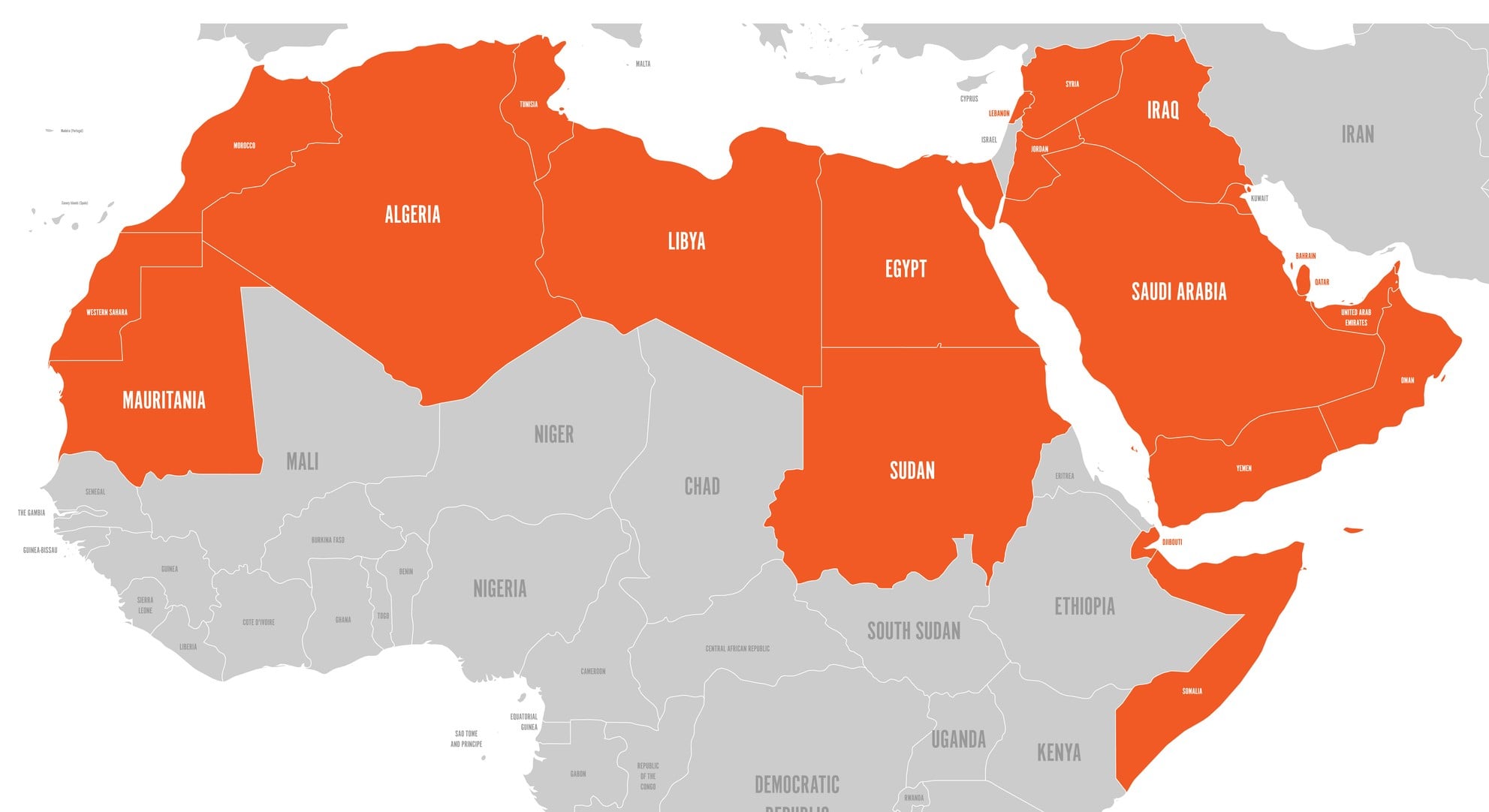
Why should the Arab states controlling vast areas of land not give up territory in exchange for peace as well as compensation for generations of aggression and terror?
Land in Exchange for Peace
As an integral part of the Arab-Israeli conflict, we have long heard of peace plans of all kinds, none of which have so far led to the desired result – establishing lasting peace in the Land of Israel. However, all of these plans have had one feature in common: Each and every one of them has been based on the premise that Israel must cede land to the Arabs in exchange for peace.
The only clear departure from this generational continuum has been the recent proposal by the new President of the United States Donald Trump that Arab states should resettle at least some of the Arab population of war-engulfed Gaza. The Arab states, which control vast territories and resources, have predictably rejected this idea out of hand, and have insisted that Gaza’s overgrown population not move anywhere from the small, now war-torn strip of land.
Decision-makers in the European Union have long declared their position, according to which the right of every migrant from a developing country to international protection and to seeking political asylum is a fundamental human right, based on international law, and something EU member states should not compromise on in the slightest. However, this ‘international law’ does not seem to apply to Arab states, as the same EU decision-makers have not been enthusiastic at all about Trump’s proposal regarding Gaza and have not taken any steps towards demanding that Arab states guarantee the inhabitants of Gaza the right to seek asylum. At the same time, various European sources have repeatedly pointed out that even a partial implementation of Trump’s proposal would constitute ‘ethnic cleansing and a war crime’.
Before Donald Trump’s ascendance to power, the position of the United States was that in order to achieve peace, Israel should hand over at least most of Judea and Samaria (also known as the West Bank) to the Arabs. Many European decision-makers, in turn, have advocated the view that Israel should completely give up the territories it captured in June 1967. In practice, this would mean handing over Judea and Samaria to Fatah, or another terrorist gang, leaving Israel’s width in its heartland at approximately 15 km at its narrowest point. Israel is also supposed to cede to the Arabs half of its capital, Jerusalem – which enlightened Europeans do not even recognize as Israel’s capital, since they have decided for Israel that its capital be Tel Aviv. As part of this process, Arabs would also take control of the holiest places in Judaism and Christianity, which are located in East Jerusalem (i.e., the very original Jerusalem).
According to the proponents of these aforementioned ‘peace plans’, of course none of this would endanger the security and viability of Israel, since the so-called Palestinian Authority, dominated by Fatah, is nowadays considered ‘moderate’, at least in comparison with Hamas. The degree of ‘moderation’ is not diminished by the fact that representatives of the Palestinian Authority praise terrorists slaughtering civilians as national heroes, and brainwash even schoolchildren into hatred and violence.
Visions of peace calling for a ‘two-state model’, in their ardency resembling a kind of shamanic spell, have not been hindered by the fact that Hamas has actually been more popular than Fatah in elections held amongst the Arabs of Judea, Samaria and Gaza. Enlightened European decision-makers obviously believe that they have the knowledge and certainty of the Arab masses supporting Hamas or Fatah actually (without even knowing it) wanting Western democracy, and peace with Israel. The overwhelming majority is surely always right, and supports the same values as the EU decision-makers at any given time – in every country and in every era. And the common sense itself tells us that after the ‘occupation’ that was begun by Israel on the 5th of June 1967 will come to an end, blissful peace shall descend on the land of Israel – perhaps similar to the one that prevailed before the 5th of June 1967…
‘The superpower Israel versus occupied Palestine’
The absurd position described above is largely based on the fact that today’s international discussion on the situation in Israel is dominated by a false premise, according to which the parties of this conflict are the regional superpower Israel, and the occupied Palestinian people.
Today, only few people remember that in the first decades of Israel’s independence, the Arab states did not bother to adjust their wording but declared openly their burning desire to wipe Israel off the world map with their armed forces. After several lost wars and consequent realization of the fact that they just lacked the ability to destroy Israel with a traditional frontal attack by mass armies, it was only from the late 1960s onwards that Arab propagandists began to professionally instill in the world’s consciousness the concept of the mighty military power Israel occupying the small, defenseless Palestine and that the only just solution to this, of course, would be the establishing of an independent Palestinian state at Israel’s expense.
The most frightening aspect is that a significant part of Israel’s own leading political circles has embraced this way of thinking. One of the characteristics of human nature is the effort to avoid unpleasant realities and painful solutions to the last, an attempt to simply look away and wish that the problem will disappear by itself. Jews have honed this skill of looking away to perfection. Perhaps it offered a way to maintain at least some kind of mental balance during the hard circumstances and the misery of past centuries, but such a policy becomes mortally dangerous, when it is adopted by political leaders, who are responsible for the fate of their nation.
Israel’s inconsistent politics and communications, torn by internal contradictions and lacking a clear vision for the future, have made the Arab propagandists’ conjuring trick most easy to accomplish. At the same time, they have been given full peace to build a public perception, according to which the share and responsibility of the Arab states – in possession of enormous territories and resources surrounding Israel – for the current situation seems to be limited to
1) legitimate sympathy for occupied Palestine;
2) moral disapproval of Israel’s aggressive power policy;
3) plans for a ‘just’ peace based on Israeli territorial concessions (which the Arab armies failed to obtain through direct violence, despite numerous attempts).
Six Revealing Questions
The following six simple questions should set straight anyone, who is willing to examine the topic based on facts:
1) By whose decision did the newly founded Arab League, an organization of Arab states, declare on December 2nd, 1945 (two and a half years before the founding of Israel) that products manufactured by Israeli Jews were undesirable in Arab countries, which laid the beginning of a complete boycott of Israel?
In order to organise and supervise this complete economic boycott, a central office was established in the Syrian capital of Damascus, with local offices in all Arab states. The boycott was extended not only directly to Israelis, but also to third-country companies and cultural figures dealing with Israel or even with other non-Israeli parties who had dealt with Israel! (the so called secondary and tertiary boycotts)
There is no other example in the world of such a comprehensive, fanatical, and long-lasting boycott system against any other state, although there have been other difficult conflicts on the planet as well. Due to the influence of the United States, this boycott has mostly crumbled up in the 2000s, but even today, some Arab states, as well as the Islamist-controlled Iran, endeavour to apply it in full.
2) By whose decision was there an entry ban into every Arab country for decades for everyone, whose passport contained a mark of even a brief visit to Israel? Several Arab countries still apply this globally unique passport boycott system to its full.
3) By whose decision did the Political Committee of the same Arab League draw up a recommendation in 1947, which sought to coordinate the discriminatory and oppressive measures aimed at the Jewish communities of the Arab states? The recommendation stated, amongst other things, the following: “…all Jewish citizens of (the Arab country in question) will be considered as members of the Jewish minority State of Palestine…bank accounts of Jews will be frozen. These funds will be utilized…to finance the movement of resistance to Zionist ambitions in Palestine. Every Jew whose activities reveal that he is an active Zionist…will be interned… His financial resources, instead of being frozen, will be confiscated…Jews who are subject of foreign countries…will be compelled either to return to their countries, with a minimum of delay…” Only Jews who had served in Arab armies, or expressed their willingness to do so, were to be exempted from the measures mentioned.
Vibrant Jewish communities had existed in many Arab countries since ancient times and prior to the Arab conquest that began in the 7th century. Following the recommendation of the Arab League in 1947, the social, economic and physical living conditions of Jews in most Arab states were trampled down to such an extent that while their Jewish population had been well over 850,000 in total in 1948, it currently numbers around 4,000 people (mostly in Morocco and Tunisia). In other words, the Jewish population of Arab states now is less than 0.5 % of its equivalent in 1948! Against this backdrop, the same Arab states and their numerous supporters have the audacity to bawl on international arenas about the feigned ‘ethnic cleansings’ and ‘genocides’ carried out by Israel. For the sake of comparison: When Israeli rule was instated in 1967, the population of Gaza was less than 400,000 people, whilst it is today reportedly 2.1 million.
4) Who started three full-scale wars against Israel in 1948, 1973, and in practice also in 1967, the official declared goal of which at least in 1948 and 1967 was the complete destruction of the world’s only Jewish state? Let us recall, for example, the position expressed by Egyptian President Gamal Abdel Nasser before the 1967 war, according to which the existence of Israel itself is an ‘act of aggression’ against the Arabs, or, the words of the then Syrian Minister of Defense, Hafez al-Assad, who later rose to become a dictator: “Our armed forces are now entirely ready…to blow up the Zionist presence from the Arab homeland of Palestine…I believe that the time has come to begin a battle of annihilation.”
5) Where has the money and all the logistical support for the systematic terrorism against Israel come from that has been carried out since the founding of the state of Israel, and has reached international proportions since the late 1960s?
6) Who has kept Arabs, who have left Israel, in refugee camps for 77 years, and artificially prevented their integration into linguistically and culturally similar Arab societies in order to use them as tools in terrorizing Israel and other nations?
If someone can convincingly demonstrate that all of the above has happened by the decision and power of so-called Palestinians, only then will I concede that this century-long conflict over the land of Israel is indeed only between Israel and the Palestinians.
Land in Exchange for Peace the Other Way Around?
It never seems to have occurred to anyone to turn the situation around, and ask: If the tiny state of Israel (which areally covers half of the size of Estonia) should give up its heartland, including its capital, in exchange for peace, why should the Arab states controlling vast areas of land not give up territory in exchange for peace – as well as compensation for generations of military, economic and political aggression and terror against both tiny Israel and many other peoples? What if the Arab states, which have been deliberately maintaining and fomenting the Middle Eastern conflict in every possible way at least since the 1940s, were made to settle their Arab brethren living both in refugee camps and in small areas controlled by Israel, on their own territories? After all, the cause of these brethren is, according to Arabs themselves, their most central concern among all political issues concerning the Arab world (according to, for example, a survey conducted a few years ago by the esteemed journal The Economist).
For example, Saudi Arabia, the original national home of the Arabs and a country which is geographically 97 times the size of Israel, made $161 billion in net revenue on oil sales in 2022. This took place against the backdrop of the fact that both commercial uses of oil as well as the technology needed to obtain and refine it have never been created in the Arab countries. In fact, they had not even discovered the oil in their own territory, but American and British experts had to do it for them. From such a starting point, it may well fit to build kilometer-high skyscrapers and seven-star hotels by the hand and health of cheap foreign labor.
Saudi Arabia professes Wahhabism, which is one of the most intolerant versions of Islam. At the same time, the country has loudly proclaimed its sympathy for the Palestinians for generations, and has regularly sent money to the Palestinian territories even in the 2000s, if for no other cause, at least to support suicide bombers’ families. This Arab state, which is, to say the least, quite a lot larger and wealthier than Israel, has, however never offered to settle and integrate its Palestinian brothers languishing in refugee camps into its own territory and society.
Moreover, who would still remember the ‘small’ episode that took place when extremely wealthy Kuwait, after being liberated from the occupation by Iraqi dictator Saddam Hussein in March 1991, expelled at least 300,000 Palestinians from its territory in one week, some of whom had lived there for decades and suddenly lost their savings, property, and even their education and birth certificates? And yes, the reason for this mass expulsion carried out by Kuwait was the support given by the Palestinians to the Iraqi occupiers, but one cannot help but wonder: If Israel had then in March 1991 expelled more than 300,000 Arabs living in its territory on the grounds that they had danced on the roofs of their houses when seeing missiles of the same Saddam hitting Israeli cities, would we have been able to forget that so blissfully?
The Root Causes and Origins of the Conflict
The confrontation between Jews and Arabs in the territories controlled by Israel is only a mirror image of the conflict between the State of Israel and the surrounding Arab states. The vast majority of Arabs, both in areas controlled by Israel and in the 21 Arab states, consider Jews as thieves from the outside, who have stolen a piece of the Middle East from the Arabs and have thus permanently offended their national honour. This distorted concept of honour is the fundamental reason for the feigned solidarity of the Arab states towards the Palestinians, whom they themselves mostly treat as cheap labor devoid of rights. Another evident reason for yelling about the Palestinian cause for one decade after another is, of course, that it has enabled Arab rulers to divert attention away from their own inefficiency and unjust use of power. The explosive nature of the conflict is also greatly increased by religious aspects related to Islam, although basically it is a dispute between two peoples – the small Jewish, and the huge Arab one – over the ownership of a certain piece of land.
What makes the situation hopeless is that the potential democratization of Arab states does not necessarily bode well, as the brainwashing of their own people against Jews, begun by Arab leaders over 100 years ago, has borne fruit so effectively that the opposition movements in Arab states today usually accuse their corrupt rulers for being too soft towards the common national and religious enemy, Israel!
Or has anyone ever heard of a single demonstration in an Arab country demanding that the rulers of the country in question make concessions to Israel in order to achieve peace – similar to, for instance, those regularly organized by vocal self-destructive Jewish groups both in Israel, and other countries? Only this year has something remotely similar finally been seen in Gaza, but it is still unclear, whether the demonstrations in Gaza have been anything more than a tactical ruse to lure Israel to stop from hammering down Hamas.
Arab States must be held responsible
The fundamental question is: Where is the responsibility of Arab states and organizations for the situation that has formed in the Middle East, and how can they finally be made to carry this responsibility? Can it really be that the solution to the situation must be drawn solely at the expense of the tiny state of Israel?