Where the Haredi World Lost Its Way on Torah Study
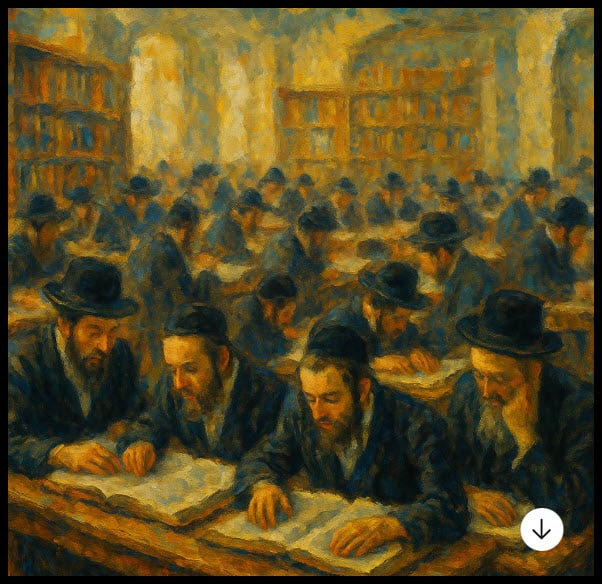
Study for study’s sake was never the Jewish ideal
In Israel today, the Haredi question is no longer a marginal sociological issue. It sits at the center of our politics, our economy, and our social fabric: mass draft exemptions, low male workforce participation, rapidly growing demographics, and escalating resentment on all sides. We are drifting toward an explosive clash between a large, semi-separated community and the rest of Israeli society. Any serious attempt to defuse this must start not with anger, but with something very Jewish: a clear look at what Torah study actually means – and what it was always meant to do – in Jewish life.
Because if we misunderstand the role of study, we will keep fighting the wrong battle.
Learning as Infrastructure, Not Ornament
From the beginning, Judaism never judged a people by what it thought or believed in abstraction, but by what it did.
The Torah asks: How do you treat the stranger? Do you cheat in business? Do you protect the vulnerable? The prophets thundered against societies that had all the right words and rituals while trampling justice and compassion. You will look in vain for a prophetic rebuke that says, “You did not learn enough.” You will, however, find sentence after sentence about corruption, oppression, and indifference.
Study has always been precious in Judaism – but as infrastructure for a way of life. It shapes conscience, refines judgment, and passes a demanding ethic from one generation to the next. Its dignity lies in what it makes possible, not in its isolation from the world.
Chochmah, Binah, Daat – and Then What?
The inner language of our tradition makes this even clearer. In the sefirot, Chochmah (wisdom), Binah (understanding), and Daat (knowledge) form a chain:
- Chochmah is the flash of insight.
- Binah is the development and integration of that insight.
- Daat is internalized knowledge – what you truly “know” in your bones.
But in our metaphysical map, the process does not end there. The upper sefirot are meant to flow into Asiyah – the world of action. Divine intention becomes real only when it is enacted: in law, in compassion, in how we build families, communities, and economies.
Daat without asiyah is a circuit that never leaves the mind. At the spiritual level, it is sterile. At the societal level, it is inert. Judaism never glorified knowledge as a private hobby; it glorified knowledge that changes how we live.
The Talmud captures this in a single sentence that is often half-quoted:
“Talmud gadol, she-ha-talmud mevi lidei ma’aseh” – Study is greater, because it leads to action.
Remove the second half of that line and you distort its meaning. Study is not “greater, full stop.” Study is greater as the head of a pipeline that must end in deed.
How the Yeshiva Once Served the Whole Community
For centuries in Europe, Jewish life – with all its flaws and constraints – reflected this integration.
Every boy started with cheder or Talmud Torah, learning to read, to daven, to study Chumash and some Mishnah or Gemara. A smaller, more talented or more motivated group continued into yeshiva. An even smaller fraction remained in full-time study for years.
But the overwhelming majority of men eventually:
- Entered trades, businesses, and crafts.
- Married, raised families, and paid communal taxes.
- Took on roles in the kehilla, served on communal bodies, supported the poor.
Their learning was not wasted because they left the beit midrash. On the contrary: it entered the world – into honest bookkeeping, fair contracts, ethical leadership, family life shaped by halakhic and moral awareness.
The yeshivot themselves were organs of the community, not separate organisms. They produced:
- Rabbis and dayanim to judge real disputes.
- Teachers to educate children.
- Shochtim, sofrim, and maggidim to serve daily religious needs.
Merchants and artisans who supported the yeshiva were not funding a distant monastery; they were feeding the brain of the body they themselves inhabited. Torah study was the nerve center of a living social organism.
In that model, Talmud Torah and derekh eretz – Torah and worldly engagement – were not rivals. They were a partnership.
The Haredi Detour: When Study Became the Destination
After the Holocaust wiped out much of that Torah world, the instinct to rebuild it was not only understandable; it was heroic. Early Haredi leaders in Israel decided to protect and recreate the yeshiva universe at all costs. In practice, however, that emergency choice hardened into a permanent ideology.
Two silent shifts took place:
- What had once been the path of a small elite – long-term, full-time Torah learning into adulthood – became the aspiration for masses of young men.
- “Torah lishmah” – learning “for its own sake” (meaning without ulterior motives of prestige or money) – was reinterpreted socially as learning without worldly engagement.
Instead of yeshiva as an intense beginning that leads into a life of action, it became, for many, the intended final state. Large numbers of men are encouraged or expected to remain in full-time study for as long as possible, often indefinitely, even when they are not destined to be major scholars or communal leaders.
The results are exactly what our own tradition would have predicted when daat is cut off from asiyah:
- A growing sector that is economically dependent on others – the state, philanthropic donors, and the very public it distances itself from.
- Minimal general education that leaves many men under-equipped to join the workforce later in life.
- Refusal, in large part, to share core civic responsibilities (above all military service), justified by the claim that their study alone fulfills an equivalent national role.
In effect, the Haredi world has taken one crucial limb of the old Jewish body – the beit midrash – and tried to live inside the limb, while relying on someone else’s body to supply oxygen and food.
Studying Our Way Out of Responsibility
To defend this arrangement, classical sources about the greatness of Torah study are lifted out of their original context:
- “Torah equals all the mitzvot.”
- “The world stands on the breath of schoolchildren.”
- “Learning protects the world.”
In the rabbinic world in which those lines were penned, the background assumptions were obvious:
- People worked.
- Communities governed themselves.
- Disputes were judged, daughters married, taxes paid, soldiers conscripted (where they had no choice).
Under those conditions, emphasizing learning was a way of saying: Do not let the pressures of life extinguish the Torah consciousness that is supposed to guide everything you do.
Read in isolation, however, these same statements become a license for withdrawal:
“Since learning is the greatest thing, we will do only that – and you, who do everything else, should support us and thank us for our merit on your behalf.”
That is not what the Talmud meant. It is what happens when we change the ecosystem and then pretend the sources have changed with it.
The Torah’s Own Metric
The tragedy here is not that the Haredim love Torah learning. So did every healthy Jewish community in history.
The tragedy is that they have drifted away from the Torah’s own metric.
The Torah praises societies that:
- Protect the weak.
- Weigh fairly in business.
- Honor the stranger.
- Uphold justice in their gates.
The prophets condemn societies that:
- Exploit, humiliate, and corrupt – even when their study and ritual are abundant.
Judaism has always recognized that learning is essential, but never sufficient. It is a starting point for a demanding way of life. The sefirotic chain, the Talmudic slogan, the lived history of European Jewry – they all converge on one simple truth:
Daat without asiyah has no impact on the world.
Knowing the laws of tzedakah does not feed the hungry. Being expert in Bava Metzia does not by itself create an honest market. Knowing Hilchot Shabbat does not make us kinder to our workers or more careful with public money.
Only when learning moves us into action does it fulfill its purpose.
A Path Back: Restoring Learning to Its Role
If we want to lower the flames of the current conflict – and avoid a catastrophic rupture between Haredi and non-Haredi Israel – we do not need to attack Torah study. We need the opposite: to restore it to what it was always meant to be.
That would mean, among other things:
- Reframing long-term full-time study as the calling of a small elite, not the default for an entire male population.
- Reasserting the value – and halakhic legitimacy – of earning a living, serving in the army, and participating in the civic life of the state as expressions of avodat Hashem, not betrayals of it.
- Building educational frameworks where serious Torah learning and serious general education coexist, so that daat can actually flow into the modern arenas where Jewish values are desperately needed.
- Teaching, from within the beit midrash, that greatness in Torah is measured not only by pages learned, but by what a person’s Torah does to the world around him.
None of this requires abandoning halakha or traditional faith. On the contrary: it is a return to the deepest logic of our own sources. It is also the only way to align a massive, growing community with the practical needs of a modern Jewish state.
The current Haredi model – study as a lifetime sanctuary from responsibility – is not the inevitable or eternal form of Torah Judaism. It is a recent detour, born of trauma and fear, that has solidified into ideology. We can honor the trauma, respect the desire to protect Torah, and still say: this is not what the Torah itself asks of us.
The Torah calls us to learn, yes. But then it calls us to act: to build a just society, to share burdens fairly, to sanctify God’s name in the eyes of one another and the world.