Exploring Memory, War, and Survival
Where Was God When He Asked for Water
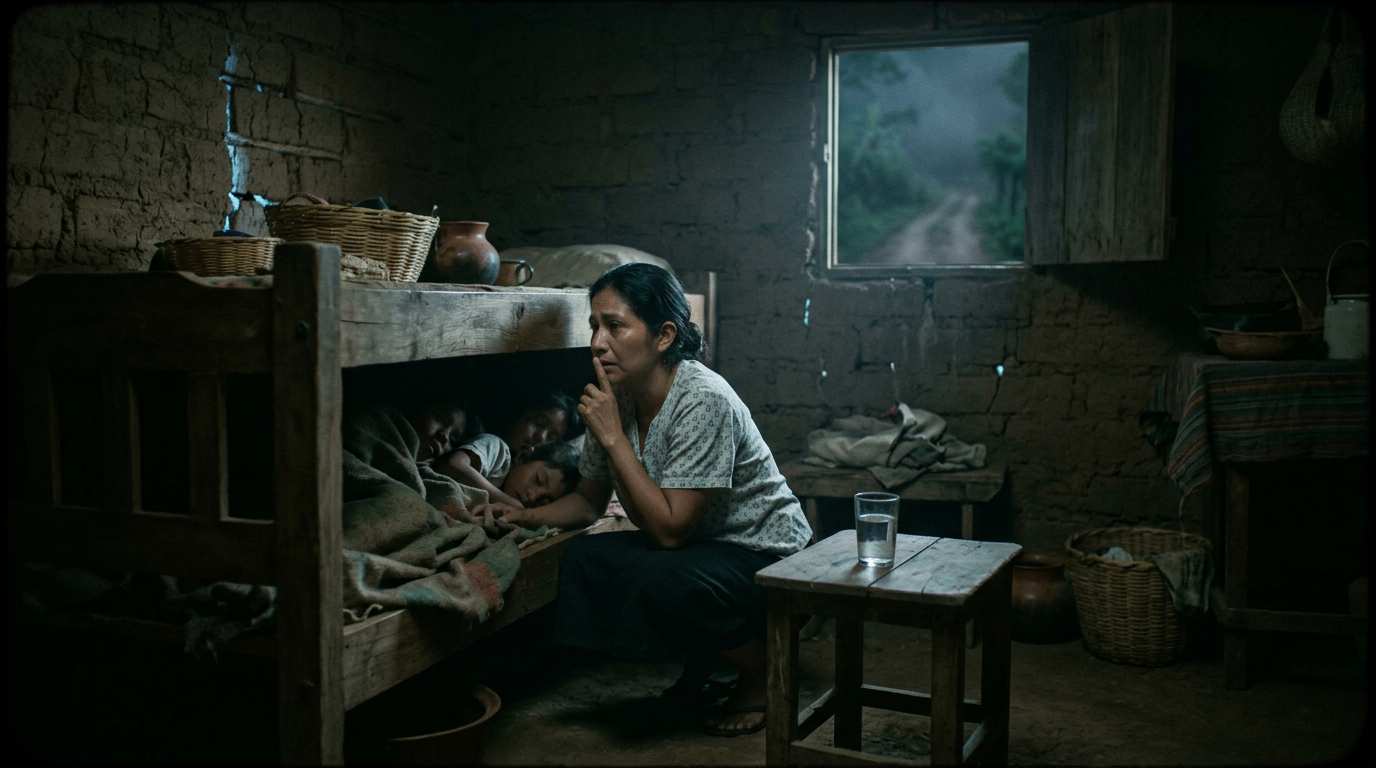
A mother hides her children during the Salvadoran civil war.
There are nights that never end.
They do not remain in the past. They return quietly, without warning, and sit beside you as if they had never left.
One of those nights still lives in me.
During the Salvadoran civil war, when I was seven years old, a man died across the street from my house, asking for water.
His name was Mauricio.
I did not see him die.
I did not see the blood.
I did not see the wound that was taking his life.
But I heard him.
That is what stayed.
Not the gunfire.
Not even the fear.
His voice.
“Water… please… water…”
It crossed the street as if distance no longer existed. As if war itself had opened a passage for suffering to enter every house at once.
My mother hid us beneath the bed.
I remember the darkness there, the smell of dust, the pressure of her body trying to shield us from the world outside.
When she heard him, she froze.
“No se puede… no se puede…”
We can’t.
It was not cruelty.
It was survival.
To reach him, she would have had to step outside during the fighting. To step outside meant risking all of us. She had six children to keep alive in the dark, and a single glass of water could have cost seven lives.
So we stayed where we were. We held our breath as if even the sound of breathing too loudly might draw danger toward the house.
And he kept asking.
“Water… please…”
As the night deepened, his voice changed. It weakened little by little until it no longer sounded like a man speaking, but like breath struggling to remain inside a body.
And then it stopped.
The silence afterward was not empty.
It was heavy with everything that could not be undone.
Years later, I still return to that moment.
Not because I believe there is an answer waiting for me there, but because some memories refuse to loosen their grip.
I have lived in another country for decades now. I have crossed borders, learned new languages, built an entirely different life. Yet that voice followed me farther than any possession I carried. It crossed the ocean with me and settled quietly into the background of my life.
Sometimes, late at night, I stand in my kitchen and turn on the faucet. As I watch clean water fill a glass, I suddenly think of Mauricio. The abundance of something so ordinary still unsettles me. I hold in my hand the very thing he spent his final moments begging for.
For years, the question that haunted me was simple:
Where was God?
Where was God when a dying man asked for water that no one could bring him?
Where was God when fear became stronger than compassion?
Where was God when even kindness became dangerous?
When I was younger, I thought every question needed an answer. I believed suffering could eventually be explained if one searched deeply enough.
I no longer believe that.
Some questions are not solved.
They are carried.
What remains with me now is not only Mauricio’s suffering, but the terrible human limit revealed in that moment.
We heard him.
We cared.
We wanted to help.
And still, we could not.
War destroys many things long before it takes lives. It destroys the ordinary bridge between feeling and action. It turns compassion into risk. It teaches people to survive by remaining still.
That may be the hardest memory of all.
Not that someone died.
But that an entire house full of people listened to him die while love and fear fought silently in the dark.
Even now, there are nights when I hear his voice again.
Not clearly.
Not fully.
Just enough.
A man somewhere in the darkness asking for water.
And each time the memory returns, I find myself standing again inside the same question.
Not because I expect certainty.
But because refusing to look away would feel like abandoning him a second time.
Perhaps that is all memory can do.
Not heal.
Not explain.
Only bear witness.
We cannot change the past, nor can we reach across the decades to place a cup of water against Mauricio’s lips. But by remembering him, by refusing to let his final plea disappear completely, something human survives the silence.
And somewhere within that act of remembering, perhaps there is still something sacred left alive.
Related Topics