
Nearly Israeli - Diaries of a Midlife Immigrant
Who are the Arab Parties?
I am not a political commentator. In fact, in a lifetime of hundreds of thousands of published words, I have managed almost completely to avoid writing about politics.
I’m just a midlife immigrant spending most of my energy trying to figure out how to shop for groceries without Google Translate. I manage by constantly learning, trying to be a little more competent at surviving here than I was the day before.
And so I wanted to understand our elections. And then I felt compelled to share my little bit of new knowledge. And now some may say I am circling obsession.
So let’s dive right in. Who are the Arab parties? To avoid my novice armchair political insights, I went to their own platforms to let them tell us.
For the sake of this essay, let’s hit a few definitions as “agreed upon”.
Zionism is support for a Jewish state on land that has been called “Palestine” since Biblical times and is currently called “Israel.”
On the tails of two thousand years of exile concluding with the Holocaust, the modern state of Israel was created as a Jewish state. This is all clearly stated in the 1948 Declaration of Independence. Despite planning to create one, Israel never created a constitution. Instead, it created a Constitution in Chapters. Each chapter is a “basic law” and together these basic laws create the backbone of Israel’s constitutional law.
Through individual laws, Israel has repeated its fundamental nature (and many say Biblical, historical and/or International fundamental right) as a democratic Jewish state. A few sources:
- Flag and Emblem law 1949- Establishes the Jewish Star of David on the flag.
- The Law of Return- 1950- Establishes Jewish immigration rights. The rights of all Jews to return to the Jewish homeland.
- Citizenship law- 1952- Establishes citizenship through the Jewish rights of return.
- World Zionist Organization- Jewish Agency Status Law- 1952- Recognizes the special role of Zionist national institutions to support a Jewish state.
- State Education Law- 1953- Establishes an education system that includes Jewish history and values including the value of Israel as a Jewish and democratic state.
- Israel- the Nation State of the Jewish People- 2018 – Establishes that Israel is the nation-state of the Jewish people on its historical homeland and that national self determination is reserved for the Jewish people.
As a still young country, Israel regularly enacts these new basic laws to flesh out the agreed upon intentions from the Declaration of Independence and earlier basic laws. In 1992, for example, the Knesset passed The Political Parties Law. According to this law
A (political) party will not be registered if in one of its objectives or actions, explicitly or suggested, is one of the following:
- The rejection of Israel’s right to exist as a Jewish and democratic state.
- Incitement of racism.
- Support of the armed struggle of enemy states or terrorist organizations against the state of Israel.
- A reasonable basis to conclude that the party will be used for illegal activities.
So what’s the Arab parties’ take on these basic constitutional laws?
Firstly not all Israeli Arabs vote for the Arab parties. Secondly, there are Jews who not only vote for the Arab parties but even, as in the case of this election’s Ra’am slate, participate as party leadership. But since the parties are primarily Arab, they are referred to collectively by all as “The Arab Parties.”
In this election there were four such parties. Three joined together for elections in what’s called The Joint List.
The Joint List 2026 platform:
We struggle to end the occupation, stop the genocide and establish the Palestinian state
We are committed to ending the occupation and throw our full weight behind any move that will lead to its end and to the establishment of an independent, sovereign Palestinian state on the borders of 4 June 1967 with East Jerusalem as its capital, alongside Israel, and to a just solution to the refugee issue and their right of return.
(The reason the laws of return have been so prominent in defining Israel as a Jewish state, is that: it is only immigration as a uniquely Jewish right that Israel will maintain a Jewish majority.)
This basic platform of the individual Arab parties is not new. Here is where they stood on a Jewish and democratic state before joining as a Joint List:
(Editorial note: when I started this essay a month ago, I provided the correct direct links to each party website. Since the elections some have changed and/or removed sections I quote.)
Hadash (Democratic Front for Peace and Equality) was founded 1977 out of Israel’s communist movement including groups of Jews and Arabs and others such as The Black Panthers. Per their last individual platform in 2013: The basic principles of Hadash as a broad leftist movement included the unique demand for the evacuation of all the territories which were occupied in June 1967 and the establishment of a Palestinian state alongside Israel.
Balad The last independent platform of The National Democratic Assembly in 2019 was submitted to the Central Elections Committee (CEC) to ban Balad from running in elections per the basic laws above. Balad explicitly calls for an end of the Jewish nation state to an Israel as a state for all its citizens under a new binding constitution that would:
- Undo Israel as a Jewish nation state
- Revoke recognition of Israel’s Zionist institutions
- Implement Palestinian Right of Return
- Establish a Palestinian State with Jerusalem as its capital
As in all such cases I could find in which the CEC banned the relevant Arab party and/or MK, the case was appealed to the Supreme Court. And as in most of these cases brought to the Supreme Court on this question, the Court determined that the anti-Zionism of the party did not reach the very narrow threshold of the law and allowed them to run. Both Ra’am and the Joint List were disqualified by the CEC for the 2026 elections, and in unanimous decisions the Supreme Court reversed both and allowed them to run.
In 2026 the Chairman of Balad (and #3 on the Joint List), Sami Abu Shehadeh, was disqualified separately by the CEC based on his published article from October 8, 2023 which encouraged learning from a historically significant Arab success during the massacres the day before. The court told him they were going to disqualify him and gave him the chance to politely withdraw with no finding of criminal guilt. And thus, the anti-Zionist Sami Abu Shehadeh remained a Balad party leader impacting today’s government.
Ta’al The Arab Party for Renewal is the third party of today’s Joint List and has always run as a part of an Arab coalition. It is a secular Arab party that, like all of the Arab parties, supports a Palestinian state and changes to issues of rights of return.
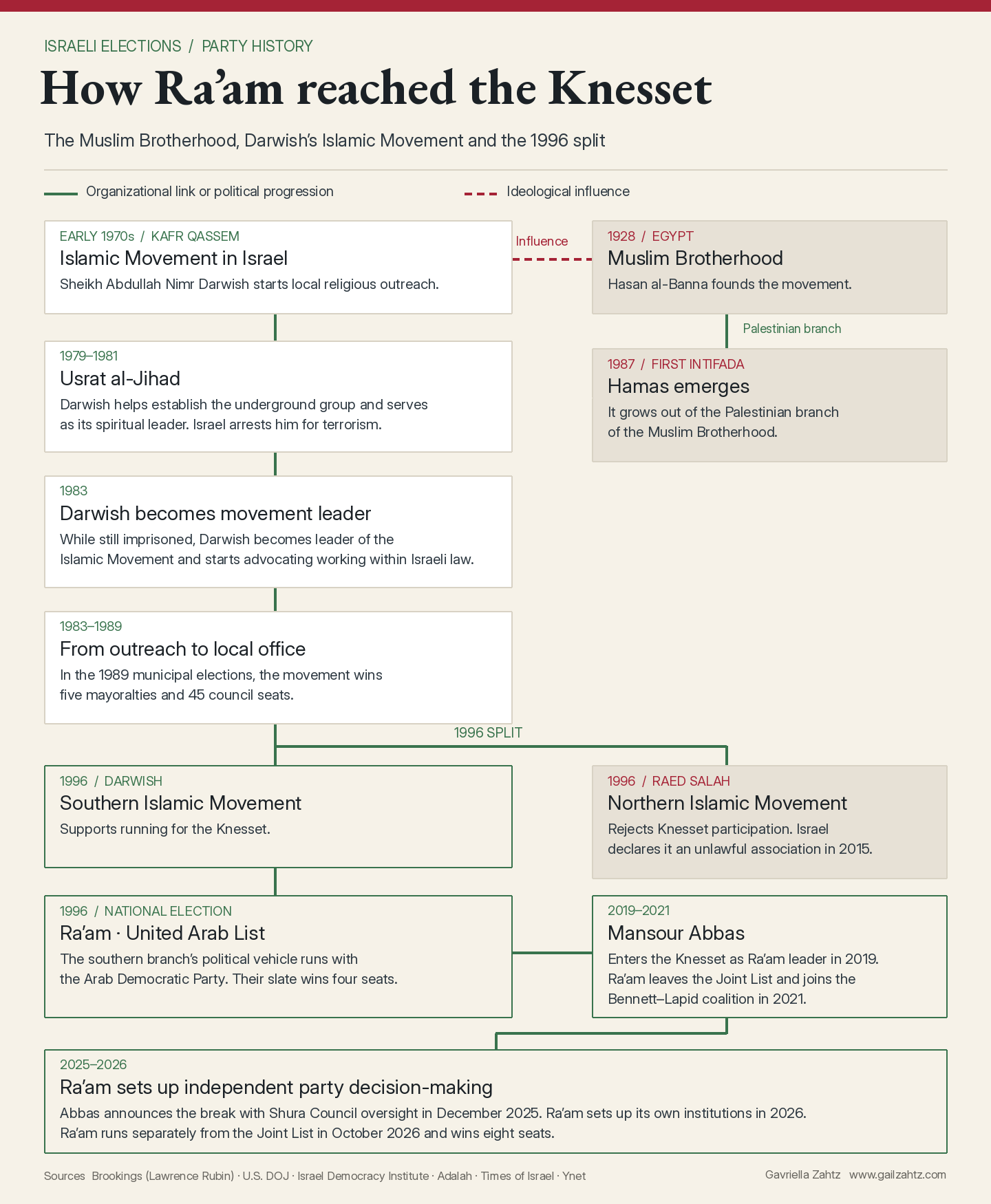
Ra’am The United Arab List ran independent of the Joint List. To understand Ra’am, we have to do a little quick historical dig. The Muslim Brotherhood was founded in Egypt in 1928 with the vision of establishing world wide rule under Islamic law under Sharia Law. For a point of reference, in 1987 Hamas emerged as a wing of the Palestinian Branch of the Muslim Brotherhood. I used a little AI assist to make a chart.
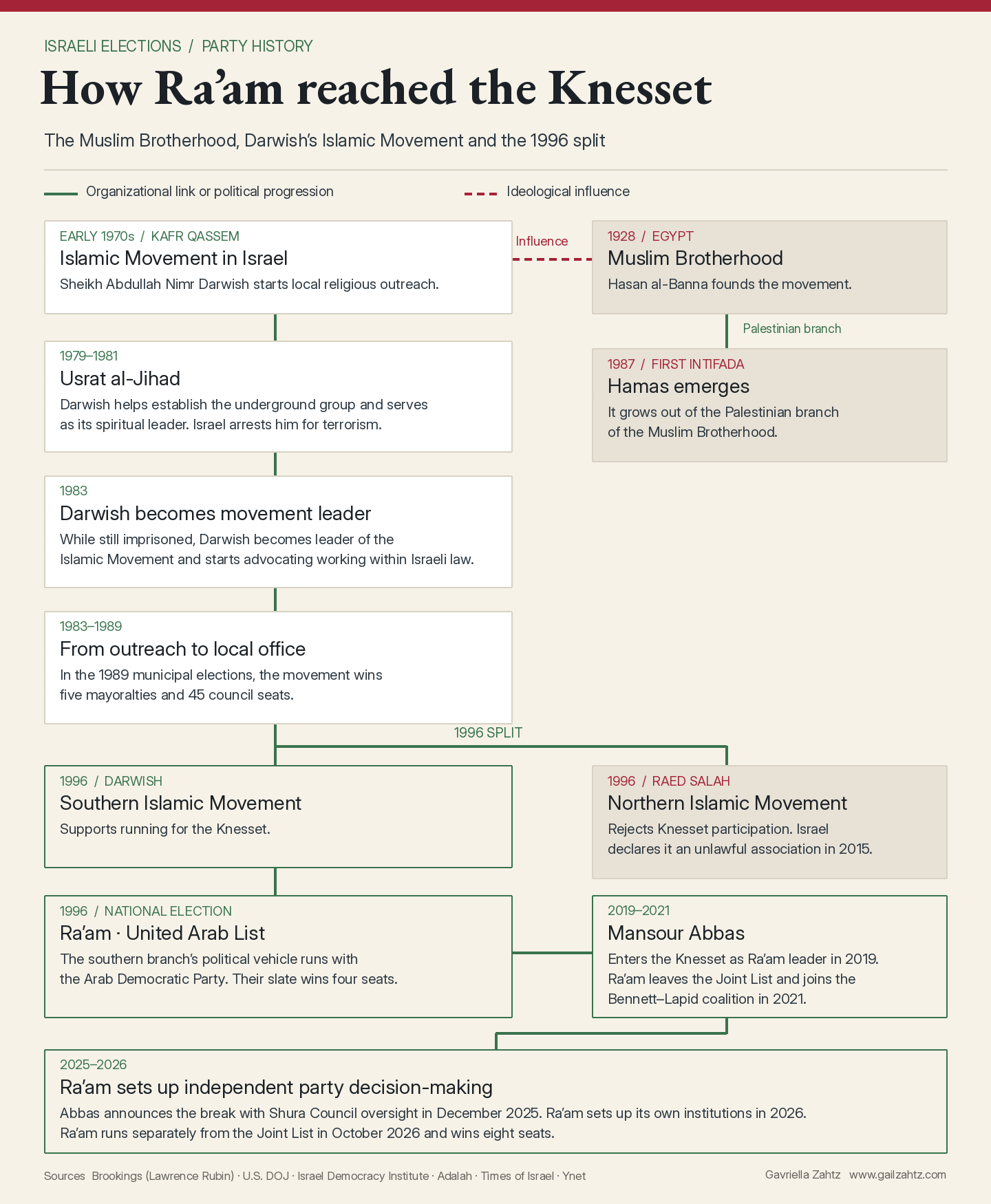 In 1971, Sheikh Abdullah Nimr Darwish created the Islamic Movement in Israel, inspired, influenced or otherwise cultivated from the soil of The Muslim Brotherhood. In 1979 he helped establish, becoming the spiritual leader of, Usrat Al-Jihad with the stated objective of establishing an Islamic state by violent means. He was arrested and imprisoned for terrorism in 1981. While still in prison, he was elected leader of the Islamic movement and he determined that it would be better for Islam to work within the State of Israel for Islamic values. This differentiation gave him the ability to enter politics.
In 1996 the Islamic movement split. The Northern Movement rejected serving in the Knesset, and by 2015 was labeled an illegal terrorist organization by the State of Israel. The Southern Movement, under Darwish, supported participation in Israeli politics and created its political party under Mansour Abbas.
The Times of Israel covered The Southern Islamic Movement 2018 charter under Mansour Abbas. Three years later, while joining the Bennett-Lapid block, Abbas publically accepted Israel’s continued existence as a Jewish state. It was not until last year, however, when Ra’am officially separated from the decision making authority of the Islamic movement’s religious decision making councils. There were a lot of other statements and announcements and denouncements by Abbas along the way that I am not expounding on here (though I am sure nay-sayors will point them out.)
Ra’am has not published a formal platform since 2018, but rather run on a set of core principles which includes: the establishment of a Palestinian state with Jerusalem as its capital, an end of the Jewish occupation, the dismantling of the settlements, the release of Palestinian prisoners and the right of return of Palestinian refugees.
And this leads us to today. You and I read the papers and watch the news and social sound bites and see that, as I wrote before the election the anti-Netanyahu block can only form a government with the support of these very same Arab parties. (A minority government would also require Arab support at least by a kind of abstention.)
I am just a newcomer. I am not a politician or political commentator. I am an armchair historian who came to the history of my country later in life. I arrived at Ben Gurion Airport in the middle of a war and in the middle of my life with five suitcases and not much of a plan. I didn’t understand Israeli culture and I certainly did not speak the language. I came because our house was on fire and our family was inside. I came to claim my stake as a Jew in my homeland.
I love this country so much it literally hurts my heart.
In the face of weeks of research, I still can not understand how my Jewish homeland could be given to parties whose very foundation is the destruction of our Jewish home.
I do not understand how, between funerals and hospital visits to Jews who have given all to defend a Jewish state, Jewish politicians can consider handing over the security of this Jewish state to leaders who hate the Jewish state.
I do not understand how our hatred for each other could be so powerful that Jews would rather partner with parties who will throw their full weight behind the establishment of a Palestinian state within the borders of the Modern State of Israel. I do not understand how that looks like a better option than unity.
During the swearing in of this Knesset, Arab Joint List MKs walked out during the national anthem. Elected leaders of the Knesset of the Jewish state of Israel walked out to avoid standing to our soul’s musical score:
As long as in the inner heart, a Jewish soul still yearns,
And to the edges of the east, forward, an eye towards Zion still looks,
Our hope has still not been lost, the hope of two thousand years,
To be a free nation in our land, the land of Zion and Jerusalem.
Am Yisrael Chai
Gavriella
Related Topics