
Reading Between Borders and Battlefields
Israel Beyond Netanyahu
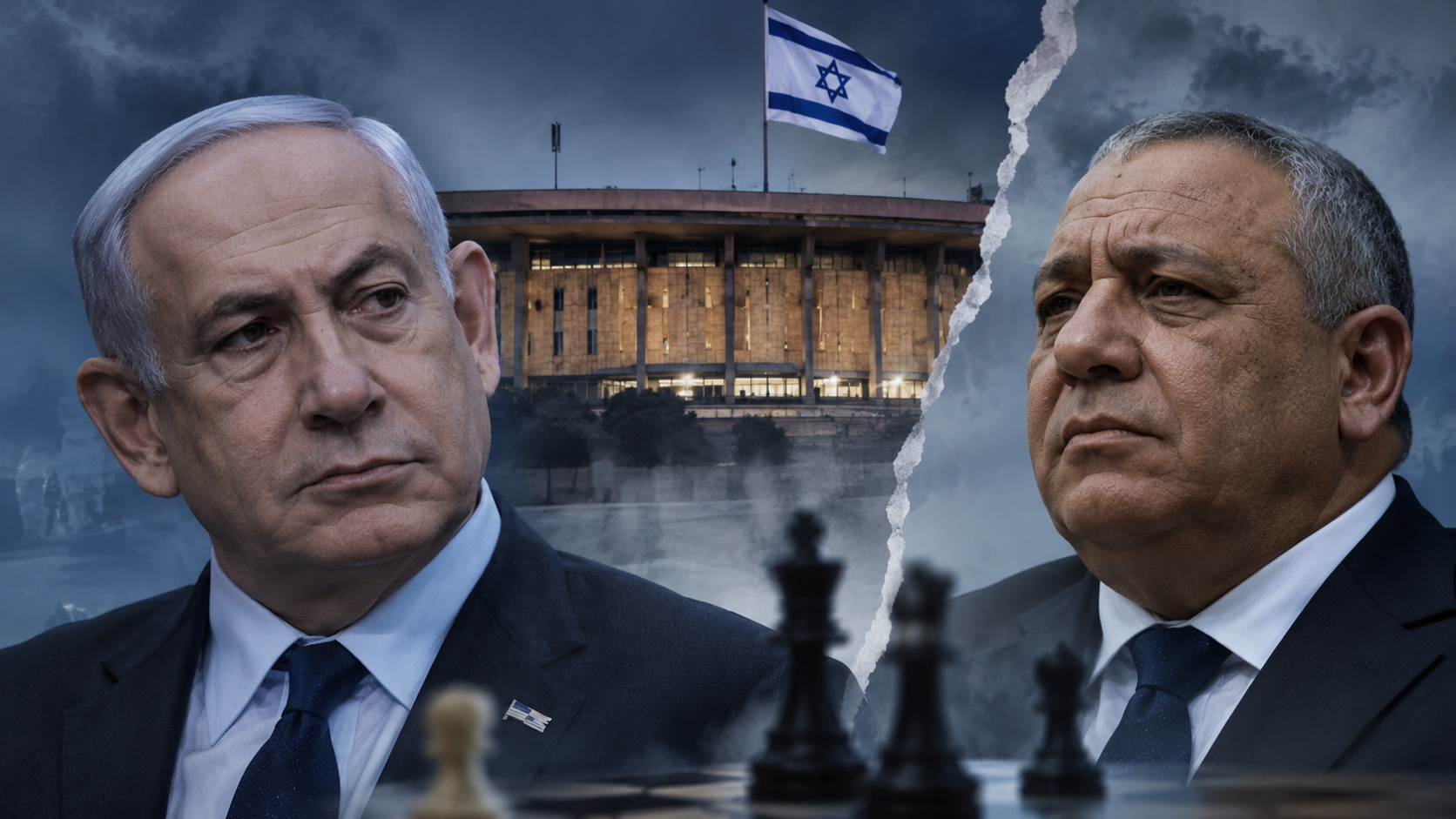
In the politics of the Middle East, the removal of a political leader does not necessarily signify the end of the political order he represents. Sometimes, it merely exposes the competing interests that had remained concealed beneath it. Israel’s present political transition is beginning to demonstrate precisely this dilemma.
The October 27 election was expected to determine the country’s political direction. Instead, it produced a more complicated question: who possesses the parliamentary strength to govern, and who possesses the political authority to preserve the existing order?
Benjamin Netanyahu’s Likud emerged as the largest party, but his traditional bloc secured only 53 seats in the 120-member Knesset. Gadi Eisenkot’s political grouping, meanwhile, has been attempting to construct an alternative government. Neither side has secured an independent parliamentary majority.
Yet the most revealing development is not the electoral arithmetic. It is the behaviour of the political actors negotiating its consequences.
The Opposition’s Dilemma
Eisenkot’s attempt to assemble a government has exposed the contradictions within the opposition itself.
His Yashar party has reached a coalition agreement with Avigdor Lieberman’s Yisrael Beytenu. However, Yair Golan’s Democrats have suspended negotiations, objecting to Eisenkot’s continued discussions with Netanyahu’s Likud over a possible unity government.
The disagreement is significant. The opposition entered the post-election period with a shared objective of replacing Netanyahu, but it does not necessarily share a common understanding of what should replace him.
The question of a unity government has consequently become more than a negotiating tactic. It has exposed the distinction between political opposition and political consensus.
Eisenkot must reconcile parties that differ over judicial reform, military conscription, relations with Arab political representatives and the future composition of Israel’s governing establishment.
The challenge is therefore not simply to secure 61 votes. It is to construct a political arrangement capable of surviving the competing ambitions of its participants.
Netanyahu and the Politics of Continuity
Netanyahu’s position deserves examination beyond the immediate question of whether he can form another government.
Despite losing his parliamentary majority, he remains caretaker prime minister. His political influence, established relationships and control of the existing executive machinery ensure that he remains central to the negotiations.
On November 25, another development complicated the political landscape: the Jerusalem District Court recommended dropping the most serious charge in his corruption trial, reconsidering another and exploring a possible agreement in the remaining case. This is a judicial development, not a final resolution of the proceedings, but its political implications are considerable.
It introduces another variable into an already uncertain transition.
The distinction between political survival and political legitimacy is important here. A leader may retain influence even when the parliamentary arithmetic changes; equally, an electoral setback does not automatically dismantle the institutions and political networks accumulated over years in power.
Netanyahu’s future will therefore depend not only on coalition negotiations, but also on the interaction between parliamentary support, judicial proceedings and the political calculations of potential partners.
The Security Dimension of Political Uncertainty
Israel’s domestic political transition cannot be separated from its regional environment.
The continuing confrontation with Iran, the situation in Gaza and the security implications of developments along Israel’s northern frontier place considerable demands on any incoming government.
The debate over Iran is particularly revealing. Netanyahu has maintained that Tehran is rebuilding its military capabilities, while Eisenkot has questioned the urgency of another immediate confrontation.
This disagreement illustrates a fundamental problem in national-security policymaking: the existence of a threat does not automatically determine the timing, scale or political utility of a military response.
Strategic decisions must account for military capability, diplomatic consequences, economic endurance and the possibility of escalation. They cannot be evaluated exclusively through the domestic political advantages they might generate.
For Israel’s next government, the challenge will be to distinguish between the requirements of national security and the pressures of political survival.
The Unfinished Transition
The debate surrounding the October 7 commission of inquiry, judicial reform and the distribution of executive authority suggests that Israel’s political transition is also an institutional struggle.
The proposed inquiry is particularly important because it concerns the accountability of the political and military leadership for the failures preceding October 7, 2023. Its mandate, composition and independence will influence how the country examines one of the most consequential security failures in its modern history.
The next government will inherit an electorate divided over leadership, a parliament divided over policy and a security environment that offers little room for prolonged political paralysis.
There is, however, a larger lesson in the present situation.
Political power is not sustained by electoral victories alone. It depends upon the ability to build coalitions, maintain institutional confidence and translate parliamentary strength into governing authority.
Israel has entered a period in which the question is no longer simply whether Netanyahu can be replaced. It is whether the political forces seeking to replace him can agree on the strategic direction of the state.
An election can change the occupants of government. It cannot, by itself, resolve the contradictions within the political order.
Related Topics
Related Posts