
An Iranian voice in exile
Who Benefits? Decoding the NYT’s Ahmadinejad Report
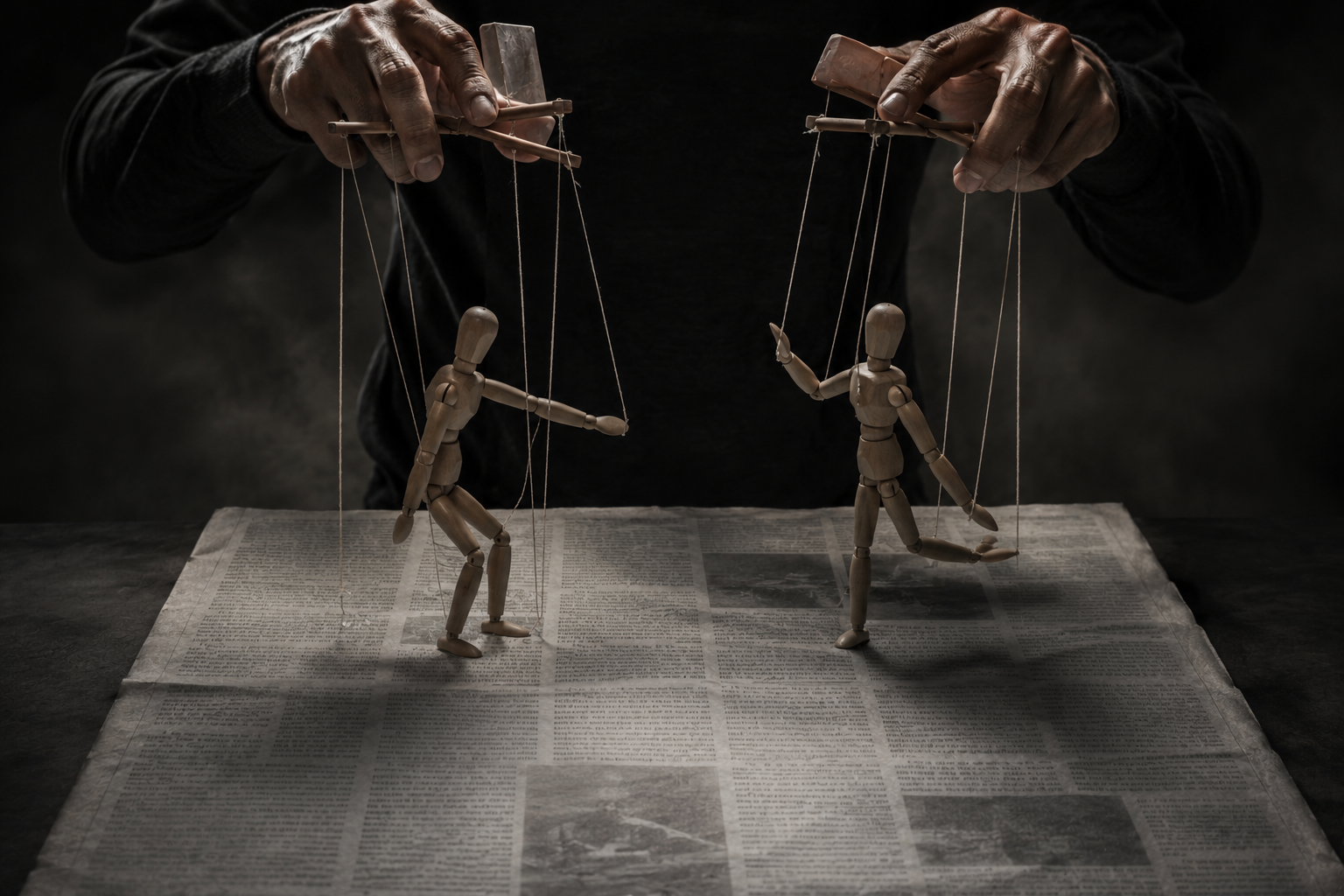
In an information war, the newspaper is not the messenger — it is the battlefield. (AI-generated illustration)
The Ahmadinejad Leak: Five Targets of a Single Report
In a hot war, each bullet strikes one target. In an information war, a single round can hit several at once. The New York Times report on a failed U.S.-Israeli plan to install Mahmoud Ahmadinejad as Iran’s post-war leader — published on May 20 — is not a stray bullet. It is a precision-guided munition in an information campaign whose full target set deserves careful examination.
The Report
The New York Times investigation, authored by Mark Mazzetti, Julian E. Barnes, Farnaz Fassihi, and Ronen Bergman, claims that the United States and Israel entered the February 2026 war with a specific regime-change scenario: replacing the Islamic Republic’s leadership with Mahmoud Ahmadinejad — the former president known for denying the Holocaust, calling for Israel’s destruction, and presiding over the violent suppression of the 2009 Green Movement. The plan, attributed to Israel’s Mossad chief David Barnea, was reportedly based on decades of intelligence collection. Ahmadinejad had been consulted. The plan, the report says, “quickly went awry.” His current whereabouts are unknown.
The sourcing rests entirely on unnamed American officials. No Israeli source is cited on the record. No documentary evidence is presented. And the journalists — while distinguished — are operating within a framework that, by definition, prevents independent verification.
This article does not dispute that such a plan may have existed. What it examines is the timing, the pattern, and the question of who benefits from its disclosure at this particular moment.
The Timing Is Not Coincidental
The report was published on May 20, 2026. Consider what else was unfolding that same week.
Inside Israel, Prime Minister Netanyahu’s coalition was facing unprecedented internal challenges. The ultra-Orthodox parties had withdrawn their support over the haredi draft bill. On the same day the Ahmadinejad report was published, the Knesset voted 110-0 in a preliminary reading to dissolve itself — with Netanyahu absent from the chamber.
Six days earlier, on May 14, Netanyahu had threatened to sue The New York Times over a Nicholas Kristof column alleging widespread sexual violence against Palestinian prisoners by Israeli forces. The Israeli Foreign Ministry stated that the column was deliberately published one day before the release of an independent Israeli report documenting Hamas’s systematic use of sexual violence during the October 7, 2023, attack — effectively preempting Israel’s own narrative. Yale Law Professor Jed Rubenfeld assessed that any resulting lawsuit would be “dead on arrival” — suggesting that even critics recognize the legal avenue leads nowhere, leaving the reputational damage as the primary effect.
This is not the first time The New York Times’ coverage of Israel has faced scrutiny for pattern and timing. In October 2023, the paper admitted its initial coverage of the Al-Ahli Hospital explosion in Gaza “relied too heavily on claims by Hamas” — publishing a headline blaming Israel for a blast later attributed to a misfired Palestinian Islamic Jihad rocket. More recently, Netanyahu accused the Times of defamation over a front-page photo of an emaciated Gazan child that the paper later acknowledged had a preexisting medical condition — cerebral palsy — not disclosed in the original reporting.
The pattern is worth noting. Within a single week in May 2026, The New York Times published two high-impact pieces targeting Israel’s moral standing (the Kristof column) and its strategic competence (the Ahmadinejad report) — both at a moment of significant political vulnerability for the Israeli government.
One such coincidence is unremarkable. Two in seven days — from a publication with a documented history of editorial choices that have damaged Israel’s credibility — invites serious scrutiny.
The Target Set
In information warfare, every operation serves multiple objectives simultaneously. The Ahmadinejad report appears to strike at least five distinct targets.
Target one: Israeli strategic credibility. The report frames Mossad chief David Barnea as the architect of a plan to install a man who called for Israel’s destruction — a framing designed to make Israeli intelligence appear reckless. Whether this framing accurately reflects operational reality or represents a selective and distorted leak is precisely the kind of question that anonymous sourcing makes impossible to answer. What is clear is that the narrative, as presented, serves to undermine confidence in Israel’s strategic planning at the worst possible moment.
Target two: Iranian public trust in Israel and the United States. Throughout the 2026 war, Iranian citizens demonstrated unprecedented cooperation with Israeli intelligence — sending photos, videos, and location data on regime security forces, raising Israeli flags alongside Iranian flags, and publicly thanking Netanyahu. When Netanyahu declared at the outset of the war that his objective was the destruction of the Islamic Republic, millions of Iranians responded not with hostility but with cautious hope. The Ahmadinejad report strikes directly at this trust. For Iranians who risked their lives cooperating with Israel and the United States, the revelation that the plan was to reinstall a regime insider — not to liberate Iran but to replace one operator with another — is a calculated blow to the most strategically valuable asset the coalition possessed: the goodwill of the Iranian people.
Target three: The U.S.-Israeli alliance. By attributing the plan primarily to Mossad while noting that CIA Director Ratcliffe described it as “farcical,” the report introduces a narrative of disagreement between Washington and Jerusalem — a narrative whose accuracy cannot be verified through anonymous sourcing, but whose effect is to suggest fractures in an alliance that both governments have publicly described as unified.
Target four: The Pahlavi alternative. The report mentions that Trump expressed skepticism about exiled opposition figures, stating that “somebody from within, maybe, would be more appropriate.” This line — whether accurately quoted or editorially framed — undercuts the most organized opposition movement currently available: the coalition led by Crown Prince Reza Pahlavi, whose Iran Prosperity Project represents the most detailed post-regime governance plan in existence.
Target five: Strengthening Ghalibaf’s negotiating position. Several Iranian analysts have noted that the report’s timing coincides with a critical phase in ceasefire negotiations, in which parliament speaker Mohammad Bagher Ghalibaf is Iran’s lead figure. By portraying the U.S.-Israeli war plan as incompetent and their chosen alternative as a failed regime insider, the report strengthens Tehran’s narrative that the coalition lacks a credible post-war strategy — giving Ghalibaf leverage to argue that the Islamic Republic remains the only viable governing structure.
Each of these targets aligns with the strategic interests of actors who benefit from the current stalemate — actors who prefer a weakened but surviving Islamic Republic to a dismantled one.
The Question That Must Be Asked
This article does not claim to know who orchestrated the timing or framing of the New York Times report. Attribution in information warfare is rarely straightforward, and responsible analysis requires distinguishing between what is known and what is inferred.
But the question must be asked: who benefits from a report that simultaneously damages Israeli credibility, shatters Iranian trust in Western intentions, weakens the U.S.-Israeli alliance, and marginalizes the only organized opposition alternative — all published at the exact moment when Israel’s governing coalition is disintegrating?
The answer is not difficult to infer. But inference is not proof, and this article will not pretend otherwise.
What can be stated with confidence is this: the Islamic Republic’s intelligence services have a well-documented history of information operations designed to fragment opposition, discredit alternatives, and manipulate international media narratives. Whether this particular report is the product of such an operation, or merely serves its objectives by coincidence, is a question that journalists, intelligence analysts, and policymakers should be actively investigating — not dismissing.
What Is Happening Inside Iran While the World Reads the Times
While international attention focuses on the Ahmadinejad revelation, the situation inside Iran continues to deteriorate in ways that receive far less coverage.
Based on field observations from within Iran, the regime’s security apparatus has intensified its operations since the ceasefire. Daily executions of protesters continue, designed not to punish individuals but to paralyze an entire society through collective trauma — driving the public psyche into a state of freezing. Mass arrests are ongoing. Security forces conduct raids on private homes, threatening families with property confiscation — particularly targeting households with relatives abroad, in an effort to sever the flow of information out of the country and maintain control over the narrative.
Cyberattacks against diaspora-run YouTube channels and independent analytical platforms have escalated sharply. The regime understands that information is the battleground — and it is fighting on that battleground with every tool available.
In this context, the New York Times report is not merely a news story. It is a weapon deployed in a contested information environment — one in which the Islamic Republic has every incentive to ensure that its adversaries appear incompetent, its opponents appear abandoned, and the international public remains confused about who is fighting whom, and why.
Why Ahmadinejad?
If the reported plan existed, its selection of Ahmadinejad reveals a deeper problem: a fundamental misreading of Iranian society by external analysts — and possibly a multi-layered operational calculus that extends beyond popular support.
The most visible rationale was straightforward — Ahmadinejad received high vote counts in 2005 and 2009, suggesting popular support. But any Iranian who lived through those elections knows that the numbers were the product of systematic electoral fraud. The 2009 fraud was so blatant that it triggered the Green Movement which the regime crushed through mass arrests, torture, and killings. Iranian election statistics have never reliably reflected public sentiment. They reflect the regime’s preferred narrative. Western analysts who rely on these numbers without understanding the mechanics of electoral manipulation in Iran are building strategies on fabricated data.
But electoral data was likely not the only consideration. In operations of this nature, the selection of an asset is typically multi-layered. Ahmadinejad may have been assessed as the most controllable option — a figure already embedded within the regime’s power structure, with known vulnerabilities, established channels of communication, and a track record of operating within institutional constraints despite his public persona of defiance. From an intelligence standpoint, a controllable insider may appear more manageable than an independent opposition figure whose loyalty cannot be guaranteed. The flaw in this logic is the assumption that the Islamic Republic’s structure can be repurposed under new management. It cannot. As I have argued throughout this series, the threat is the structure itself — not the personnel operating within it.
Moreover, while Ahmadinejad appeared to fall out of favor with Khamenei — he was barred from running in 2017 and 2021 — Iranians understand this dynamic differently than outside observers. The internal politics of the Islamic Republic are designed to present the appearance of factional conflict while maintaining structural unity. The “dissident insider” is a role the regime has deployed before. From an Iranian perspective, Ahmadinejad was never outside the system. He was — and remains — a product of it.
Installing him as a replacement for the regime would not represent change. It would represent continuity under a different label — precisely the kind of cosmetic transition that the Islamic Republic’s operational structure is designed to survive.
Conclusion
The failed Ahmadinejad plan — if accurately reported — represents a genuine strategic error rooted in insufficient understanding of Iranian society. Installing a regime insider as a replacement for the regime contradicts the fundamental principle that the Islamic Republic’s threat resides in its structure, not in its personnel. You do not fix an operation by changing its operator. You dismantle the operation.
But the disclosure of this failure, at this moment, in this form, through anonymous sources that cannot be verified, in a publication with a documented pattern of precisely timed releases that damage Israeli credibility — this is not journalism in isolation. This is information in motion.
The international community would do well to read the Ahmadinejad report carefully — not only for what it reveals about the war’s planning failures, but for what its timing and framing reveal about the information war being waged alongside the military one.
In a conflict where the Islamic Republic has lost its navy, its ayatollah, and much of its conventional capacity, information may be the last weapon it has left. And it appears to be deploying it with considerable precision.
Related Topics
Related Posts