

Who can we trust with our children’s lives?
A moment before you cast your vote today, I ask you to take a minute to read this and reflect:
Forty years ago, Yitzhak Rabin pinned the officer’s insignia on my uniform as an outstanding cadet graduating from the IDF Officers’ Course (November 1986). I felt immense pride and a profound sense of awe at the weight of responsibility being placed upon my shoulders—as expressed in David Ben-Gurion’s injunction:
“Let every Hebrew mother know that she has entrusted the fate of her sons to commanders worthy of that trust.”
At Officers’ School, we were put to the test. We were instilled with—and held to—the highest standards of integrity, unqualified truthfulness in reporting, devotion to the mission, discipline, purity of arms, and leadership through personal example. We were taught to lead from the front, with the cry of “Follow me!”—never asking those under our command to undertake a mission, face a danger, or perform a task that we ourselves were unwilling to lead, risk our lives for, and carry out.
We were taught what responsibility means. Without compromise.
Authority may be delegated, but responsibility cannot be divided.
Even in matters that might seem trivial. If I failed to inspect the ammunition magazines of every soldier under my command, and even a single bullet was missing, and as a result, God forbid, a soldier was harmed or a failure occurred, I would bear responsibility.
From the smallest matter to the gravest. Whatever the circumstances.
There are no limits to responsibility. Even when we cannot control every circumstance—indeed, all the more so—we have a duty to prepare for every contingency.
Responsibility rests with the commander at the head of the force, for better or worse.
At the graduation ceremony, as I received my officer’s insignia, I was filled with a conscious sense of mission: the responsibility, and the privilege, of serving as a defender of a state that previous generations had not had to protect them.
My grandmother had no such protection when she witnessed her mother murdered by Petliura’s pogromists.
Thanks to us, and through our responsibility, we believed, such atrocities would never happen again.
How, then, did history repeat itself on October 7?
How did my sister and her husband come to be murdered in their own home in a pogrom, as she shielded her son with her body, hiding him beneath her in bed—just as her great-grandmother had done before her—left to face her fate without the protection of the state?
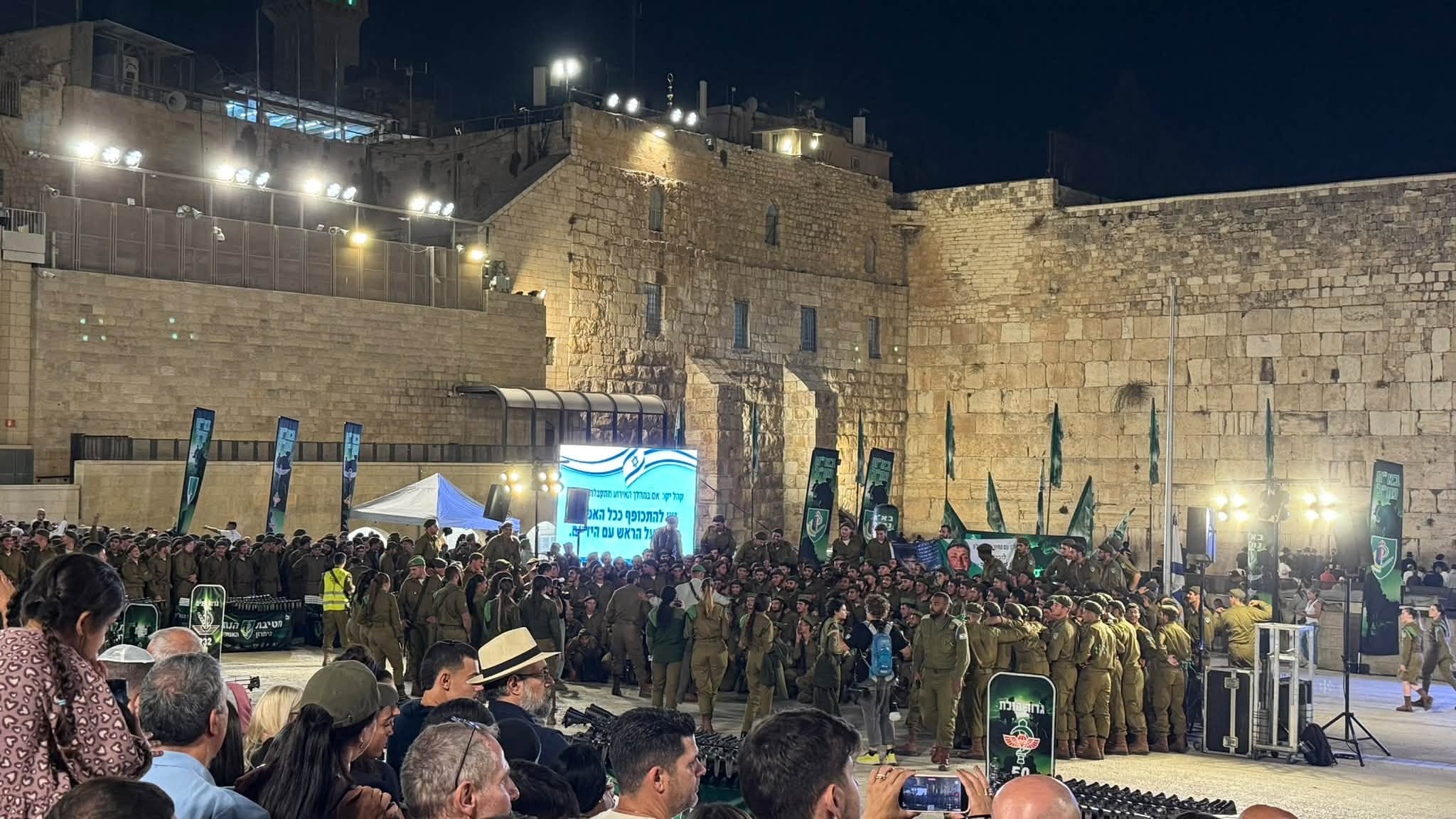
A week ago, on the national memorial day marking the assassination of Prime Minister Yitzhak Rabin, I went to the Western Wall for the swearing-in ceremony of my nephew, a young combat soldier training for the Nahal Brigade’s reconnaissance unit.
The very same unit that defended the Kerem Shalom, Holit, and Sufa sector on October 7; that suffered devastating losses and could not withstand the brutal assault; that was overwhelmed by Hamas’s Nukhba forces despite the extraordinary courage of its soldiers and commanders.
Entire communities were left alone to face their fate, including my own family—as though there were no army and no state.
All of this hung over the ceremony, understood by everyone, without needing to be spoken.
And in the background, the threat of war with Iran, military operations and unrest in the territories. We all feel as though we are sitting on a powder keg, with the matches in the hands of pyromaniacs.
And the young people standing before us in the plaza will place their bodies and their lives between us and our enemies, if, as a last resort, they are called upon to do so.
My nephew and his brothers-in-arms swore their oath of allegiance in these words:
“I hereby swear and solemnly pledge, on my honor, to remain faithful to the State of Israel, its laws, and its duly constituted authorities; to accept upon myself, unconditionally and without reservation, the discipline of the Israel Defense Forces; to obey all orders and instructions issued by authorized commanders; and to devote all my strength, and even to sacrifice my life, for the defense of the homeland and the freedom of Israel.”
The full weight of responsibility for administering that oath, and for commanding those who had taken it, was unmistakable in the words of the brigade commander.
He emphasized to the recruits and their families the values from which they would draw their strength when they went into battle.
Moral and spiritual values. Not simply force, and more force.
And he did not say if they would fight.
The brigade commander had no doubt that these young, pioneering combat soldiers would face the test of battle, sooner or later.
The young soldiers understood this, too.
They carried flags and banners bearing the faces and names of those who had gone before them—fallen soldiers of their own generation, just a year or two ahead of them in high school or basic training, who only a moment ago had been just like them: full of life, determination, promise, and hope.
And we, too, understood.
All of us gathered there: parents, brothers and sisters, grandparents, aunts and uncles. All of us who stood there, having entrusted our sons to an army to which they had just pledged their very lives.
And in our hearts, one prayer. One plea.
If this is our duty, and this is their turn to serve; if there truly is no other way—then may we at least know that we have entrusted the fate of our sons to leaders worthy of that trust.
And in stark contrast to all of this stands Benjamin Netanyahu.
So fearful, so morally diminished, that at the very moments when these young recruits were taking their solemn and terrible oath of allegiance, he could not bring himself to attend the state memorial ceremony for Yitzhak Rabin, offering the flimsy, contrived excuse of a scheduling conflict.
Rabin was certainly not a perfect leader. But no one can seriously dispute that he understood responsibility, and that he was not afraid to admit mistakes, accept the consequences, and make amends.
Rabin was a leader who knew how to pursue both war and peace.
He was murdered by a fanatical, incited assassin, in an atmosphere of hatred that Netanyahu himself helped inflame and fuel.
And since then, Netanyahu has learned nothing.
He has never ceased sowing division and polarization, fear and hatred. He governs by divide and rule, through falsehood and deceit, tearing apart the bonds of mutual responsibility that hold us together.
He encourages draft evasion under the banner of “We will die rather than enlist.”
He enables extremism and racism, criminality and corruption.
He attacks the judiciary, the IDF, the Shin Bet, the civil service, and the institutions of the state.
He undermines the norms of decency, civility, and solidarity; erodes the ethos of public service and the common good; and shows contempt for the law and for justice.
Through his words and through his silence, he has incited hostility toward the families of hostages and the families of those murdered.
And this man continues to cling to power and demand the authority to send our sons into battle.
All the while, a terrifying, gnawing doubt persists: that the profound crisis in which we find ourselves is not inevitable; that it is not simply the consequence of having no alternative; that it has not been forced upon us solely by our enemies.
Rather, that it is also—and to a considerable, unforgivable degree—the result of arrogance and callousness, political and strategic blindness, and a loss of moral and ethical direction that threaten our lives, our future, and our very existence.
The prime minister of the catastrophic failure.
The utter failure.
The man who bears responsibility.
From beginning to end.
No exemptions. No compromises.
Total responsibility, indivisible and nondelegable.
The whole of it.
With or without a commission of inquiry.
Whether he admits it or denies it.
And he denies it.
He lies. He makes excuses. He incites.
And he disgraces every value on which we were raised, the very bedrock of our existence here:
Truth. Integrity. Responsibility.
Benjamin Netanyahu, a veteran of Sayeret Matkal, Israel’s elite General Staff Reconnaissance Unit, knows the truth.
He brings shame upon the values of the IDF and dishonors the memory of his courageous brother, Yonatan.
History will judge him for all of this, and his name will be remembered in infamy.
But before the judgment of history comes the judgment of the voters.
I hope that today we too will know to remove him from power.
David Ben-Gurion said:
“The State of Israel will be judged not by its wealth, not by its army, and not by its technology, but by its moral character and its human values.”
My nephew and his comrades—young, pioneering combat soldiers, volunteers filled with a sense of mission—understand this.
I believe their commanders understand it, too.
And so do the families who stand behind them, and whom they, together with all of us, have sworn to defend.
I was there.
I heard that spirit in the thunderous roar of:
“I swear! I swear! I swear!”
In them, I place my trust.
But without worthy leadership, all of this will be in vain.
And yet, our hope is not lost.
There is still time to set things right.
I ask you to think about this as you cast your vote.
When you stand alone in the voting booth, with only your conscience beside you.
Feel the full weight of the responsibility.
And the privilege.
And the duty—to vote with a commitment to truth, before you cast your ballot.
Today’s choice is fateful.
Make certain that the fate of our sons and daughters, and our own fate, is entrusted to leaders worthy of that trust.