Founder | Children’s Book Author | Empowering Women and Girls & Supporter of Global Peace Initiatives | Mom | Yema
Who Counts as Jewish Now? Wrestling with Identity in a Divided Time
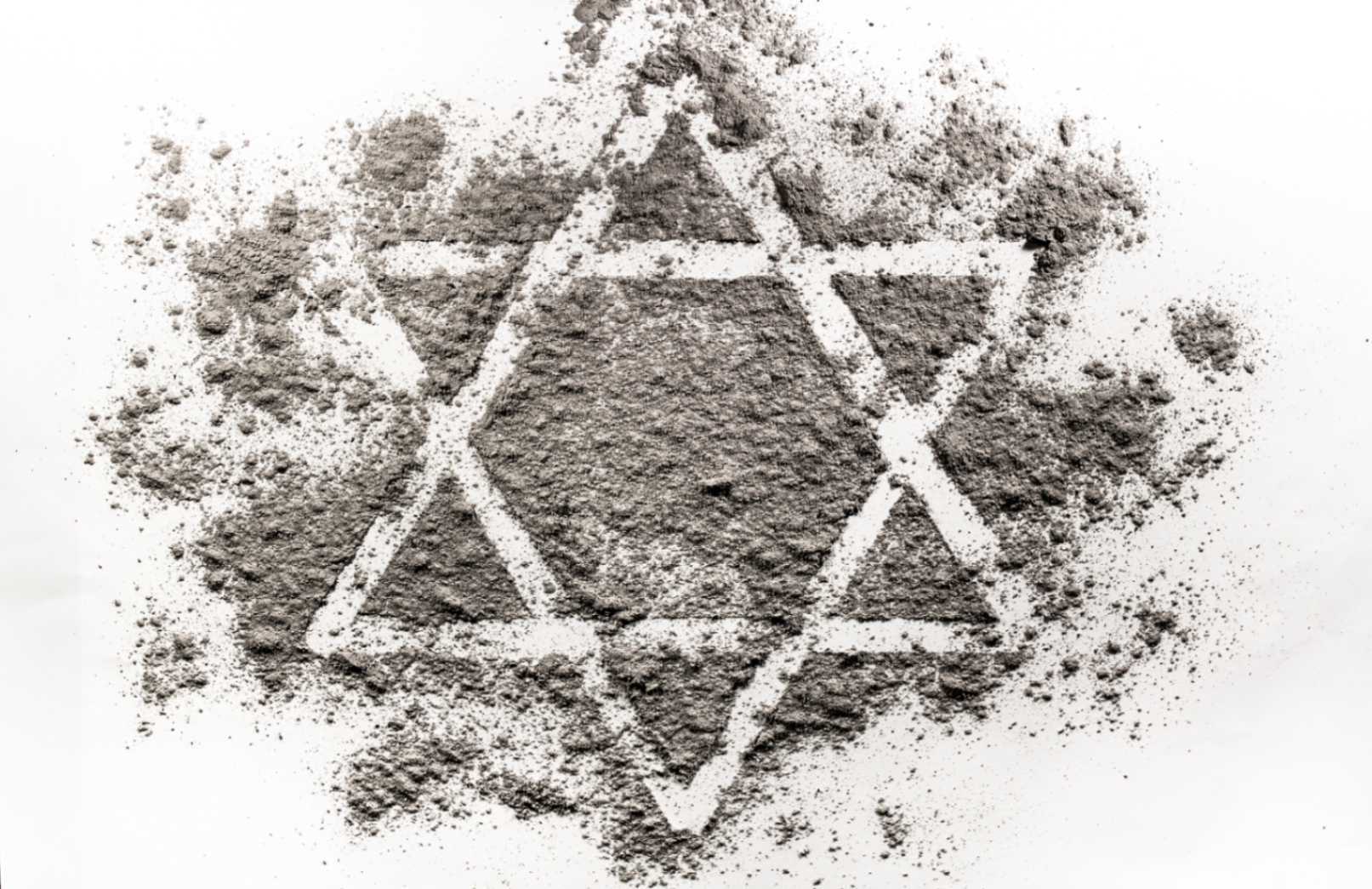
David star shape, jew and Israel symbol made of ash, dust, sand (Shutterstock)
The other day, I criticized the Israeli government—not for defending itself, but for failing to prioritize the hostages and minimize casualties. I said, “Why hasn’t Israel said yes to the Hamas deal to get the hostages out? Once they’re safe, do what needs to be done.”
Someone close to me replied, “That kind of talk makes it sound like you’re against Israel.”
That stung.
I was born in Tzrifin during the Suez War and lived through the Six-Day War. My family moved to Canada in 1967, and I’ve lived in California for decades. But my heart has always been tied to Israel. I was raised on the leadership and vision of Golda Meir and Moshe Dayan. My early childhood was shaped not just by the country itself, but by my father’s deep desire for peace over war. My prayers were in Hebrew. So when someone who knows me well questioned my loyalty, it didn’t just hurt; it shook me.
I know I’m not alone.
Since October 7, many Jews around the world have asked what it means to be Jewish—and who gets to decide.
Jewish identity has never been simple. It’s a rich tapestry of ancestry, ethics, religion, culture, history, and shared struggle. But these days, people reduce it to a rigid binary. If you support the Israeli government without question, they say you’re truly Jewish. If you voice concern for Palestinian civilians or criticize government policy, they brand you anti-Israel—or worse, not really Jewish.
That judgment doesn’t come only from strangers—it’s echoed by friends, family, colleagues, and high-profile voices suddenly elevated as unofficial spokespeople for Jewish identity. Their social media posts are treated like official declarations, as if they’re auditioning to be the next Netanyahu of TikTok or X.
Who gave them the right to decide who belongs? When they suggest that anyone who doesn’t fit a narrow mold of political and ideological loyalty is a traitor, I want to scream: Really?
We used to be a people of debate. Machloket l’shem shamayim—arguments for the sake of heaven. Now, disagreements feel like betrayal. Jewishness has become a political litmus test.
But this moment isn’t just about politics. It’s about fear—and how easily it’s used to turn people against each other.
Our social media feeds are flooded with rage. Nuance gets lost. Complex conversations are reduced to yes-or-no loyalty tests. We retreat into our corners. Misinformation spreads—not because it’s true, but because it confirms what we already fear.
This painful divide came into sharper focus with Ezra Klein’s recent New York Times column, “Why American Jews No Longer Understand Each Other,” which explored generational and ideological rifts in the Jewish community. In Jewish Insider, Josh Kraushaar pushed back. He pointed to polls showing that most American Jews, including many younger ones, still support Israel and see it as central to their identity.
Perhaps the Jewish community isn’t as fractured as it sometimes feels. Maybe we’re just exhausted—tired of defending our identity, enduring loyalty tests, and grieving a world politicizing our pain.
We’re stuck in a storm of false choices. Many of us love Israel and believe in its right to exist in peace. We also believe in democracy, human rights, and empathy for all civilians. That used to be a reasonable position. Now it’s treated as treason.
If you show concern for Palestinian lives, some label you a Hamas sympathizer. If you support Israel’s right to defend itself, others call you an apartheid apologist. The nuance, moral wrestling, and empathy that have always been core to Jewish life are vanishing.
And the pressure isn’t just from the outside. It’s coming from within. On college campuses, Jewish students feel forced into ideological corners. Political scientist Eitan Hersh’s research found that while most Jewish students still feel connected to Israel, they’ve grown increasingly isolated. The loudest voices dominate. The quieter majority censors themselves. Their views haven’t changed—but they fear their social circles won’t accept them if they speak.
In Tablet, Eric Kaufmann wrote that Jewish Ivy League students are shifting politically, not because their beliefs have changed, but out of necessity. Former allies have grown indifferent—even hostile. These students aren’t becoming conservative; they’re trying to survive in spaces that no longer feel safe.
So no, Jewish identity is not unraveling because we’ve stopped caring. We’re disoriented. What’s breaking isn’t our connection to Israel or Judaism—it’s our trust in the places that once held us.
After I published, I Was Accused of Being an Israeli Spy When I Stood Up for Human Rights, I shared my experience with WILPF, the Women’s International League for Peace and Freedom. It’s a historic pacifist group I once believed in—founded in 1915 with feminist values of disarmament and justice.
I joined their Middle East committee hoping to build bridges. But I was shocked when they asked us to help legitimize Hamas—a terrorist group that has, for decades, called for the destruction of Israel and Jews. When I spoke out against this, I faced discrimination. I resigned on principle and reported the organization to the ADL.
Some readers expressed sympathy. A few responded with accusations, misinformation, and doubts about my Jewish identity. They insisted you can’t support both Palestinians and Israelis, claiming that all Palestinians hate Jews and want us dead—and that if I did my “research,” I’d see the truth.
I told them I’m pro-peace. I don’t support terror. Caring about human rights doesn’t mean endorsing violence; it means believing that dignity and safety must be universal.
A close friend reminded me that I don’t need to defend myself for caring about the humanity of others. I don’t have to pass loyalty tests just to speak out against the normalization of innocent people’s suffering. My story matters. It’s mine to tell. Her words were a lifeline.
We need to reclaim a broader, more honest Jewish identity that makes space for anguish and hope, criticism and compassion. One that understands being Jewish isn’t about loyalty to a government or a script—but a commitment to conscience.
Jewishness is not a purity test. It’s a living, breathing connection to justice, memory, resilience, and community.
In a time when so many demand certainty, those who wrestle with doubt are often the most faithful.
So, who counts as Jewish?
The only honest answer is: the one still asking.
Related Topics
Related Posts