CEO of Time to Stand Up for Israel
Who Has the Biggest…?
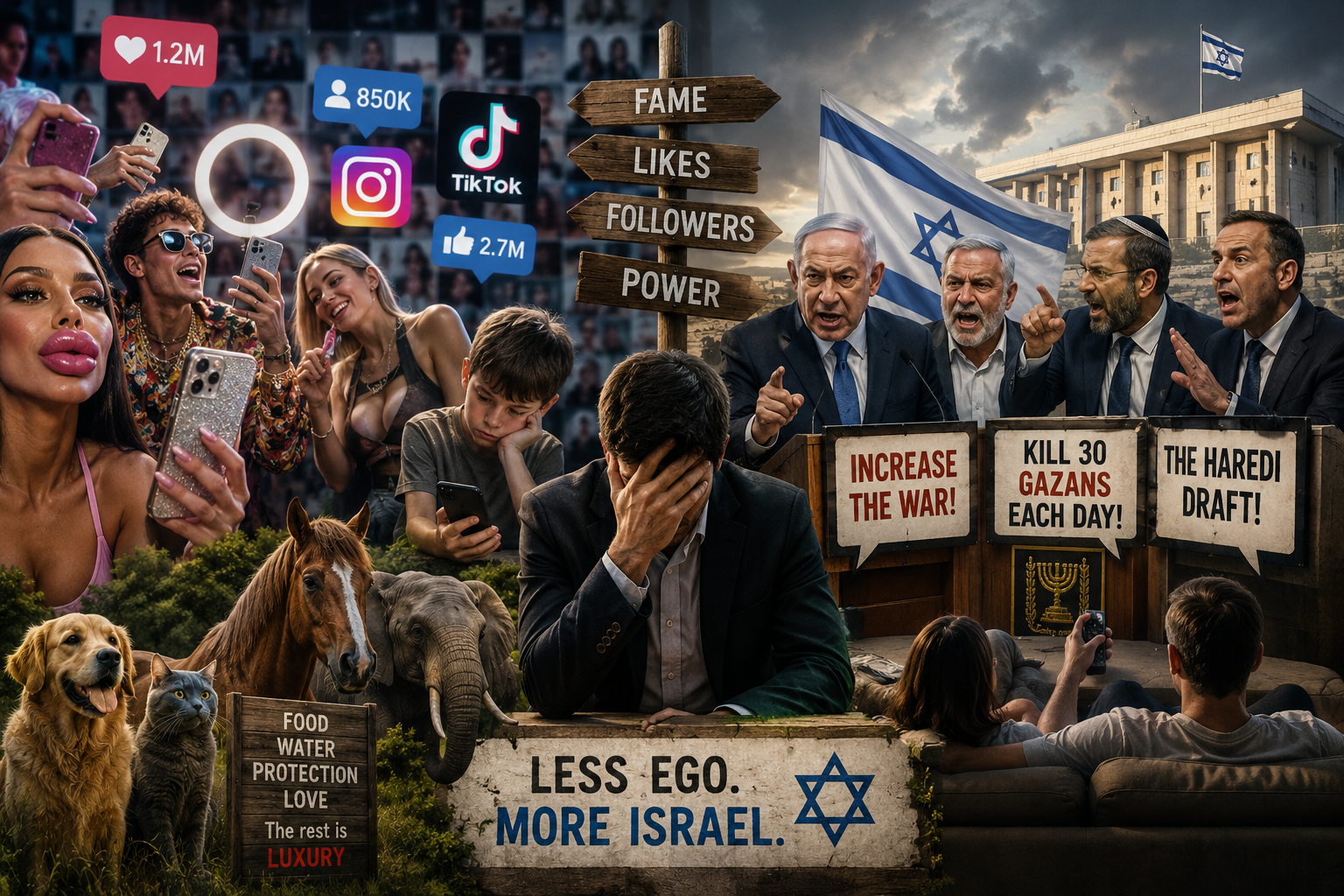
Photo Credits: Sabine Sterk ( Ai)
Human beings are rather narcissistic creatures.
We like to believe that we are sophisticated. Cultivated. Intelligent. We have philosophy, science, literature, universities and technology. We build cities, send spacecraft into the universe and develop machines that can think alongside us.
We certainly consider ourselves far more advanced than animals because, after all, we have these magnificent brains.
But sometimes I look at humanity and wonder whether we are actually using them.
For centuries, human status was largely connected to wealth, power and position. The bigger the house, the more land you owned, the more impressive your title, the more important you supposedly were.
Then came the internet.
And eventually social media.
Suddenly another currency became almost as important as money.
Attention.
Who has the most followers? Who gets the most likes? Who is verified? Who goes viral? Who has the biggest audience?
And perhaps most importantly, who has the biggest ego?
TikTok, Instagram and other platforms have turned parts of society into one enormous competition for attention. People film themselves eating breakfast. Couples carefully present their supposedly perfect relationships. Children become content before they are old enough to understand what content even means. People alter their faces until their lips resemble the sponge hanging in my shower.
Everything is amazing.
Everything is incredible.
Everything is super.
And when super is no longer super enough, it becomes super, super amazing.
Behind all this manufactured excitement sits a very primitive human desire.
Look at me.
The strange thing is that this phenomenon is no longer limited to influencers.
It has entered advocacy.
It has entered journalism.
And most dangerously, it has entered politics.
I see it in the pro Israel advocacy world too.
Advocacy should be about Israel. It should be about defending historical truth, exposing misinformation, fighting antisemitism and explaining a complicated country to people who increasingly receive their knowledge through thirty second videos.
Instead, advocacy can sometimes become another competition for visibility.
Concerned faces for the camera. Dramatic videos. Carefully staged moments. Grand declarations. People presenting themselves as though they personally changed history because they visited a meaningful place with a camera crew.
The cause slowly becomes the background.
The advocate becomes the product.
That should worry us.
Because when advocacy becomes primarily about the advocate, truth becomes secondary to engagement. The temptation is always to become louder, angrier, more dramatic and more outrageous because outrage generates attention.
And now Israel is heading toward another election, and we can see the same mechanism appearing in politics.
Politicians know perfectly well how social media works.
Moderation rarely goes viral.
Nuance certainly does not.
Imagine a politician posting: “This is an extremely complicated problem. I need to examine the military, economic, diplomatic and humanitarian consequences before reaching a conclusion.”
Good luck getting a million views with that.
So political communication becomes increasingly theatrical.
One politician needs to sound tougher than the politician standing next to him. Another needs a more shocking proposal. Someone else suddenly discovers that an issue he barely discussed yesterday is apparently the defining question of Israel’s future today.
The political marketplace starts resembling TikTok.
Swipe.
Like.
Share.
Next.
Except governing a country is not TikTok.
And governing Israel certainly is not.
Israel exists in one of the most dangerous geopolitical environments on earth. Decisions made by Israeli leaders can determine whether soldiers come home, whether civilians are safe, whether hostages live or die, whether alliances survive and whether another war begins.
These decisions cannot be reduced to engagement statistics.
Israel does not need the politician with the most spectacular soundbite.
Israel needs responsible leadership.
And this is not exclusively an Israeli problem. Far from it. We see the same phenomenon across Europe, America and elsewhere. Politics everywhere has become increasingly personalized. Politicians build brands. Followers become political capital. Algorithms reward anger. Extreme statements travel further than careful explanations.
The politician gradually becomes an influencer with parliamentary privileges.
And perhaps that tells us something uncomfortable about humanity.
Maybe our sophisticated civilization is not quite as sophisticated as we imagine.
Which brings me to animals.
I love animals partly because animals are refreshingly uncomplicated.
A dog does not care how many Instagram followers another dog has.
A horse does not need verification.
An elephant does not wake up wondering whether the elephant standing beside him received more likes yesterday.
Animals need relatively basic things.
Food.
Water.
Safety.
Protection from their group.
Connection.
And, in many social species, something remarkably close to what we humans call love.
Everything beyond our genuine needs is something humanity created.
There is nothing inherently wrong with ambition, wealth, technology or recognition. Human ambition has produced extraordinary achievements. Israel itself is proof of what intelligence, creativity and determination can accomplish.
The problem begins when recognition becomes the objective rather than the consequence.
When politicians ask, “Will this make me popular?” before asking, “Will this make Israel stronger?”
When advocates ask, “How many people watched me?” before asking, “Did anyone understand Israel better because of what I did?”
When leaders measure success through applause rather than results.
Perhaps humanity needs to borrow a little wisdom from the creatures we consider less intelligent.
Return to the basics.
What does a country actually need?
Safety.
Food and water.
A functioning economy.
A community capable of protecting its members.
A future for its children.
And yes, a sense of belonging and love.
Israel needs security. It needs unity. It needs strong democratic institutions. It needs an army capable of protecting its citizens. It needs relationships with allies. It needs economic strength. It needs Jews, Muslims, Christians, Druze and others who call Israel home to understand that whatever their disagreements, they share responsibility for the future of the same country.
Imagine, for a moment, Israeli politics stripped of personal ambition.
Imagine politicians on the right asking not what will satisfy their political base but what will strengthen Israel.
Imagine politicians on the left doing exactly the same.
Imagine coalition negotiations based primarily on national interest rather than ministries, positions and political survival.
Imagine advocates caring less about who has the largest following and more about whether the person they reached actually learned something.
Imagine leadership where admitting “I was wrong” was considered strength rather than weakness.
Imagine politicians occasionally saying, “My opponent has a point.”
It sounds almost revolutionary.
Perhaps even ridiculous.
But why should it?
We humans proudly call ourselves the most intelligent species on this planet.
Maybe it is time we started behaving like it.
Because Israel, especially now, cannot afford politics governed by algorithms, egos and the desperate search for applause.
The Jewish state has survived wars, terrorism, isolation and enormous challenges because generations before us understood something fundamentally simple.
There was something bigger than themselves.
Israel.
Maybe that is the question every politician and every advocate should ask when looking into a camera.
Not how many people will like me?
Not how many followers will I gain?
Not whether this will make me famous?
Just one question.
Is what I am doing good for Israel?
If the answer is yes, continue.
If the answer is no, perhaps put down the phone, forget the likes and spend an afternoon watching the animals.
They might be able to teach the supposedly smartest species on earth something about what actually matters.
Related Topics
Related Posts