Protect What You Love
Who Is Behind the Reputation War Against Israel?
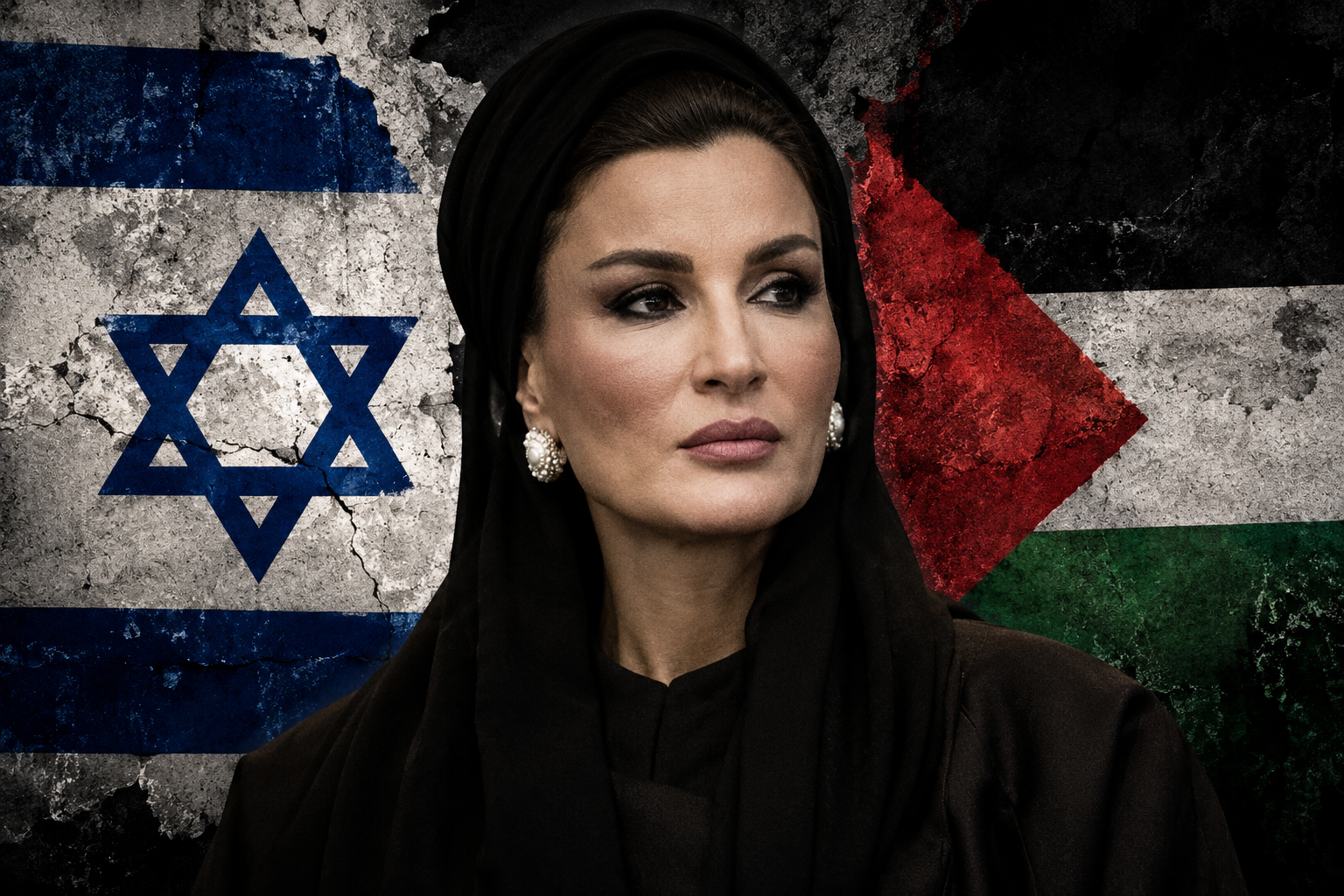
The mind behind the Anti-Israel influence
After October 7, many Jews looked at what was happening in the West and asked how the reaction had turned against Israel so quickly.
Hamas had just murdered about 1,200 people in Israel and kidnapped roughly 250. Israeli families were still identifying bodies and looking for the missing. Yet within days, protests against Israel were spreading across Western cities and university campuses. Students were already using the language of colonialism, apartheid, genocide and resistance. Some defended Hamas as a liberation movement. Others tore down posters of kidnapped Israeli children.
I wanted to understand where this came from.
People do not suddenly adopt the same political language, the same historical claims and the same moral framework within a few days. Something had already been built before October 7.
The more I researched, the more I came back to Qatar.
Then I came across Sheikha Moza bint Nasser.
Most Jews have probably never heard her name. They should.
Sheikha Moza is the wife of Qatar’s former emir, Sheikh Hamad bin Khalifa Al Thani, and the mother of the current emir, Sheikh Tamim bin Hamad Al Thani. She co-founded Qatar Foundation in 1995 and remains its chairperson.
For almost three decades, she has helped build the polished, respected side of Qatar’s influence in the West through education, philanthropy, culture and international institutions.
At the same time, Qatar became deeply connected to Hamas, gave senior Hamas leaders a home in Doha, funded Al Jazeera and supported an Islamist political environment closely connected to the Muslim Brotherhood.
Once I started looking at the whole picture, I stopped treating these as separate subjects.
Qatar Understood How Influence Works
Qatar is a tiny country with enormous wealth.
It used that wealth intelligently.
Qatar developed a close military relationship with the United States, invested heavily in Western businesses and real estate, bought global prestige through sports and built relationships with elite universities.
Sheikha Moza helped lead the educational side of that strategy.
Through Qatar Foundation and Education City, major American universities established operations in Doha, including Georgetown, Northwestern, Carnegie Mellon and Weill Cornell Medicine.
Qatar also became one of the largest foreign financial sources connected to American higher education.
According to the U.S. Department of Education, American universities reported more than $1.1 billion in gifts and contracts from Qatari sources in 2025 alone.
I often see this money described simply as donations.
That description misses the larger relationship.
Qatar built long-term financial and institutional connections with universities that educate future journalists, diplomats, lawyers, academics and political leaders.
You do not need to call a professor and dictate a lesson plan to influence an institution.
You can fund programs, host campuses, sponsor research, build partnerships, develop professional networks and become financially useful to the people running the institution.
Over time, you gain access and credibility.
Sheikha Moza helped Qatar build both.
Her Own Words Tell Us What She Believes
On November 15, 2023, about five weeks after the October 7 massacre, Sheikha Moza spoke at the “United for Peace in Palestine” summit in Istanbul.
She accused Israel of spreading “fabricated narratives” and called for those narratives to be challenged through media, culture, intellectual work and official channels.
Then she spoke about antisemitism.
She called antisemitism “a problematic concept” and argued that Arabs are Semitic people too.
That argument is historically false.
Antisemitism has had a specific meaning for more than a century. It refers to hatred and prejudice directed at Jews. Turning the word into a discussion about Semitic languages avoids the real issue.
Look at when she chose to make that argument.
Jews had just been murdered in their homes and at a music festival. Hostages were still being held in Gaza. Antisemitic incidents were already rising around the world.
Sheikha Moza used that moment to question the meaning of antisemitism while accusing Israel of spreading false narratives.
She also described where she believed the fight against Israel should take place: media, culture and intellectual institutions.
Qatar had already spent decades investing in exactly those areas.
I take that seriously because she told us, in her own words, where she wanted the fight to happen.
The Muslim Brotherhood Is Part of This Story
Israeli reporting adds another part that Western coverage often treats carefully or ignores.
Qatar has long provided a home and platform to prominent figures from the Muslim Brotherhood world.
One of the most important was Sheikh Yusuf al-Qaradawi.
Qaradawi lived in Qatar for decades and became one of the most influential Islamist clerics in the Arab world. Al Jazeera gave him an enormous platform. His religious and political influence reached far beyond Qatar.
His position toward Israel was clear. He supported the ideological struggle against Zionism and defended violence against Israelis.
Hamas itself grew out of the Palestinian branch of the Muslim Brotherhood.
Israeli reporting has also described connections between Sheikha Moza’s institutional world and Qaradawi’s network, including reported financial support for IslamOnline, a platform associated with his teachings.
When I look at Qatar Foundation, I therefore do not see an education project floating separately from Qatar’s politics.
I see one part of a larger state strategy.
The same ruling system that built relationships with Western universities also gave space and legitimacy to an Islamist ideological movement whose Palestinian branch produced Hamas.
That is a connection Western institutions should have examined much more seriously.
Al Jazeera Is Another Part of the Same System
Qatar funds Al Jazeera.
Western audiences usually know Al Jazeera through its English-language operation. It looks professional, sounds familiar, and speaks the language of human rights, inequality, oppression, and international law.
Arabic audiences have sometimes received something much harsher.
In 2019, AJ+ Arabic published a Holocaust video that questioned the accepted history of six million murdered Jews and suggested that Zionists had benefited politically from the Holocaust.
Al Jazeera removed the video and suspended two journalists.
The network was right to take it down.
The fact that the content was created and published still tells us something.
Since October 7, Israel has made more serious allegations about connections between Hamas and individual Al Jazeera journalists. The IDF says documents recovered in Gaza show links between Hamas and several journalists and attempts by Hamas to influence coverage. Al Jazeera disputes those accusations.
Those specific allegations should be judged on the evidence.
The wider structure is already visible.
Qatar funds Al Jazeera. Qatar hosted Hamas leaders. Qatar supported figures from the Muslim Brotherhood political world. Sheikha Moza called for Israel’s narrative to be fought through media and intellectual institutions.
At some point, you have to stop pretending these are unrelated facts.
Qatar Gave Hamas a Home
Hamas is a terrorist organization designated by the United States.
Its senior political leaders operated from Qatar for years.
Hamas maintained a political office in Doha. Ismail Haniyeh lived there. Qatar became one of Hamas’s most important foreign relationships.
Qatar also transferred large amounts of money into Gaza while Hamas controlled the territory.
Some of that money entered with Israeli approval and was intended for humanitarian assistance, fuel, salaries and poor families.
Israel believed that allowing Qatari money into Gaza could help maintain stability.
Israel was wrong. We should own that mistake.
Israel convinced itself that Hamas could be contained while Hamas was preparing for war. That does not remove Qatar’s responsibility for the relationship it chose to maintain with Hamas.
Then October 7 happened.
Qatar suddenly became indispensable because it had access to Hamas.
Israel and the United States needed that access because Israeli hostages were being held in Gaza.
I understand why they used Qatar.
If my children were being held underground by terrorists, I would speak through anyone who might help bring them home.
Using Qatar as a channel was necessary.
Treating Qatar as a neutral peace partner is something else entirely.
Qatar gained diplomatic importance because it had spent years cultivating the relationship that gave it access to Hamas.
The country that gave Hamas leaders a home became valuable because Western governments needed somebody who could reach those same Hamas leaders.
That should make us far more skeptical of Qatar’s role.
Then She Praised Sinwar
After Israel killed Yahya Sinwar, one of the principal architects of October 7, Sheikha Moza posted a message about him.
She wrote that the name Yahya means “the one who lives,” that “they thought he died, but he lives,” and that he would continue to live while “they” would disappear.
Israeli media understood the message as praise for Sinwar and his legacy.
I think that reading is reasonable.
This was written by the chairperson of Qatar Foundation, the woman whose organization spent decades developing relationships with some of the most respected universities in America.
She had already accused Israel of spreading fabricated narratives.
She had questioned the meaning of antisemitism only weeks after the massacre.
She had called for a fight against Israel through media, culture and intellectual institutions.
Then she spoke about Sinwar’s legacy in language that treated him as someone whose influence would live on.
Her own words tell us where she stands.
I Recognize the Pattern Because of What I Teach
I teach self-defense for a living.
A large part of that work has nothing to do with punching or kicking.
It is about recognizing what is developing before the attack reaches you.
You study behavior. You look at intent. You examine capability. You pay attention to preparation.
If you only look at the final punch, you have already missed most of the story.
I think Jews made that mistake after October 7.
We looked at the protests all over the world, students celebrating Hamas. Jewish students being intimidated and excluded.
We saw kidnapped children’s posters being torn down.
Then we asked:
how society had changed so quickly?
The stronger question is what had been happening for years before October 7.
Who was funding institutions? Who was shaping the language? Who was building media influence? Who was creating relationships inside universities? Who was helping normalize the idea that Israel is uniquely evil?
It belongs near the center of the investigation.
The Attack on Israel’s Reputation Has Consequences
This is not an argument about public relations.
How people describe Israel changes what they are willing to accept against Israelis and Jews.
When Israel is taught as a colonial project, violence against Israelis can be presented as decolonization.
When Israel is described as an apartheid state, excluding Israelis can be presented as justice.
When Israel is accused of genocide, support for groups fighting Israel can be presented as a moral position.
When Zionism is defined as racism, Jews who believe Israel has a right to exist can be treated as supporters of something evil.
Then the old hatred of Jews gets new language.
The person attacking a Jew can claim the problem is Zionism.
The university excluding Jewish students can claim it is taking a political position.
The activist celebrating murdered Israelis can call it resistance.
The terminology changes. The result becomes very familiar.
That is why I reject the easy separation between anti-Israel ideology and antisemitism when the behavior shows that the two have merged.
October 7 exposed how far that process had already gone.
Now Look at the Whole Picture
Qatar spent billions building relationships inside Western education.
Sheikha Moza helped create the institution responsible for much of that work.
Qatar funded Al Jazeera and built one of the most influential Arab media networks in the world.
Its ruling establishment gave a home and platform to major Muslim Brotherhood figures.
It hosted Hamas leaders for years.
After October 7, the relationship with Hamas gave Qatar a central role in negotiations with Israel and the United States.
Sheikha Moza accused Israel of spreading fabricated narratives, questioned the meaning of antisemitism, called for a campaign through media and intellectual institutions and later praised the legacy of Yahya Sinwar.
I do not see a collection of coincidences.
I see a country that understood how modern influence works and invested in it for decades.
Qatar learned how to become useful to the West while supporting political and ideological forces deeply hostile to Israel.
Sheikha Moza helped build the Western-facing side of that strategy.
She could sit with university presidents, speak about education and children, build prestigious institutions and receive praise for philanthropy. That credibility gave Qatar access to places where ideas are formed and future leaders are educated.
Meanwhile, the same state maintained relationships with Hamas and the Muslim Brotherhood world, funded Al Jazeera and pushed a political narrative that treated Israel as the aggressor and Palestinian violence through the language of resistance.
What happened after October 7 did not begin on October 8.
The infrastructure had been built over years.
The money had been invested.
The relationships were already in place.
The language had already entered Western institutions.
October 7 showed us how powerful that system had become.
The war against Israel’s reputation has a face and a name.
Sheikha Moza bint Nasser is one of them.
Do something amazing,
Tsahi Shemesh
Related Topics