Strategic Intelligence Consultant & Insights Advisor
Who is (probably) the next mayor of New York?
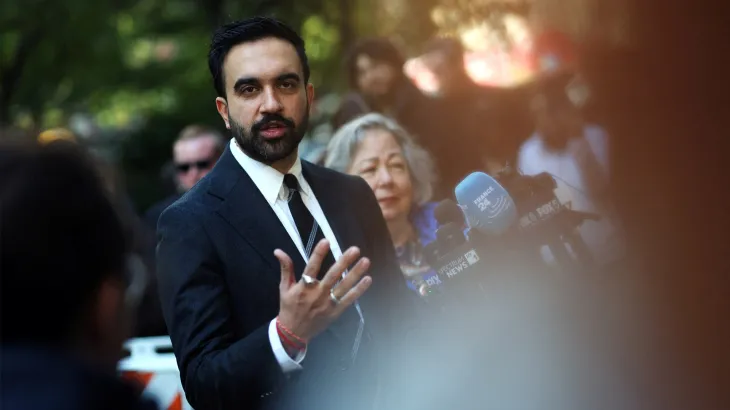
Zohran Mamdani
New York faces a historic turning point: 34-year-old Mamdani, a Democratic socialist of African and South Asian heritage, is running for mayor with a platform of economic justice focused on affordable housing, free public services and redistribution.
His rise symbolizes the energy of a generation shaped by civil rights movements, but at the same time intensifies tensions, especially within the city’s large Jewish community, because of his steadfast support for Palestinian rights and criticism of the State of Israel. To some progressives he is a figure of hope; to his opponents, a herald of disruption of the economic establishment and fragile inter-community balances.
Born in 1991 in Kampala, Uganda, Mamdani moved to New York at age seven. His mother is Indian film-director Mira Nair and his father is academic Mahmood Mamdani. He attended public schools and studied African Studies at Bowdoin College. As a child of immigrants and a second-generation Muslim, he developed early social awareness and activism. Among other things, he co-founded Students for Justice in Palestine at his university.
He engaged with art, specifically film and rap, but political activism kept returning. He became a U.S. citizen in 2018.
Professionally, he served on the front line of the housing crisis as a housing-counsellor in Queens, helping vulnerable homeowners avoid foreclosures and evictions. This experience convinced him that the housing crisis is the result of policy decisions, not a “natural phenomenon”. Thus, in 2020 he was elected to the State Assembly for neighbourhoods in Astoria, becoming the first man of South Asian descent, the first Ugandan-born member, and only the third Muslim in that body.
Since January 2021 he has joined the progressive wing of the Democrats, as a member of the Democratic Socialists of America. His key priorities: economic justice, workers’ rights, affordable housing. A signature success is his contribution to the regulation that erased about $450 million of taxi-medallion debt in New York, after the collapse in medallion values.
Legislatively he pushed the Good-Cause Eviction law (right to lease renewal for significant cause) and pressed for measures against unjust evictions; although at the state level he met obstacles, his agenda influenced later municipal regulations. He backed the Public Power movement for a stronger public role in energy and defended New York as a “sanctuary city” for undocumented immigrants.
In the mayoral race he is promoting a cost-of-living support program for workers: freezing rents on rent-regulated apartments (appointing a pro-tenant majority on the Rent Guidelines Board so that increases are zero%), free bus transport, universal municipal childcare from six weeks old, creation of municipal grocery stores, mass production of affordable housing and higher taxation on billionaires and large corporations.
Mamdani aligns with Bernie Sanders (“I care about what workers need, not what billionaires want”). His alliances include Alexandria Ocasio‑Cortez, labour unions and progressive organisations.
He faces the centrist Democratic establishment led by Andrew Cuomo, who has accused him of inexperience and “communications without substance”. The party leadership in New York (Governor Kathy Hochul, Congressman Hakeem Jeffries, Senator Chuck Schumer) has kept its distance, unlike Sanders who simply greeted him as a model for Democrats. This confrontation sums up the intra-party rift: radical social agenda vs pragmatism and ties with business circles.
If implemented, his platform signals a shift toward a “social-democratic” metropolis: stronger public services, tighter market regulation, redistribution. On housing, the slogan “Freeze the rent” moves a city where most are renters. Four years at 0% would give households with disproportionate rent burdens a breath of relief, especially in neighbourhoods like Astoria. Owners and developers, however, warn of reduced investment and asset degradation.
Mamdani counters with the “right to decent housing”.
On transport, free buses would reduce daily costs for low-wage earners. Universal childcare would ease burdens on families and, he argues, boost women’s labour-market participation. Overall, the programme is framed as “redistribution of dignity”: basic goods, housing, food, transport, care, made affordable for everyone.
Realistically, funding his announcements is considered highly doubtful. Independent estimates show that his proposals, from rent freeze and free transport to education and building 200 000 affordable homes, would cost over $5–10 billion annually, with the free buses alone requiring about $652 million per year. The housing build is estimated to exceed $100 billion over a decade.
In contrast, the proposed 2 % tax on incomes above $1 million would yield just about $4 billion, leaving a huge fiscal gap. Experts warn that such a package could balloon the city’s debt, forcing New York to cut services or borrow at levels that would threaten its fiscal stability.
Also, on public safety, Mamdani has indeed distanced himself from extreme “Defund” slogans, but proposes a reshaping of roles: a new Department of Public Safety with social workers and health-care staff to handle much of the calls, aimed at prevention and tackling the social causes of crime.
The success of a declared socialist in a flagship Democratic metropolis, even under the Trump presidency, has national weight. The progressive wing sees it as a path to reconnect with the working class; centrists fear alienation of moderate voters. Conservative media and Republicans “nationalise” Mamdani as an example of “far-left New York”, a mobilising tool in other states.
Thus, his mayorship would function as a large-scale experiment: can a strongly progressive agenda coexist with the viability of the USA’s “financial capital”?
At the same time, there is a strong symbolic component: he would be New York’s first Muslim mayor, a product of political empowerment of Muslim communities that organised and gained voice. The message of inclusion coexists with polarisation: Mamdani presents himself as “Trump’s worst nightmare”, i.e., progressive Muslim immigrant who claims redistribution of power and resources.
Metropolitan New York hosts more than a million Jews, from ultra-Orthodox to secular progressives. Mamdani’s candidacy, the most openly pro-Palestinian politician to come so close to the mayoralty, triggered strong reactions: eminent rabbis publicly warned that he constitutes a “danger” for the community, citing his support for BDS, the rejection of the “Jewish state” definition for Israel and failure to clearly condemn some violent slogans. Media also highlighted his harsh comments on Netanyahu.
But the picture is not uniform. Younger and “progressive” Jews, in organisations like Jews for Racial and Economic Justice (JFREJ), see Mamdani as an ally in social issues (housing, equality) and a moral stance for Palestinian rights, without antisemitism. Private meetings of his with synagogues of the Reform movement took place with mutual listening: there he committed to strengthening hate-crime and antisemitism programmes.
In terms of polls, the picture changes with time: a recent survey showed impressively high support for him (especially under-44s), while later indications suggest majority preference for a rival among Jewish voters. In any case, there is no “crushing majority in his favour”; on the contrary, the Jewish community appears divided by age, religiosity and geography (liberal neighbourhoods vs ultra-Orthodox cores in Brooklyn).
What matters is that his candidacy opened internal debate within the Jewish community: what does “liberal Zionism” mean after the war in Gaza? How is the struggle against antisemitism balanced with criticism of the Israeli government? And how does a symbolic city position itself when its likely mayor identifies with the Palestinian rights side of one of the most polarising international issues?
Mamdani embodies a bold promise: a New York that is fairer, where basic goods do not depend entirely on the market. At the same time he provokes existential concerns for the economic establishment and the Democratic centre that see risk for investment, tax revenue and moderate electorates. His relation with the Trump-era federal government, should conflict arise on immigration and other topics, will be an additional field of tension.
A crucial question: can he translate his radical narrative into effective governance without disrupting the city’s functioning? Will he maintain his multi-constituency alliance against organised resistance from economic interests? And how will he balance protection of minorities (including Jews) with his public stance on one of the most divisive international issues?
If elected, Mamdani’s mayoralty will act as a large-scale experiment: can a metropolis like New York combine a dynamic economy with deep social policy? Can a progressive agenda endure pressures of markets, property lobbies and federal confrontation? And in the sphere of minorities, can New York serve as a model of coexistence when its leader challenges entrenched doctrines on the Middle East?
Whatever follows, one thing is clear: Zohran Mamdani has already transformed the mayoral race into a referendum on the future of “progressive” politics in the United States, and its outcome will influence far beyond the boundaries of the five boroughs.
Related Topics
Related Posts