
Who Says My Vote Is Wasted?
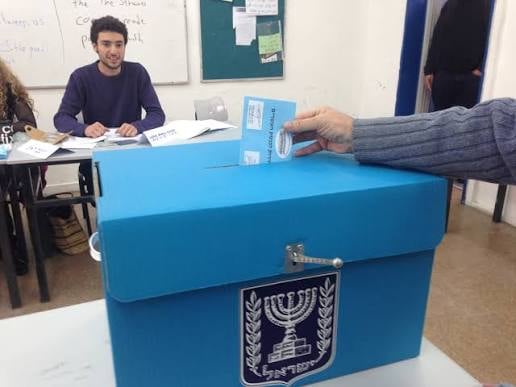
An oleh chadash discovers that casting an Israeli ballot requires political convictions—and a little electoral mathematics.
I am about to vote in another Israeli election, and I have a confession to make.
I still don’t completely understand how I am supposed to vote.
That may sound strange coming from someone who has spent the past several months writing a series of columns trying to explain Israeli politics to American readers. But perhaps that is precisely the point. The more I learn about Israel’s electoral system, the more I realize that casting a ballot here is not quite as simple as voting for the party that best represents what you believe.
You also have to calculate.
And lately one phrase keeps turning up: “Don’t waste your vote.”
I should say where I’m coming from. I am a Religious Zionist. Politically, I am on the right. There are issues on which I may disagree with this politician or that one, but there is little mystery about which side of Israel’s political divide I inhabit.
So you would think my voting decision should be simple.
It isn’t.
Israel requires a party to receive at least 3.25 percent of the valid vote before it receives a single seat in the Knesset. A party can receive tens of thousands—indeed, more than 100,000—perfectly valid votes and still wind up with no representation whatsoever.
That is where the warnings about “wasted votes” come from.
And sometimes the warning is entirely legitimate.
Ofer Winter, for example, has attracted considerable support on the right. But the final polls before Election Day put his party below the electoral threshold. A right-wing voter who chooses Winter therefore has to confront a genuine possibility: His candidate may receive his vote, but his political camp may receive no Knesset seat from it.
That is a real electoral calculation.
But then consider Bezalel Smotrich.
For months we heard warnings that Smotrich and Religious Zionism might not cross the threshold. There were polls in which his party was indeed in danger. Prime Minister Benjamin Netanyahu repeatedly warned about fragmenting the right and losing votes to smaller parties.
Fair enough.
But elections eventually arrive, and polls change.
The final polls now have Smotrich comfortably crossing the threshold, with Religious Zionism projected to receive roughly six to eight seats.
So if I prefer Smotrich to Likud, exactly how is my vote for Smotrich being “wasted”?
It isn’t.
At least not according to the very polling that everyone has been telling me to take seriously.
And that raises a question every voter—not merely every new immigrant—ought to ask when someone tells him that his intended vote will be wasted:
Wasted according to whom?
There is an enormous difference between electoral arithmetic and political salesmanship.
If a party is polling at two percent the weekend before an election, its supporters have a difficult decision to make. They can vote their convictions knowing there is a substantial possibility that their ballots will produce no Knesset representation.
But if a party is polling at six, seven or eight seats, the argument changes.
Then “Don’t waste your vote” begins to sound suspiciously like “Don’t vote for the party you prefer. Vote for mine.”
That isn’t mathematics. That’s campaigning.
Perhaps I notice this more because I came to Israeli politics from America.
The United States has its own version of the wasted-vote argument. People are constantly told that a vote for a third-party presidential candidate is really a vote for whichever major-party candidate they dislike most.
But Israel has institutionalized the problem. Here the electoral threshold can literally erase a party from parliamentary representation.
And because coalitions determine who governs, four seats disappearing on the right or left can conceivably change the identity of the next prime minister.
So strategic voting isn’t foolish. Sometimes it is essential.
But neither should “strategic voting” become an excuse for the largest parties to frighten everyone else into line.
There has to be some room left in democracy for voting for what you actually believe.
That is particularly important on the Israeli right, where differences among Likud, Religious Zionism, Otzma Yehudit and other parties are not imaginary. They have different leaders, different priorities and different approaches to security, religion and state, settlements, judicial power and the future of Gaza.
If those distinctions did not matter, there would be no reason to have separate parties in the first place.
So I have developed my own two-part test as Election Day approaches.
First: Which party most closely represents the Israel I want?
Second: Is there credible evidence that the party is actually in danger of failing to enter the Knesset?
If the answer to the second question is yes, then I have a difficult strategic decision to make.
But if the answer is no, I am increasingly reluctant to let somebody else tell me that voting my convictions constitutes throwing away my vote.
Maybe that is another stage in becoming Israeli.
An oleh learns Hebrew. He learns the bureaucracy. He learns when Israelis really mean “five minutes.” Eventually he even figures out which supermarket line is moving fastest.
And then comes the advanced course:
Israeli election mathematics.
On Tuesday I will walk into a polling station and choose one little slip of paper from among a bewildering collection of letters.
I know which side I’m on.
Now I just have to decide whom on my side I actually want to vote for.
And I think I’ve finally figured out one thing.
A wasted vote isn’t necessarily a vote somebody else doesn’t like.