
Bridging faith. Defending truth. Confronting hate
Why Antisemitism Feels True
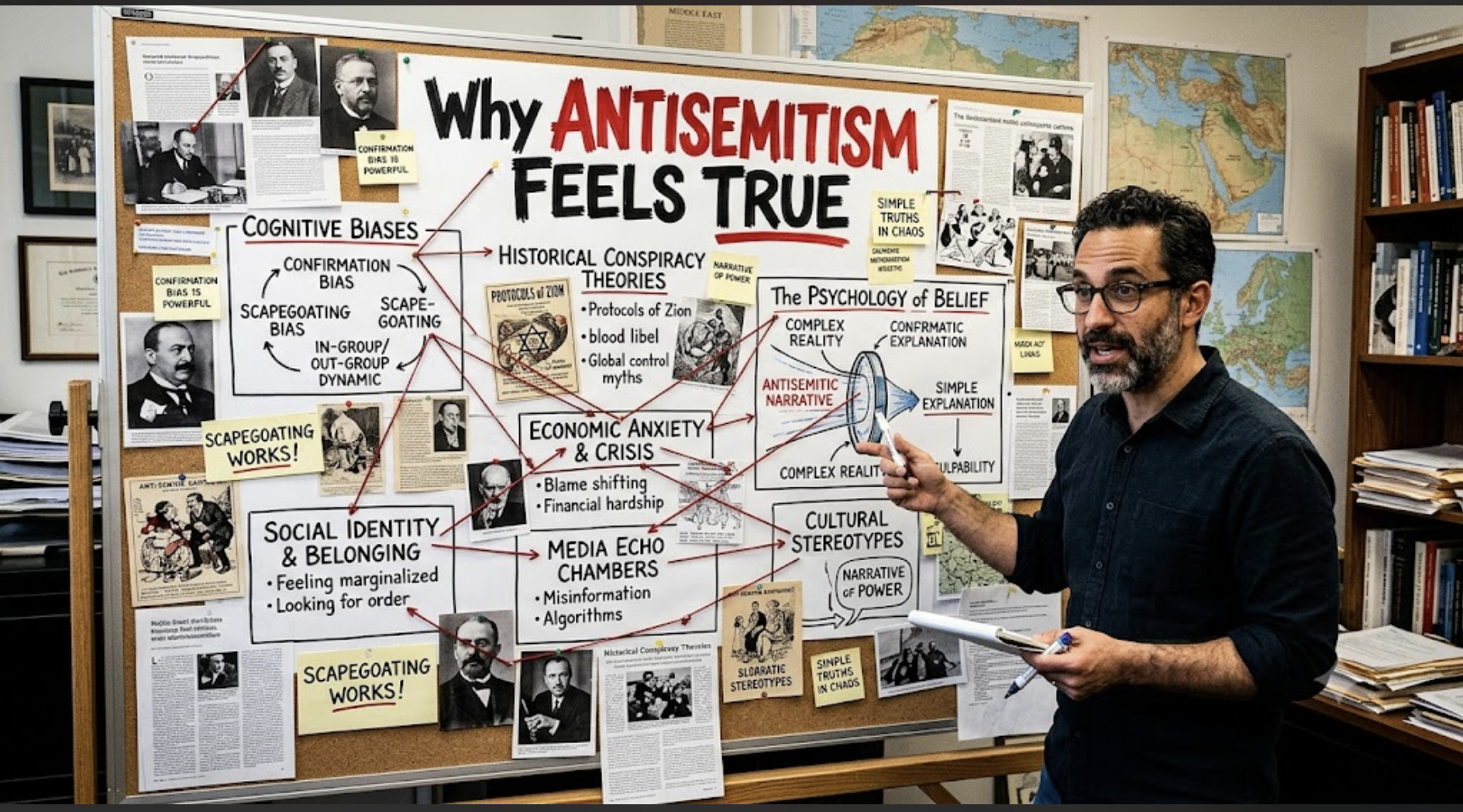
Image created from Google Gemini by Tim Orr
The deeper question is not simply why antisemitism appears, but why so many people have found it persuasive. Most people do not see themselves as motivated by hatred. More often, they believe they are defending something valuable—a community, a nation, a set of ideals, or a vision of justice. Antisemitism rarely presents itself in the language of hostility. It presents itself as a way of seeing what others have missed. People come to believe they have uncovered a hidden truth, exposed a concealed threat, or recognized the real cause of society’s problems. In that sense, antisemitism does more than identify an enemy. It turns suspicion into a duty and convinces people that distrust is a form of moral responsibility.
One of the most troubling things about evil is that it changes what people notice. The issue is not simply that they begin calling good things bad and bad things good. They begin paying attention to different things altogether. Facts that reinforce the story become highly significant. Facts that complicate it begin to fade into the background. Reality is still being observed, but it is being filtered through a lens that increasingly determines what can and cannot be seen.
Imagine a man who becomes convinced that his neighbor is stealing from him. At first, the evidence seems minor: a tool he cannot find, a package that never arrived, something that feels slightly out of place. Each incident appears to confirm the suspicion. Before long, he begins interpreting everything through that lens. A missing item is no longer an oversight. A misunderstanding no longer seems innocent. Events that once appeared unrelated begin to form a pattern in his mind. The suspicion starts to organize reality around itself. Even the neighbor’s attempts to clear things up begin to look suspicious. The problem is no longer the individual events themselves. It is that they are all being interpreted through a conclusion that was accepted beforehand. Once that happens, certainty tends to feed on itself. The more convinced he becomes, the harder it is for him to imagine that he may have been wrong from the start.
What begins as a mistaken conclusion eventually affects more than how events are interpreted. It also changes how people respond when that conclusion is challenged. Once this happens, correction becomes difficult. Every healthy society depends upon institutions, traditions, and habits capable of challenging its assumptions. Criticism serves a necessary function because it exposes blind spots that would otherwise remain hidden. But when criticism is automatically interpreted as hostility, one of the primary mechanisms of self-correction begins to fail. The issue is no longer whether a particular criticism is true. The issue is that criticism itself loses legitimacy.
The deepest danger is not simply that people come to believe things that are false. The greater danger comes when people begin to lose the ability to tell the difference between what is true and what is not.
Antisemitism does not merely distort conclusions.
It distorts the standards by which conclusions are judged. Ideas that should be tested are treated as beyond question.
Doubt becomes suspect. Caution is mistaken for weakness. At that point, the problem is no longer limited to a particular belief. The habits of judgment that help people correct their mistakes begin to break down.
Think of a navigator crossing unfamiliar waters. As long as his compass is working properly, he can correct mistakes and adjust his course. But suppose the compass has been damaged and is drifting slightly off true north without his knowing it. Nothing about his decisions will seem irrational. In fact, he may be carefully checking his bearings and doing exactly what he believes he should do. Yet each correction moves him farther from where he intends to go. The problem is that the instrument he trusts is no longer giving reliable guidance. The farther he travels, the more difficult it becomes to recognize how far off course he has drifted.
The same danger exists within societies. A community can continue making decisions with complete confidence even after the standards guiding those decisions have begun to drift. The result is more than prejudice. It is a shrinking capacity for self-correction. A society becomes trapped inside explanations that preserve its confidence while pulling it further away from reality.
When that capacity weakens, explanations are no longer judged primarily by whether they are true, but by whether they preserve the story people already believe. Once judgment is distorted, explanations no longer need to be plausible. They only need to preserve the sense that someone is responsible. This is one reason antisemitism keeps reappearing in such different forms. It does not depend on any single set of arguments. As older explanations lose their credibility, new ones take their place. In one era, Jews are portrayed as enemies of religion. In another, they are portrayed as enemies of science, the nation, or humanity itself. The accusations change with the times, but the basic impulse remains. Again and again, people come to see suspicion as wisdom, exclusion as responsibility, and hostility as a defense of what is good.
Once a society begins sorting people into those who are helping history reach its destination and those who are standing in the way, its moral vision can start to change. Things that once seemed obviously wrong begin to look necessary. Exclusion can be defended as prudence. Suppression can be described as responsibility. Few people consciously decide to abandon their principles. More often, they convince themselves that unusual circumstances require unusual measures. The shift is usually gradual. The real danger arrives when people no longer notice that a shift has taken place at all.
At that point, antisemitism is doing more than expressing hostility toward Jews. It has become a way of explaining why things have gone wrong. Jews may remain the object of suspicion, but the deeper consequences are felt by the society that embraces the explanation. When people become accustomed to blaming hidden enemies for their disappointments, the habit of self-examination begins to fade. Questions that might have led to reflection are pushed aside. Criticism starts to sound like disloyalty. Doubt is treated as weakness rather than intellectual honesty. Over time, a false explanation of one problem becomes a false way of thinking about many others.
The damage is easy to miss because it does not appear all at once. Most societies get things wrong from time to time. The difference is that some retain the ability to learn from those failures while others do not. A healthy society can admit mistakes, rethink old assumptions, and make corrections when reality proves it wrong. Antisemitism makes that harder because it provides an answer before the questions have been fully asked. If the source of every disappointment lies in an enemy, then there is little need to examine our own decisions, expectations, or beliefs. The accusation becomes a way of avoiding self-correction. The more persuasive the explanation seems, the less willing people become to consider that the problem might lie closer to home.
For that reason, the greatest danger of antisemitism is not simply that it spreads false accusations. The deeper danger is that it weakens a society’s relationship with reality. It encourages certainty where humility is needed and confidence where reflection is required. Over time, people become less interested in testing their beliefs than defending them. The line between what is true and what is useful begins to blur.
This helps explain why antisemitism often becomes attractive during periods of uncertainty, disappointment, or rapid change. Its appeal lies in the simplicity it offers. Problems that seem complicated suddenly appear easy to explain. Frustrations that have many causes are traced to a single source. The world becomes easier to understand because someone has been identified as the reason things have gone wrong. But that simplicity is purchased at a high price. A society may gain confidence in its explanation while losing the ability to understand itself.
Seen from this perspective, antisemitism does more than distort the way people think about Jews. It also distorts the way a society thinks about itself. Once people become convinced that the source of their problems lies somewhere else, they become less willing to examine their own assumptions, decisions, and failures. Blame becomes easier than reflection. The greatest loss is not only that innocent people are accused. It is that the sear
Related Topics
Related Posts