
Founder and CEO of OurCrowd
Why are Israeli stocks hitting record highs under fire?
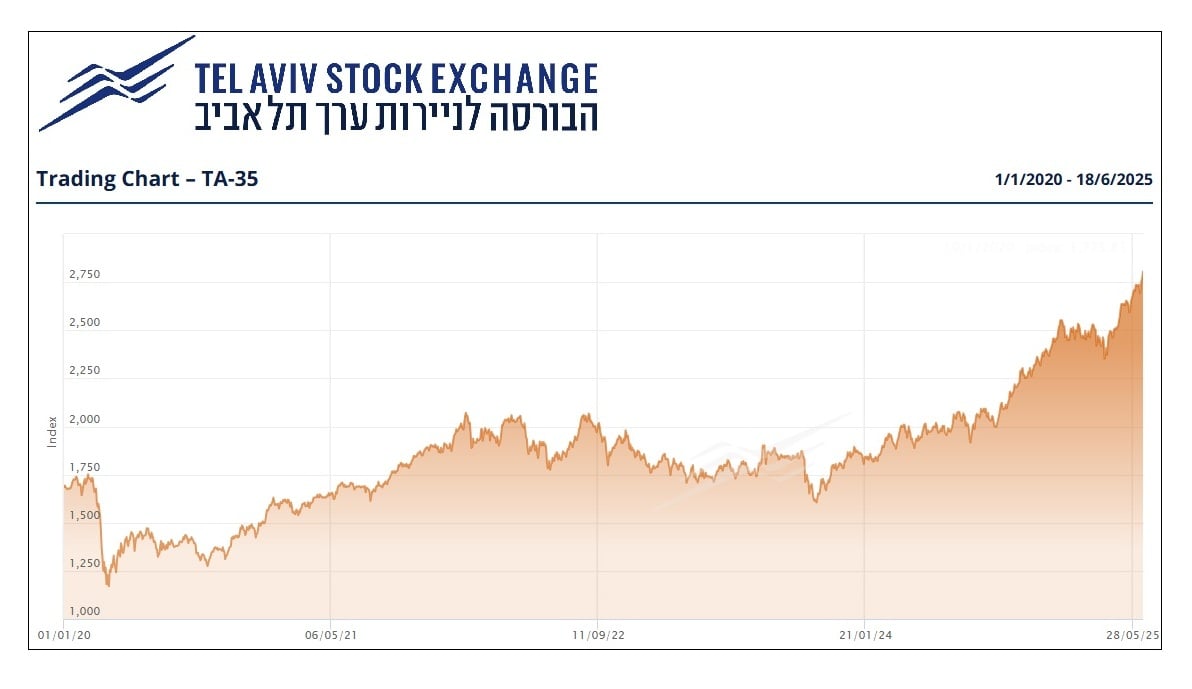
The TA-35 stock index is at all-time high. (Tel Aviv Stock Exchange)
Iran has launched hundreds of deadly ballistic missiles and explosive drones against Israel during the past week, triggering air-raid alerts across the country and closing Israel’s international airports.
But, perhaps counter-intuitively, after an initial drop, the Tel Aviv Stock Exchange TA-35 Index has bounced back to a record high and continues to climb.
How can we explain such an extraordinary vote of confidence in the Israeli economy at this moment of extreme crisis?
Israel’s multi-layered anti-missile defense technology – including Iron Dome, with a command and control system developed by OurCrowd portfolio company mPrest – has intercepted every drone and about 95% of the missiles. But those that have slipped through the net, each carrying up to half a ton of high explosives, have killed dozens of people, lightly injured hundreds more, and destroyed many homes and buildings, including part of Soroka Hospital in Beersheba and the Bazan oil refinery complex in Haifa.
This year’s Cyber Week and AI Week in Tel Aviv have been postponed. But, as I told Yuliya Chernova at the Wall Street Journal, Israeli resilience remains high.
Israel’s tech sector is not hitting pause. Founders are showing grit, teams are focused, and we’re still seeing new investments close across sectors from AI to climate tech. Some international funds are taking a wait and see approach, but others view this as a time to double down. I expect investor interest in Israeli startups to stay strong, especially in cybersecurity, dual-use defense technologies, energy resilience, artificial intelligence, and emergency health.
Always have Paris
At the Paris Air Show this week, organizers took the extraordinary step of obscuring Israeli exhibition stands. The move backfired, highlighting the fact that the military hardware on display was at that moment being battle tested live in Tel Aviv and Tehran.
I also know from personal experience that investors are impressed, not intimidated, when they see Israeli technology responding and winning against external threats.
In November 2012, I was showing two of our first US investors around Tel Aviv, introducing them to some of the stars of Israel’s startup landscape. I wasn’t worried about taking my guests to Tel Aviv because the city had not come under fire for more than 20 years.
After a successful afternoon with some impressive young entrepreneurs, we were on the highway back to Jerusalem when the eerie wail of air raid sirens sounded overhead, announcing the start of the first ever Hamas rocket attack on Tel Aviv.

I pulled over to the hard shoulder and directed my guests to lie down in the dirt by a wall as Israel’s Iron Dome defense system soared into action. We felt the sickening impact as three of the rockets fired by Hamas exploded a couple of miles from where we were taking cover.
After the skies fell silent, my guests picked themselves up from the ground, brushed off their Armani and Zegna suits, and climbed back into the car. When I arrived the next day, I opened my mouth to speak but one of them stopped me short.
“Jon, we must tell you that we’ve decided not to invest a million dollars. After what we went through yesterday, we’re going to invest two million dollars. If those guys from Hamas think they can intimidate us, they’ve never met a real New Yorker.”
But the soaring stock index also points to something bigger.
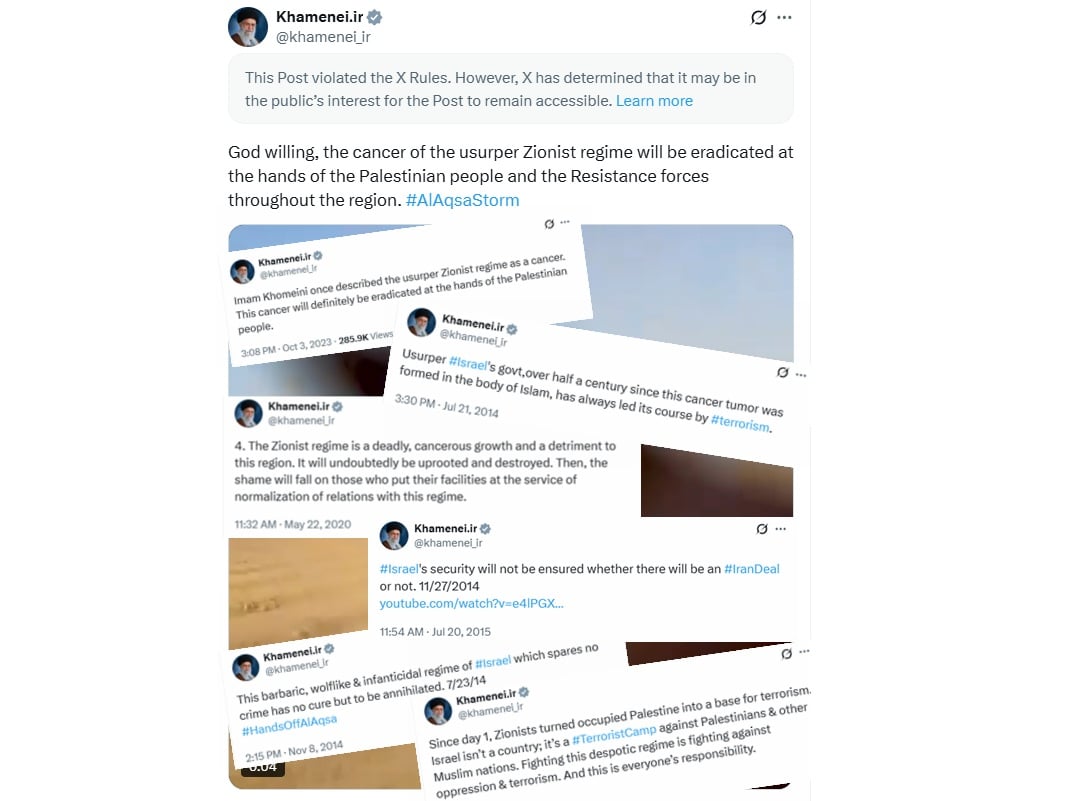
The Iranian regime has made no secret of its desire to wipe Israel off the map. Fired by an extreme theology that casts Jews as the descendants of apes and pigs, Supreme Leader Ayatollah Khamenei says Israel is “a long-lasting virus” and “a deadly, cancerous growth” that should be “annihilated,” “eradicated,” “eliminated,” “uprooted and destroyed.” The Islamic Republic turned its back on thousands of years of Persian-Jewish friendship and began preparing for the physical obliteration of Israel.
Tehran is nearly a thousand miles from Jerusalem and Iran shares no land border with Israel. There is no real dispute between the two countries, and at first the antagonism seemed comical – literally – with Tehran even hosting an annual Holocaust Cartoon Competition.
But the hatred soon turned deadly. Iran began to export its fiery revolution through the Islamic Revolutionary Guard Corps which trained, equipped and financed terrorist groups abroad, including Hamas, Hezbollah, the Yemenite Houthis and various Shia militia in Iraq. The Corps even played a crucial role trying to prop up the murderous Assad regime in Syria.
At the same time, the Iranian regime began racing to develop a nuclear bomb, spreading its weapons-grade uranium enrichment efforts and advanced centrifuge facilities across the country, together with the mass production of ballistic and hypersonic missiles capable of firing a nuclear bomb at Israel.
For the past 35 years, Israel has been the target of constant attacks by these Iranian-backed terror groups, while Iran’s leaders have openly called for Israel’s destruction while racing to achieve nuclear breakout. Just last week, the International Atomic Energy Agency found Iran non-compliant with its nuclear obligations.
New future
Since the Iranian-inspired assault by Hamas in October 2023, Israel has systematically destroyed the military infrastructure of Hamas, Hezbollah and the Houthis built by Iran. It now appears that Israel’s remarkable pre-emptive attack on Iran’s nuclear weapons facilities may finally put an end to the deadly threat that has overshadowed Israel for more than a quarter of a century. That may depend on the US providing the bunker-busting ordnance required to reach the fortified Fordow facility buried 80 metres beneath the Iranian hills.
The Iranian regime is not just a threat to Israel. Its pernicious influence is the main destabilizing factor across the Middle East, from Gaza to Iraq. But the peaceful people of the region are fighting back. Lebanon is finally throwing off Hezbollah’s deadly stranglehold. Even the new government of Syria, despite being led by former Jihadists, has severed ties with the murderous mullahs of Tehran.
I think investors in Tel Aviv are betting on the end of the Iranian threat and the removal of its dark nuclear shadow.
With Iran defanged and contained, Israel and its partners across Middle East have the chance to renew their efforts to achieve peace and prosperity for the entire region. If the victory to come is obvious and decisive, we hope the peacemakers will be equally courageous and creative in producing a new future for us all.
Related Topics
Related Posts