
Historian, Librarian, Educator, and Artist
Why Australia’s Antisemitism Feels Like a Warning
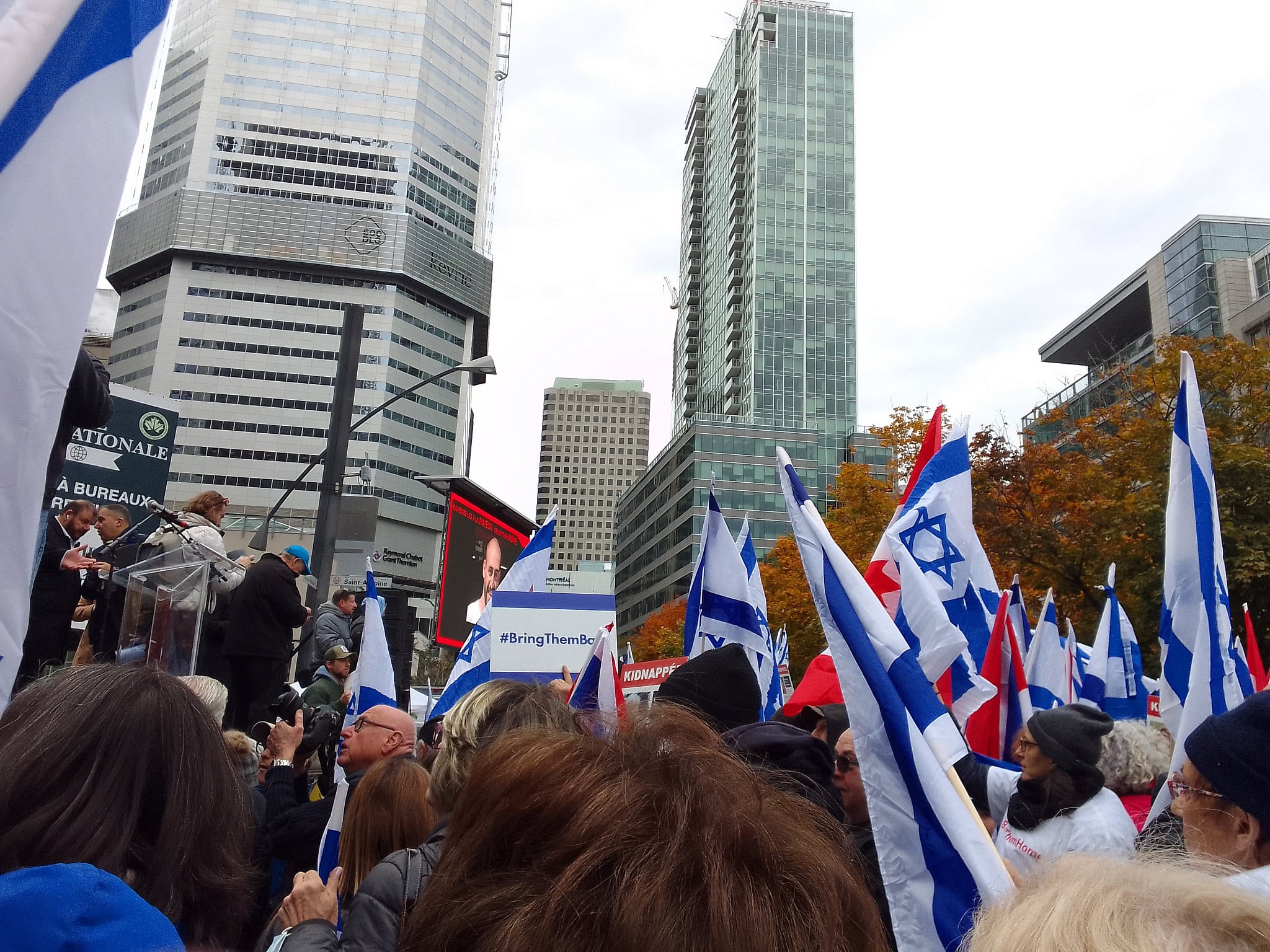
Participants gather at a pro-Israel rally in downtown Montreal in late October 2023, amid rising antisemitism and heightened security concerns for Jewish communities across Canada. (Photo: Bonnie K. Goodman)
What a violent attack in Australia exposes about Jewish vulnerability in Canada
An antisemitic attack targeting Jewish life in Australia just as the Jewish world was about to celebrate the first light of Hanukkah left a community shaken and once again forced a reckoning with how quickly political hostility toward Israel can translate into real-world danger for Jews far from the Middle East.
On Sunday, December 14, 2025, a violent attack targeted a public Hanukkah gathering and menorah lighting near Bondi Beach in Sydney, Australia. The reports described two gunmen, a father and son reportedly with ties to Islamic extremism, opening fire on families gathered for the holiday, with early accounts indicating that at least 16 people were killed, including a child, and over 40 more injured, including some seriously. Australian authorities characterized the incident as an antisemitic terrorist attack on Jewish communal life, and details continue to emerge.
What struck me most about these reports was not only their horror, but their familiarity.
From Jerusalem, Australia appears geographically distant, almost abstract — a place associated with beaches, prosperity, and a Jewish community long considered stable and well-integrated. However, viewed through a Canadian lens, the attack felt less like a shocking aberration than a warning flare. I have seen this progression before. I grew up inside it.
Canada and Australia share more than Commonwealth ties and parliamentary systems. They share a political temperament: a belief in moderation, civility, and moral balance; a confidence that extremism belongs elsewhere; and a tendency to frame national identity through narratives of reconciliation and restraint. Jews in both societies were encouraged to believe that antisemitism, while never eradicated, had been safely relegated to the margins.
That belief has proven dangerously optimistic.
Montreal: Deep Jewish Roots, Persistent Hostility
Montreal is home to one of the largest and oldest Jewish communities in North America. Jewish life there is not peripheral. It is historical, institutional, and deeply woven into the city’s cultural, economic, and intellectual fabric. And yet, year after year, Montreal records some of the highest levels of reported antisemitic incidents in Canada.
This contradiction is often explained away as statistical coincidence or the inevitable friction of urban diversity. For those living within the Jewish community, however, the pattern is unmistakable. Antisemitism in Montreal is not episodic. It is ambient.
Jewish schools and synagogues operate behind layers of security that would be unthinkable for most other religious communities. Community centers plan events with police coordination as a matter of routine. Acts of vandalism, intimidation, and harassment are familiar enough to be anticipated, yet insufficiently disruptive to prompt sustained public reckoning.
Each incident is condemned. Rarely are they connected.
What distinguishes Montreal is not only the frequency of antisemitic acts, but the ease with which they are absorbed into the background of civic life. Jewish concern is often reframed as emotional excess. Jewish requests for protection are interpreted as political sensitivity. The Jewish community is expected to be more patient, explain things, and be quiet than other groups.
The Ideological Climate in Quebec
Quebec’s larger political culture has a big impact on this situation. The province’s focus on secularism, national identity, and ideological consistency has led to a public sphere that is often uncomfortable with open Jewish particularism.
Only certain kinds of religious expression are allowed. Jewish symbols are scrutinized as political statements. Zionism is treated not as a legitimate political position but as a moral liability. Jewish identity becomes acceptable only when abstracted, privatized, or disavowed.
In this climate, antisemitism rarely presents itself as hatred of Jews. Instead, it manifests as exclusion — exclusion from protected categories, from acceptable expressions of grief, and from full participation in the moral consensus of public life.
October 7 did not introduce antisemitism into Quebec. It removed the remaining inhibitions around expressing it openly.
Universities as Accelerators, Not Exceptions
Nowhere has this shift been more visible than on Montreal’s university campuses.
Institutions such as McGill University and Concordia University are internationally celebrated as bastions of liberal inquiry. For many Jewish students and faculty, however, these campuses have increasingly become spaces of moral surveillance rather than intellectual openness.
Long before October 7, Jewish campus groups faced disruption, intimidation, and delegitimization tied to Israel-related discourse. They targeted Jewish speakers not for their arguments, but for their identity. Jewish students learned to self-censor, to preemptively qualify, to distance themselves simply to remain socially acceptable.
After October 7, these pressures intensified.
Expressions of Jewish grief were scrutinized or relativized. Calls for empathy were selectively applied. Jewish students were implicitly asked to prove their political acceptability before their safety concerns would be taken seriously. University administrations emphasized free expression while declining to articulate firm boundaries when Jewish students were targeted.
This equivocation is not neutral. It instructs. It signals whose safety is negotiable.
Defiance and Disruption: Hanukkah in Canada after Australia
In the day following the reported attack in Australia, Jewish communities across Canada responded not by retreating but by insisting on visibility. Public Hanukkah lightings went ahead as planned, framed explicitly as acts of resilience rather than uncomplicated celebration.
In Toronto, a major menorah lighting at Bathurst Street and Sheppard Avenue — long recognized as a symbolic heart of Jewish communal life — was repeatedly interrupted by pro-Palestinian counter-protesters across the street, according to Canadian Jewish News reporting. Jewish families gathered to mark a religious holiday under police presence, while demonstrators reframed the moment politically.
This dynamic has become increasingly familiar to Canadian Jews. Jewish ritual is no longer treated as culturally neutral. Even a Hanukkah menorah — a symbol historically associated with survival and religious continuity — is interpreted through a geopolitical lens. Visibility is reframed as provocation.
What matters here is not disagreement but displacement. Jewish public life is being recast as political by default, while hostility toward it is rationalized as protest.
From Australia to Quebec: A Structural Parallel
Seen through this lens, the connection between Australia and Canada is not rhetorical — it is structural.
The progression is consistent across borders. Anti-Israel rhetoric intensifies and is normalized. Jewish institutions are recast as political actors. Jewish fear is minimized. Jewish public space becomes contested. And when violence erupts — or when intimidation escalates — it is treated as shocking rather than foreseeable.
Australia, like Canada, has long imagined itself as a moderate exception: a society where pluralism functions smoothly and antisemitism remains containable. Quebec Jews know how fragile that assumption can be.
Recognition without Accountability
In this context, state-level gestures — such as the recognition of a Palestinian state that does not exist in any accountable governing form — take on heightened significance. These acts are often defended as symbolic, humanitarian, or necessary for diplomatic balance.
But symbols do not operate in a vacuum.
From a Canadian perspective, symbolic politics are familiar. Recognition without responsibility is often framed as moral progress. For Jewish communities already experiencing hostility, however, such gestures signal reclassification.
Israel becomes an abstract moral wrong rather than a concrete state. Jews become associated not with citizenship but with obstruction. Jewish security becomes conditional.
This does not cause antisemitic violence in a linear way. But it creates moral permission. It explains hostility rather than condemns it.
Antisemitism as Structure, Not Surge
What both Quebec and Australia reveal is that antisemitism today rarely arrives as a sudden eruption. It settles in gradually — through language, policy, and institutional habit.
Antisemitism no longer requires extremists. It requires consensus language. It thrives where moral clarity erodes quietly and where Jews are assured that exclusion is not personal even as it becomes systemic.
A Warning, Not a Footnote
The reports from Australia should not be treated as a distant tragedy. For Canadian Jews — especially those from Montreal — they read like a warning written in familiar ink.
The danger is not only physical violence. It is the steady normalization of moral ambiguity: the refusal to name antisemitism when it is embedded in respectable language, academic caution, or foreign-policy symbolism.
Antisemitism today does not always shout. More often, it speaks calmly, rationally, and with institutional confidence. It insists it is not about Jews — even as it narrows the space in which Jews can live openly.
Seen through a Canadian lens, Australia’s antisemitism is not foreign. It is instructive. And it is a warning that should be taken seriously — before familiarity hardens into inevitability.
For Israelis watching these developments from a distance, the lesson is sobering but clarifying: the diaspora’s vulnerability is not a relic of the past. It is being reshaped in real time by political language and institutional choices. October 7 did not isolate Israel — it exposed how quickly Jewish safety elsewhere can unravel when moral clarity collapses.
—
Sources
Canadian Jewish News. “Canadian Jews Hold Defiant Public Hanukkah Lightings After an Attack in Australia Kills 15.”
https://thecjn.ca/news/canadian-jews-hold-defiant-public-hanukkah-lightings-after-an-attack-in-australia-kills-15/
Friends of Simon Wiesenthal Center. Annual Reports on Antisemitism in Canada.
https://www.fswc.ca/
B’nai Brith Canada. Antisemitism Audit.
https://www.bnaibrith.ca/antisemitism-audit/
CIJA (Centre for Israel and Jewish Affairs). Campus Climate and Antisemitism Resources.
https://www.cija.ca/
Related Topics
Related Posts