
International affairs analyst
Why defense tech is attracting investors
Signature: f0sE5RznmRdweRuFlwOcYx1YEg0Vh6nUDePMZzEtTY1HM819VyLY/CLoWDViCno6CcmK23et5JgUikPmwrkRKAlDv9kc4dVrquEBJp253exZyHpE5Yvkv9rv2wqh/HHs+rUT+SbzanIgVQikJX17l7KBRIMu2+duA0cpwyUUyOjVtKTLRVEz+8rQsJIIHb+jaDEDmM7lauRJal5bRcIlBvJ2qojUwNMyY//CgOISFFkWpejX0Q4rj3JNGgCTpYlKWg/BMf7qDNg7k/nxTP1sELDPE5bIe8uiCDpfivTPyetLh+c59ppyxqqeypi+z2j5JkhhFlHJBH3JZf9ryM2kZRPyrOENvhupcC0Yldhnt4SV8keOO4OMZuKveQ/TTWwhlHbg8/yzeytVkjLY4e+E+m0Dr18TUIe7q/Zo4xIrLTGg4Ubdu/Vege9all9CmBk7qaJzRumxbYB7VO/abm68j6oZNx295pYX4tveK9iXrfqHL2METD16rcL0OX0WmTlbW4+hdk24YGxV+Xkux9R89g/5/5liVliUJI2FbWjgxiSSt/4PPCdiuYo26gMIjBIHUl7bfgDmQZV5uRkYeP8Ka8JPPmlTqWLfmtSoVb8CttrZH6lNl1yuvqpkkXcGEA/IDZbBBN/6QJFvKBcTeiBuPmPc9qaDHMMsAZYbYqIJyPY=
Mykhailo Fedorov has an unusual proposition for American investors. Ukraine’s former defense minister is seeking Western capital for a fund that would invest in Ukrainian defense start-ups while also creating companies of its own, taking technologies developed through years of war with Russia and turning them into businesses capable of operating at scale.
“This isn’t exactly a classic venture fund,” Fedorov told the Financial Times during a visit to Washington. “We’re writing a new history of the war.”
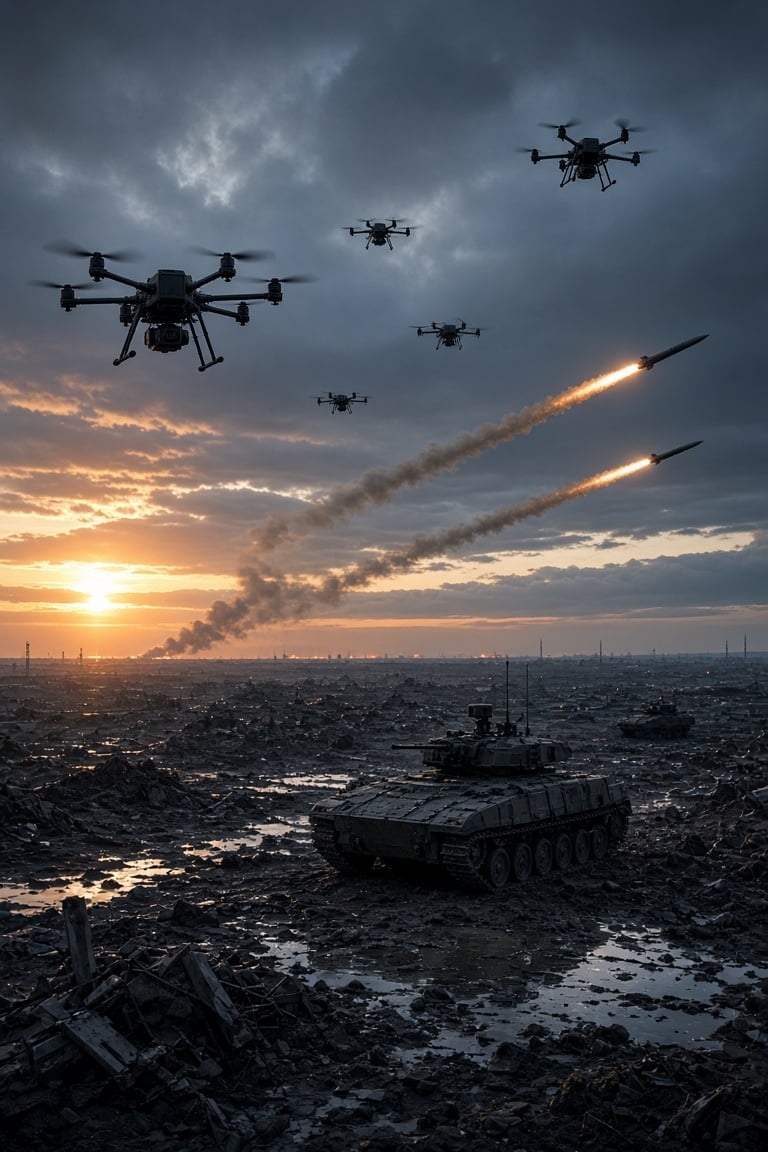
His choice of words may sound grandiose, but the model Fedorov is proposing captures a shift that has been taking place across the defense industry since Russia’s full-scale invasion of Ukraine. The technologies he has identified as priorities — battlefield robotics, inexpensive high-speed interceptor drones and low-cost AI-enabled missiles — belong to a generation of military systems whose development cycles, industrial structure and financing increasingly resemble those of the technology sector.
Ukraine has accelerated this process because necessity has forced innovation to take place at a pace rarely associated with military procurement. At the same time, advances in artificial intelligence, autonomous systems and software have made technological capabilities developed outside the traditional defense industry increasingly relevant to military power.
The combination is beginning to reshape how investors value the companies producing them.
A different kind of defense company
The change is particularly visible in the United States, where companies that would once have occupied a relatively narrow corner of the defense market are attracting valuations more commonly associated with high-growth technology businesses.
Anduril Industries, which specializes in autonomous systems and defense software, was valued at around $61 billion in June 2026, approximately 14 times its projected revenues for the year. Shield AI reportedly reached a valuation of $12.7 billion, equivalent to roughly 23 times expected 2026 revenues, while publicly traded Kratos Defense has also commanded multiples well above those usually associated with established defense contractors.
These valuations reflect expectations that go beyond the rise in defense budgets that followed Russia’s invasion of Ukraine. Traditional contractors have long offered investors an attractive combination of predictable government demand, high barriers to entry and contracts extending over many years. Their younger competitors offer something rather different: the prospect that technologies developed around software, autonomy and relatively inexpensive platforms can be improved rapidly, deployed across multiple applications and produced at growing scale.
There are obvious reasons for caution. Defense remains a peculiar market in which governments are usually the ultimate customers, procurement decisions are political as well as commercial, and security requirements limit the freedom enjoyed by ordinary technology companies. Many of the newer defense firms are still loss-making, meaning that current valuations depend heavily on assumptions about their ability to turn rapidly expanding order books into sustainable businesses.
Even so, the willingness of investors to accept those risks points towards a broader reassessment of what a defense company can look like.
Ukraine shortens the innovation cycle
The war in Ukraine has provided unusually fertile conditions for that reassessment. Over more than four years of full-scale conflict, Ukrainian and Russian forces have repeatedly adapted drones, electronic warfare systems, communications, sensors and software in response to changes introduced by the other side. The result has been a cycle in which technological advantage is often temporary and adaptation becomes almost as important as the original capability.
This creates pressures very different from those surrounding traditional weapons programs. A drone or software system deployed at the front may encounter a new form of electronic warfare, forcing developers to alter its navigation, communications or targeting systems. The revised version can then return to operational use, generating another round of feedback. The proximity between engineer and operator, and between production line and battlefield, has compressed processes that conventional defense procurement often measures in years.
Artificial intelligence makes this cycle still more consequential. As military systems become increasingly dependent on computer vision, autonomous navigation, sensor fusion and the rapid processing of battlefield information, improvements can come from changes in software as well as hardware. The military value of a platform therefore becomes less fixed at the moment it leaves the factory.
This helps explain why Ukraine’s wartime experience has economic value beyond the immediate requirements of its armed forces. Companies operating there have accumulated operational data and engineering knowledge under conditions that are impossible to reproduce fully in peacetime testing. A technology that survives repeated adaptation against an adversary attempting to disrupt or destroy it carries a form of validation that is particularly valuable in a defense market now searching for lessons from the Ukrainian battlefield.
Fedorov’s proposed fund would effectively attempt to institutionalize this process. Rather than treating Ukrainian defense innovation primarily as an emergency response to the invasion, it would use Western capital to build companies around the technologies and knowledge produced by it.
AI changes the value of the weapon
The growing role of artificial intelligence extends the argument beyond drones. Modern military power remains dependent on expensive physical platforms, but their effectiveness increasingly rests on the software, sensors and networks that allow them to operate in complex environments.
AI can assist with identifying objects from large quantities of imagery, navigating when communications are disrupted, processing information from multiple sensors and shortening the time between detection and response. Its importance lies partly in the possibility of autonomy, but also in making existing systems faster and more adaptable.
This is one reason the distinction between the traditional defense industry and the newer defense-tech sector can be misleading. They are becoming increasingly interdependent.
Fedorov’s offer to help the United States develop an “army of drones” in return for additional Patriot interceptors illustrates the point particularly well. Ukraine needs sophisticated and costly air-defense systems produced through established industrial structures, while simultaneously seeking cheaper interceptor drones and AI-enabled missiles that can be manufactured in much larger numbers.
The economics of the two systems are very different, yet contemporary warfare increasingly requires them to operate alongside one another. As militaries seek greater mass without abandoning high-end capabilities, technologies that can provide military effects at lower unit costs become more attractive. When those technologies can also be improved through software and produced by companies operating on shorter development cycles, they become attractive to a different class of investor as well.
From wartime necessity to an investment thesis
The scale of the opportunity is one reason capital has begun to follow. The global military drone market is estimated at around $45 billion in 2026 and could reach $180 billion by 2035, according to figures cited by Il Sole 24 Ore. European defense spending is also expanding, creating a larger market for autonomous systems and encouraging established contractors to move further into technologies pioneered by younger companies.
The important question for investors is whether Ukraine has produced a temporary wartime phenomenon or revealed a more durable change in the structure of military demand.
Evidence increasingly points towards the latter. Governments have discovered the importance of combining exquisite platforms with systems that can be produced in large numbers and replaced relatively cheaply. Militaries are learning that software updates and access to data can influence combat effectiveness almost as much as improvements in hardware. The rapid evolution of AI is likely to reinforce both trends, particularly as autonomy moves from experimental programs into increasingly routine military applications.
None of this suggests that the large defense primes are about to be displaced. Building combat aircraft, submarines, missile defenses and other complex systems still requires industrial capacity, engineering expertise and capital on a scale that few newcomers can reproduce. What is changing is the ecosystem around them, as technologies originating in the software and start-up worlds become more deeply embedded in military capability and private capital becomes increasingly willing to finance their development.
Fedorov’s initiative is revealing because it takes this logic one stage further. His fund would seek to convert battlefield experience directly into company creation, using private capital to scale technologies developed under wartime pressure and then offering the resulting capabilities to a broader defense market.
Ukraine became a laboratory for this model through necessity. The more consequential development may now be its spread beyond Ukraine, as governments, technology companies and investors begin to treat the lessons of that laboratory as the foundations of a new defense economy.
Related Topics
Related Posts