
Why Do Anti-Zionism and Anti-Capitalism Go Hand in Hand?
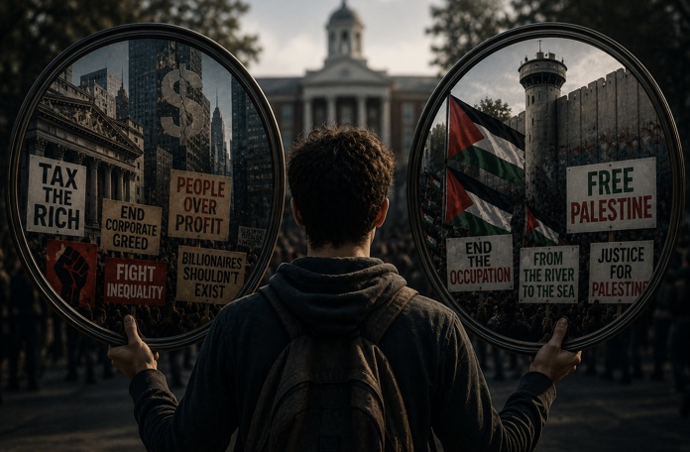
Since October 7, anti-Israel activism has become one of the most visible political movements on American campuses. Yet one pattern stands out: many of the same activists, influencers, and political figures leading anti-Israel campaigns are also among the strongest critics of capitalism.
Coincidence? Or part of a larger pattern?
At first glance, opposition to Israel and opposition to capitalism appear to be separate causes. One concerns a conflict in the Middle East. The other concerns economic systems and wealth distribution. Yet the more closely one looks, the more often they appear side by side.
Like an optical illusion, what first appears to be two different images may reveal a deeper connection when viewed from a wider perspective.
Part of the answer begins with a profound generational disillusionment. Many young Americans see a different reality from their parents. Their parents bought homes, started families, and entered the middle class at an age when many young adults today are still struggling to achieve those milestones. At the same time, the most desirable jobs are often concentrated in major metropolitan areas, where living costs continue to rise faster than wages.
For many, the frustration is not simply economic, nor does it emerge from a vacuum. They were told that education, hard work, and talent would provide the same opportunities previous generations enjoyed. Instead, many feel they are working harder for fewer rewards, leading some to question whether the American Dream still holds. This perception is supported by a striking trend: while roughly 90 percent of Americans born in the 1940s earned more than their parents by age 30, only about half of those born in the mid-1980s achieved the same milestone.
For a growing number of young Americans, capitalism appears less as a pathway to prosperity and more as a system that benefits those who already possess wealth, influence, and power. Rather than viewing it as an opportunity to build prosperity through talent, innovation, and hard work, many have come to see it as a system that exploits ordinary people while rewarding those at the top.
When people lose faith in the system, they begin searching for simple explanations for complex problems.
In such an environment, narratives built around categories of oppressors and the oppressed become particularly attractive. The world is no longer viewed as a collection of separate disputes. Instead, many issues are filtered through the same moral framework.
In that framework, corporations exploit workers, billionaires benefit from inequality, and Western powers dominate weaker societies. Israel is often portrayed as an extension of American influence in the Middle East and therefore associated with the same power structures many activists already oppose. Once politics is interpreted through this lens, opposition to capitalism and opposition to Israel become mutually reinforcing rather than separate causes.
This overlap is visible among influential political and cultural figures. Politicians such as Zohran Mamdani and commentators such as Hasan Piker have built large audiences around criticism of capitalism, ruling elites, and established institutions while also becoming prominent voices of anti-Israel activism. Their popularity reflects the growing appeal of a worldview that links economic inequality, political power, and global conflicts into a single moral framework.
Social media has accelerated this trend by rewarding outrage, moral certainty, and simplified explanations. These ideas have also been reinforced by foreign soft power initiatives. Qatar, for example, has invested heavily in American universities as part of a broader strategy to expand its influence. Anti-capitalist and anti-Israel narratives fit naturally within this environment because both challenge existing power structures.
Importantly, this phenomenon is not confined to one side of the political spectrum. The woke left expresses its distrust of the status quo through anti-capitalist and anti-colonial narratives, often portraying Israel as a Western outpost in the Middle East. The woke right channels similar distrust through anti-elite rhetoric and conspiracy thinking. The ideological paths differ, but both challenge the status quo and often converge in their hostility toward Israel.
Anti-Zionism and anti-capitalism are symptoms, not the disease.
The anger is no longer directed only at Israel. Nor is it directed only at capitalism. Increasingly, it is directed at the institutions, values, and systems associated with the modern Western order itself.
Like an optical illusion, the growing overlap between anti-Zionism and anti-capitalism may be the first image we see.
But when we step back, a larger picture emerges.
The deeper issue is not Israel alone.
It is not capitalism alone.
It is a growing crisis of confidence in the institutions and values that shaped modern Western society.
As a student and as a member of this generation, I do not believe October 7 created these trends.
It exposed them.