
Published author, Jewish educator and scholar
Why Do We Need A Jewish State? Insights from Parashat Ki Tavo
ChatGPT
Why do the Jewish people need a sovereign state?
Modern Zionism offered several powerful answers to that question.
Political Zionism, most famously associated with Theodor Herzl, argued that Jews needed a state because Jewish life in the Diaspora had become politically untenable. Antisemitism was not merely a social prejudice that could be overcome through emancipation and integration. Jews remained a vulnerable minority dependent upon the goodwill of others. Sovereignty would give the Jewish people political independence, physical security, and the ability to determine their own fate.
Cultural Zionism, associated especially with Ahad Ha’am, offered a different argument. The Jewish problem was not only physical insecurity but spiritual and cultural erosion. Assimilation threatened to drain Jewish life of its distinctiveness. The Land of Israel therefore needed to become a great Jewish cultural center—a place where Hebrew language, literature, learning, and creativity could flourish and radiate outward to Jewish communities throughout the world.
Labor Zionism, articulated in different forms by figures such as A. D. Gordon and the pioneers of the Second Aliyah, added yet another dimension. Centuries of exile had distorted Jewish economic and social existence. Jews needed to return to productive labor, work the soil, build communities, and create a healthy national society. Sovereignty would enable the Jewish people not simply to survive but to remake themselves.
Each of these visions captured something essential. But Parashat Ki Tavo suggests another answer.
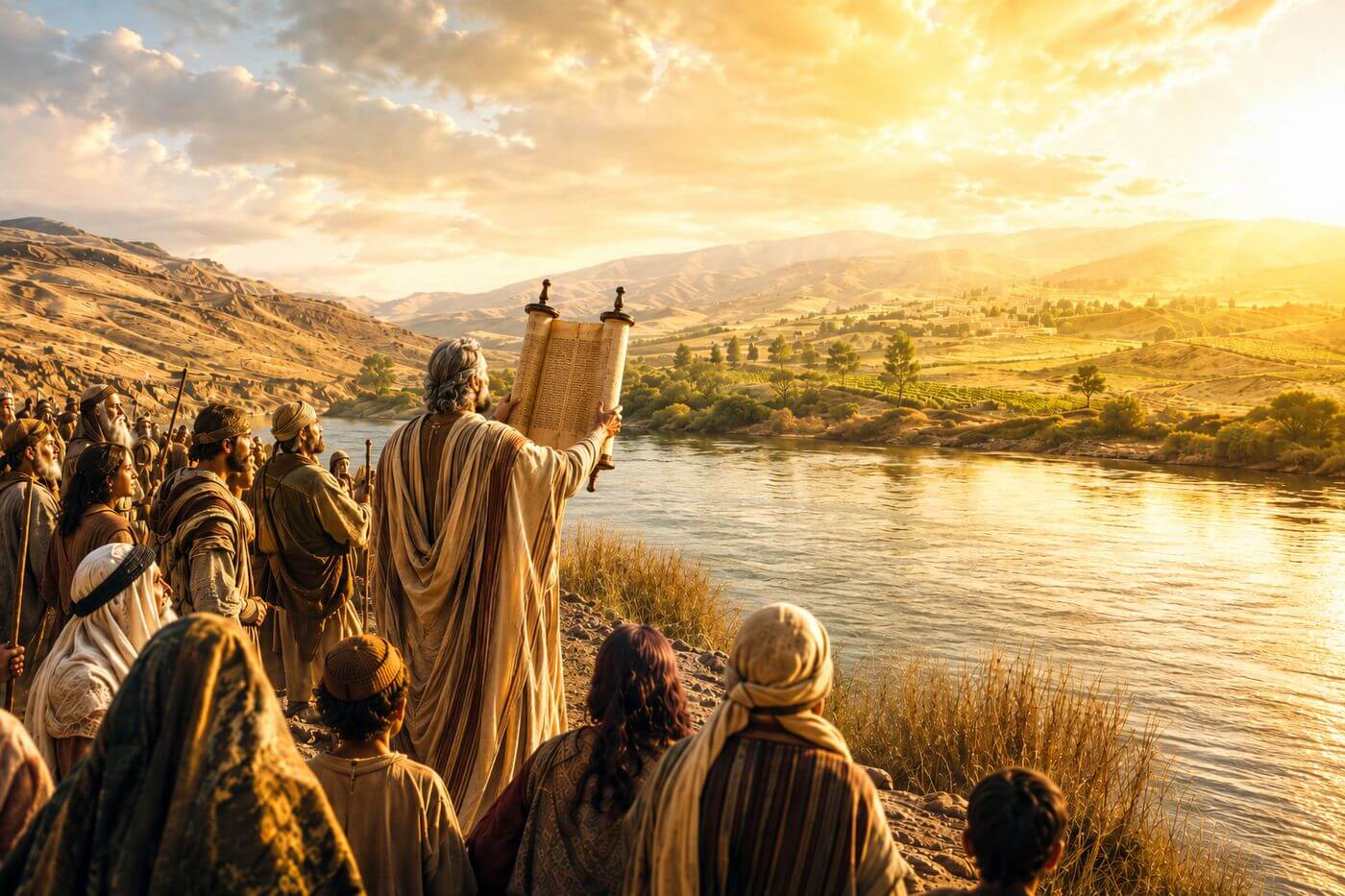
Moses tells the Israelites that after crossing the Jordan they must erect large stones, coat them with plaster, and: “Write upon them all the words of this Torah… when you cross over to enter the land that the Lord your God is giving you” (Deuteronomy 27:3).
The timing is striking. The Torah had already been given at Sinai nearly forty years earlier. Israel had carried it through the wilderness and lived according to its commandments. Why must the Torah now be written again precisely as the nation enters the Land?
Perhaps because something fundamental is about to change. Until now, the Israelites have been a wandering people. They have no permanent territory, no agricultural economy, no normal political institutions, and no sovereign responsibility for the organization of society.
Once they cross the Jordan, Torah enters an entirely new dimension. Now the Jewish people will have land to cultivate, cities to build, courts to administer, an economy to regulate, wars to fight, vulnerable populations to protect, leaders to restrain, wealth to distribute, and public institutions to create.
Precisely at that moment, the Torah must be written on stones.
The message is unmistakable: Jewish sovereignty is not merely about creating a safe place for Jews. It is about creating a Jewish society shaped by Torah.
Diaspora Judaism, through no fault of its own, could express only part of the Torah’s vision. Jews could build synagogues, observe Shabbat, keep kosher, study Torah, give charity, and construct remarkable communal institutions. But they could not determine the laws governing an economy, command an army, administer national justice, establish immigration policy, or decide how political power should be exercised.
Sovereignty changes the religious question. Instead of asking only, how does a Jew live according to Torah? we must also ask: How does a Jewish nation live according to Torah?
What does Torah have to say about the use of military power? What obligations does a wealthy society have toward its poor? How should workers be treated? What limits should be placed upon political leaders? What responsibilities do we bear toward strangers and minorities? What should justice look like when we—not some foreign ruler—control the courts and institutions of the state?
These questions have confronted the State of Israel since its founding, and they remain no less urgent today.
This also means that measuring Israel’s Jewish character only by the number of kosher restaurants, synagogues, yeshivot, or people observing Shabbat is inadequate. All of these are important. But they are only part of the Torah’s national vision.
A genuinely Jewish state must ask not only whether Jews are living Jewish lives but whether Jewish sovereignty itself is being exercised in accordance with Jewish values.
Herzl asked how Jews could become politically secure. Ahad Ha’am asked how Jewish culture could flourish. A. D. Gordon asked how the Jewish people could renew itself through labor and connection to the land.
Ki Tavo asks an additional and perhaps even more demanding question: What happens when the Torah itself crosses the Jordan?
The great religious opportunity of the State of Israel is not simply that Jews can practice Judaism there freely. It is that, for the first time in nearly two thousand years, we can ask what Torah looks like when it is responsible not merely for the life of the individual Jew, but for the life of an entire sovereign nation.
Shabbat Shalom.
For more insights on the parasha and current events in Israel, visit
https://davidharbater.com/parasha-current-events/
Related Topics
Related Posts