
Israel as a global geostrategic axis
Why don’t Arab parties declare Hamas a terrorist group?
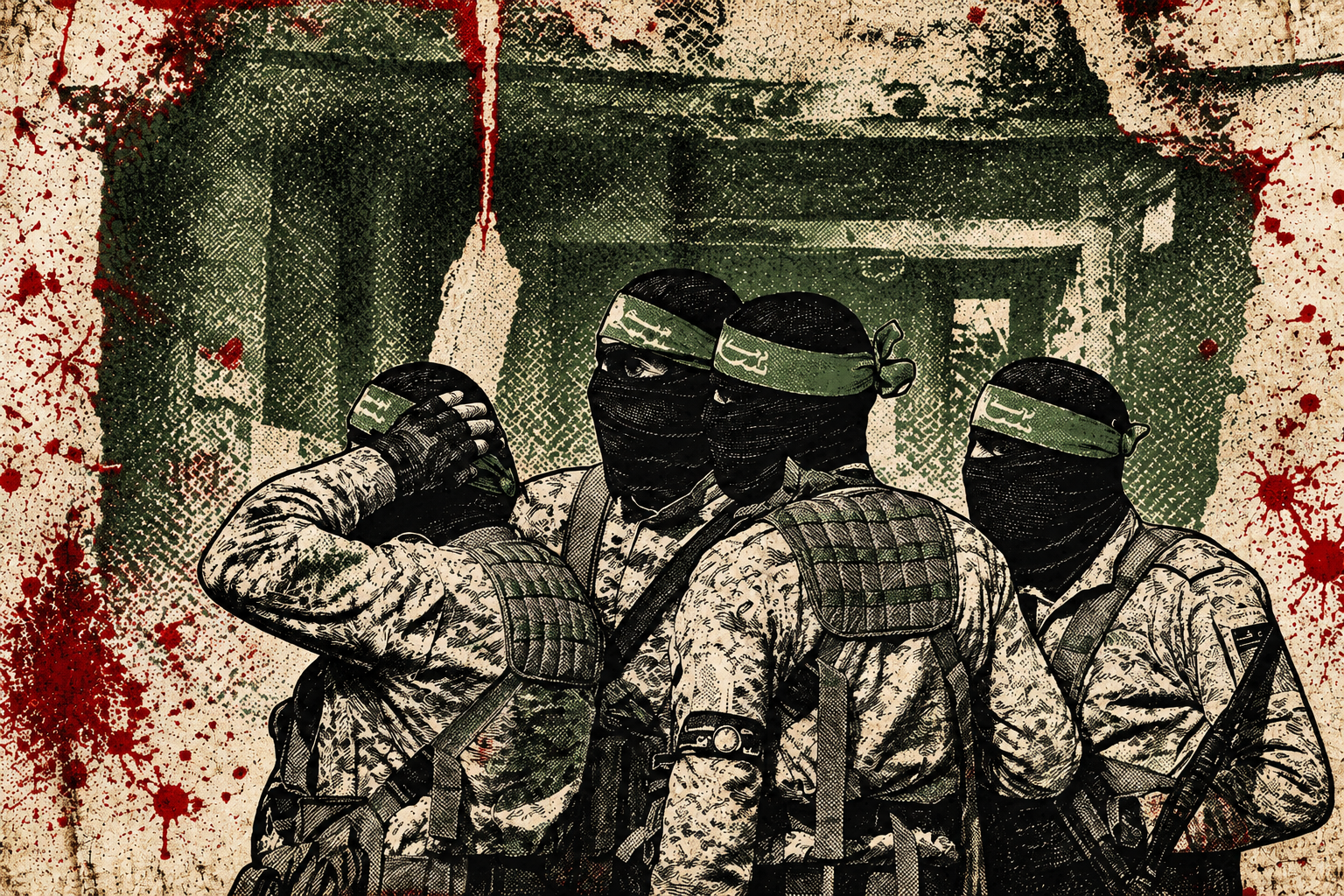
How far will this so-called democracy's limits extend? (AI-generated image)
This is very serious! Why are most of them afraid to address the issue? How does Israel allow actors in its politics who do not declare Hamas a terrorist group, even after it perpetrated the worst massacre against its population since the Holocaust? We all know that, besides all the Arab countries being dictatorships, with various facets, they would never allow such a situation within their territories. How far will this so-called democracy go?
From the beginning, the Israeli system allowed Arab citizens to participate in politics. The Knesset, a unicameral parliament with 120 seats, was inspired by the ancient Great Assembly of the Jews, the Knesset HaGedolah. In the first election, in 1949, the Nazareth Democratic List, of Arab origin and linked to Mapai, won two seats and took part in forming David Ben-Gurion’s first government.
Participation, however, was long and limited. For decades, Arab parties were kept out of coalitions. There was outside support in the 1990s, but the first full participation of an Arab party in a government did not occur until 2021, with Ra’am, which joined the coalition of Naftali Bennett and Yair Lapid.
The contrast with the 22 countries of the Arab League is very stark. After 1948 and 1967, the Jewish communities of countries such as Iraq, Egypt, Libya, Syria, Yemen, Morocco, and Tunisia suffered expulsions, confiscation of property, and persecution. Common estimates indicate that about 800,000 Jews left these countries, many of them for Israel. Today only tiny communities remain, and there are no Jews in political office in these states. There were historical exceptions, such as Jewish ministers in monarchist Iraq in the 1930s and 1940s, but they did not survive the deterioration of the Jews’ situation in the region.
The comparison has limits. Israel is also accused of inequality against its Arab citizens, who face higher poverty rates and reduced representation in the civil service. The difference is that in Israel this inequality is debated in parliament and in the courts, and Arab parties have institutional voice, something their neighbors do not offer their minorities.
The current dilemma of Arab parties in forming a new government
The elections of October 27, 2026 left a complex picture. The Arab parties together won 19 seats, which makes them decisive for any government without Benjamin Netanyahu. The Joint List, reconstituted in August 2026 by Hadash, Ta’al, and Balad, won 11 seats.
Today, the main scenario under discussion is a government led by Gadi Eisenkot. On November 8, President Isaac Herzog gave him the first mandate to form a government, with an initial deadline of 28 days, extendable by another 14. Eisenkot received the recommendation of 67 members of parliament, compared with 46 who recommended Netanyahu.
The Arab parties’ dilemma has four dimensions:
– Support without participation or full participation? The Joint List wants to support a government from outside, as a parliamentary safety net, without entering the cabinet. Ra’am wants to join the coalition, as it did in 2021. This disagreement has already made unity among the Arab parties difficult.
– Concessions or the risk of being instrumentalized? The parties demand progress on public safety in Arab communities and on the Palestinian issue in exchange for their support. However, they risk sustaining a government with no real influence over its most important decisions.
– Political rejection. Members of Eisenkot’s coalition rule out Arab support, and part of the Jewish opposition avoids publicly admitting this dependence. Arab parties are necessary for a majority, but they are not accepted as legitimate partners.
– Suspicions about the electoral process. Likud accused the Arab parties of “stealing” the election. The Shin Bet investigation did not confirm the broader accusations, but a police investigation into the purchase of votes in favor of Ra’am in the Negev resulted in seven arrests. Ra’am denies that its leadership was involved.
There is also an uncomfortable precedent. In 2022, Ra’am suspended its participation in the coalition for two weeks after clashes in Jerusalem, which critics cited to argue that governments dependent on Arab parties are unstable on security issues.
The scenarios being discussed range from an Eisenkot government supported by Arab and ultra-Orthodox parties to a new election, possibly in 2027. For the Arab parties, the challenge is to turn their numerical weight into real influence, without negotiations reducing them to a reserve that keeps a government in place without ever actually governing.
October 7 and the question of the loyalty of Arab leaders
The Hamas attack of October 7, 2023 is, for Israel, the most decisive moment for its survival since the 1973 war. About 1,200 people were killed, most of them civilians, and hundreds were taken hostage. The shock revealed intelligence and defense failures and led the country to ask whether coexistence between Jews and Arabs within its borders was sustainable. In this context, the position of the Arab parties on Hamas became a political and moral test, both for the Jewish electorate and for the parties themselves.
The central question is not whether they condemn the massacre, but how they do so. The Arab parties condemned the attacks against civilians, but they differ in their approach. The Joint List says it condemned the massacre in the Gaza border communities, but it refuses to classify Hamas as a terrorist organization. In an interview with Channel 12 on October 31, 2026, the Joint List’s chairman, Yousef Jabareen, repeated the refusal and, when questioned several times, said: “I am not in an interrogation room.”
Ra’am takes a similar position, with a difference in tone. Its leader, Mansour Abbas, condemned the attack as contrary to the values of Islam, but in an interview with Kan radio in July 2026, he refused three times to say whether Hamas is a terrorist organization that should be eliminated. In 2024, he had described Hamas as part of the Palestinian people, and then stated that the group committed crimes and must answer for them.
The case of Balad was the most serious. Its chairman, Sami Abu Shehadeh, published an article the day after the attack that treated October 7 as a historic event and suggested that others could learn from Hamas’s success. After the Supreme Court indicated it would approve his disqualification, he withdrew his candidacy.
The refusal has a reading that goes beyond Israel. Right after October 7, many Arab states also avoided naming Hamas, although before the war, leaders of Saudi Arabia and the United Arab Emirates had called the group terrorist. Inside Israel, however, the ambiguity has direct consequences, because these parties are needed to form a majority.
The Arab parties have their own arguments. They say that demanding a specific declaration of loyalty is a test that no Jewish party faces, and that it serves to delegitimize Arab representation. Adalah, the legal organization that defends the Arab minority, stated in September 2026 that the disqualification actions seek to delegitimize these parties and incite against them. For critics, however, the refusal to name Hamas weakens the parties’ credibility as partners of a state facing an organization that vows its destruction. This is the central tension: the Jewish majority wants a clear condemnation before accepting Arab support, and part of the Arab leadership sees this demand as a form of exclusion.
Was it a gross mistake to embrace equality from the start?
The criticism has merit. Israel’s founders knew that the neighboring Arab states did not accept the new state’s existence, and that part of the local Arab population had supported the adversaries in the 1947–1949 war. Given this, denying full equality to a minority of about 150,000 people, who remained in the territory after the war, could have been seen as a security measure. This is the position of those who consider equality naive.
The fairest assessment may be this: equality was not a mistake in principle, but it was applied incompletely and, in some periods, contradictorily. Today’s cost stems not only from the democratic choice of 1948, but from the gap between promise and implementation, and from the absence of a clear definition of how a Jewish and democratic state should treat its largest minority.
The democracy Israel adopted exposes contradictions the country has carried since its founding: the definition of a Jewish state with full rights for all, and the need for a parliamentary majority that includes, or at least accepts, its largest minority. October 7 made these contradictions more visible, because it called into question both the security of the state and the loyalty of the Arab parties, which refuse to classify Hamas as a terrorist organization and yet are indispensable to any government without Netanyahu…
Shema Yisrael שְׁמַע יִשְׂרָאֵל
Related Topics
Related Posts