Why Don’t More Muslims Speak Up?
Why Don’t More Muslims Speak Up? The Answer Is Harder Than the Question
“Why don’t Muslims speak up?”
I hear this question constantly, particularly from Jewish friends confronting antisemitism, Islamist extremism and the glorification of terrorist organizations.
It is a legitimate question.
Muslims should speak. We should confront antisemitism in our own communities. We should challenge extremist clerics and organizations. We should reject the idea that murdering civilians becomes acceptable when the victims are Israeli or Jewish.
But before concluding that Muslim silence means Muslim agreement, we need to understand the world in which most Muslims actually live.
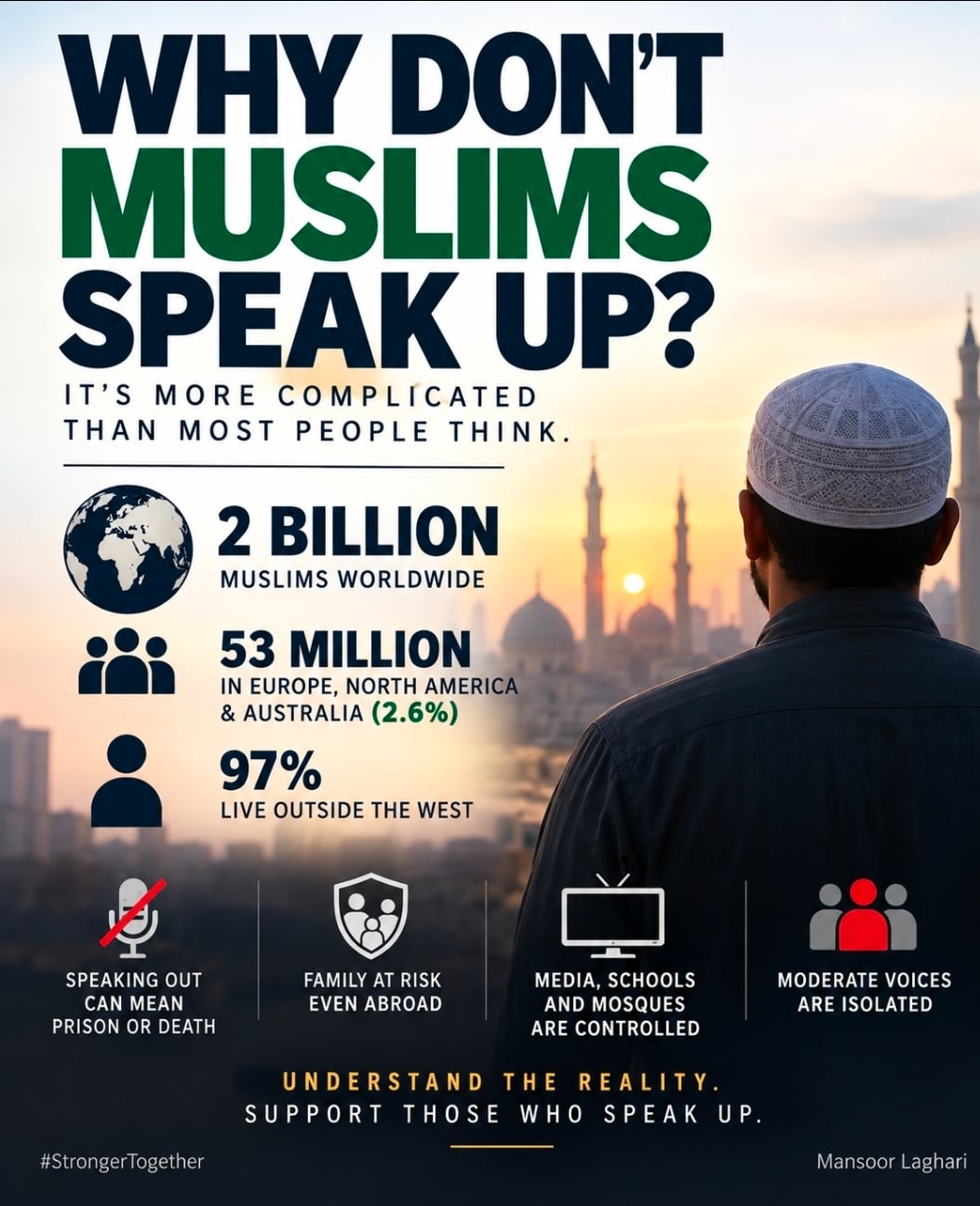
There are roughly two billion Muslims worldwide. Only a small fraction live in North America, Europe, Australia and New Zealand. The overwhelming majority live outside the Western democratic environment in which publicly criticizing religion, government or political ideology is largely taken for granted.
That distinction changes everything.
Speaking freely is not a universal privilege
I was born in Sindh. I understand something many Westerners understandably do not: challenging religious extremism in parts of the Muslim world is not equivalent to writing an angry Facebook post in America.
In some societies, criticizing a powerful cleric can cost you your livelihood.
Questioning religious orthodoxy can bring accusations of blasphemy or apostasy.
Challenging an extremist organization can bring threats.
Confronting an authoritarian government can bring prison.
And sometimes speaking carries the ultimate price.
Pakistan provides a disturbing example. Blasphemy accusations have resulted not only in prosecutions but also mob violence and killings. Journalists, dissidents, religious minorities and reformers have all faced enormous pressures.
So when someone safely sitting in America asks a Muslim living under those conditions, “Why don’t you simply speak up?”, my response is:
There is nothing simple about it.
That does not excuse silence. It explains the environment that produces it.
Authoritarianism and extremism sometimes feed each other
There is another uncomfortable reality the West needs to examine.
We often discuss authoritarian Muslim governments and Islamist extremism as opposing forces. Sometimes they are. Islamist terrorist organizations have killed enormous numbers of Muslims, and several Muslim governments have fought brutal wars against them.
But the relationship between authoritarianism and religious extremism is not always so clean.
Some regimes suppress independent political and religious voices while tolerating, promoting or exploiting religious narratives useful to their own legitimacy.
They influence television.
They influence education.
They regulate mosques.
They appoint or approve clerics.
They determine which political conversations are dangerous and which grievances are permitted to flourish.
And external enemies are extraordinarily useful to authoritarian politics.
If the population is furious about Israel, Jews, America or “the West,” it is spending less time asking why its own government cannot provide accountable institutions, economic opportunity, decent schools or basic freedoms.
Hatred becomes a diversion from failure.
The same government can then present itself to Washington or European capitals as an indispensable partner in fighting the very radicalization flourishing within its society.
This is one of the great contradictions of the modern Muslim world.
The moderate is squeezed from both directions.
The Islamist calls him a traitor.
The authoritarian government distrusts independent voices.
And too often the West barely notices him.
Leaving the Muslim world does not necessarily leave the fear behind
The obvious response is: What about Muslims living in America, Britain or Europe?
Surely they are free to speak.
Legally, yes.
But geography does not erase family.
A Muslim living in New York may have parents in Pakistan.
An Egyptian in London may have siblings in Cairo.
An Iranian in California may have relatives in Tehran.
Authoritarian governments know this vulnerability. Human-rights organizations have extensively documented transnational repression, including intimidation, surveillance, abductions and pressure against relatives of dissidents living abroad.
You can possess freedom of speech in America while someone you love remains beyond the protection of the First Amendment.
Then there is another form of punishment: social isolation.
Challenge Islamism and you may be called a traitor.
Challenge antisemitism and people may accuse you of betraying Muslims.
Defend Jews and you may lose friends.
Defend Israel’s right to exist and the pressure can become greater still.
Question an extremist interpretation of Islam and someone may decide you are no longer Muslim enough.
No prison cell is required. Sometimes ostracism does the work.
But Muslims cannot use fear as a permanent excuse
Understanding these pressures does not absolve Muslims of responsibility.
We have work to do inside our own communities.
We cannot complain that extremists have hijacked the image of Islam while surrendering the microphone to them.
Muslim scholars must challenge antisemitic interpretations.
Parents must stop passing inherited hatred to their children.
Mosques must reject the demonization of Jews.
Muslim organizations must stop treating terrorism as morally different depending upon the identity of its victims.
And Muslim intellectuals must reclaim the right to question religious interpretations without being threatened into silence.
Western governments should also ask questions they have sometimes been reluctant to ask.
Who finances religious institutions?
Who trains clerics?
Who influences religious curricula?
Which foreign governments and ideological networks are exporting their political conflicts into diaspora communities?
Following those networks is not hostility toward Muslims.
It is part of protecting moderate Muslims.
Do not hand Islamists their greatest recruiting argument
There is also something I ask of my Jewish, Christian and secular friends.
Do not confuse the Muslim confronting Islamism with the Islamist he is confronting.
A Muslim serving in the United States military is not the Taliban.
A Muslim fighting Hamas ideology is not Hamas.
A Muslim defending his Jewish neighbors is not secretly responsible for every atrocity committed in the name of Islam.
When two billion Muslims are treated as a single ideological bloc, Islamists receive an extraordinary propaganda gift.
Their message has always been simple:
“The Jews hate you. The West will never accept you. You belong with us.”
Every moderate Muslim who stands beside a Jewish neighbor disproves that message.
Every Jew who stands beside a Muslim reformer disproves it again.
I am Muslim.
I oppose Islamist extremism.
I oppose antisemitism.
I believe Jews have the same right as every other people to live without being threatened, hunted or collectively blamed for the actions of others.
None of these convictions contradict one another.
For me, they come from the same place.
Human dignity.
So yes, continue asking why more Muslims are not speaking.
But go one step further.
Examine the systems that silence them, the regimes that manipulate public anger, the extremists who threaten them, the institutions that spread intolerance and the social structures that punish dissent.
Then find the Muslims who are already standing against it.
Protect them.
Amplify them.
Debate them when you disagree with them.
But do not abandon them.
Because the struggle against Islamist extremism will not ultimately be won by convincing two billion Muslims that they are the enemy.
It will be won when millions of Muslims decide that the extremists no longer speak for them, and discover that when they say so, someone is standing beside them.
Mansoor Laghari
Muslim Zionist | U.S. Army Veteran | Human Rights Activist