Where history exposes power and moral failure
Why Historians Care About Evidence, Not Vibes
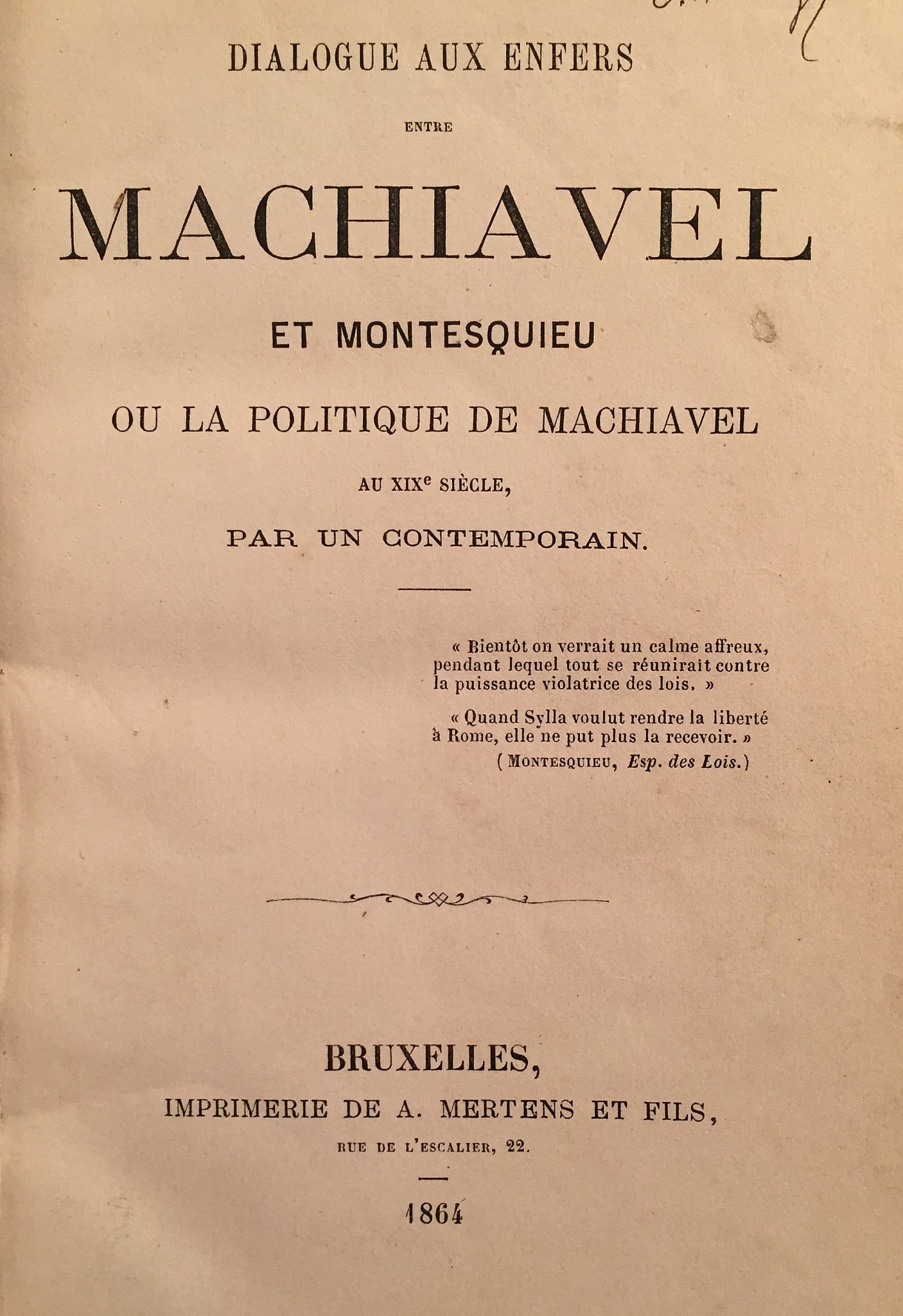
Title page of 1864 (1st) edition of Maurice Joly's book 'Dialogue aux enfers entre Machiavel et Montesquieu' from Varshavsky Collection library. (Wikimedia Commons)
In August 1921, The Times of London printed passages from a book by Maurice Joly next to passages from The Protocols of the Elders of Zion.
Joly had published Dialogue in Hell Between Machiavelli and Montesquieu in Brussels in 1864. It was political satire aimed at Napoleon III. He was not Jewish, his book was not about a Jewish conspiracy, and he died in 1878.
Then somebody stole his work.
Large sections of The Protocols, the notorious document purporting to record a secret Jewish plan for world domination, had been lifted from Joly. Philip Graves, the Times correspondent who exposed the plagiarism, could put the texts next to each other and let readers compare them. The supposed minutes of a clandestine Jewish conspiracy contained material written decades earlier by a French lawyer attacking the government of Napoleon III.
That is the sort of thing historians like. Not antisemitic forgery, obviously. We like evidence that can be tested.
The Protocols also demonstrates why historical methodology can become more complicated than simply finding a document. The document certainly existed. Millions of people read it. The Nazis promoted it. German authorities were still publishing editions in Russian, Ukrainian and Belarusian in 1943, while Germany was murdering the Jews supposedly engaged in the conspiracy described in its pages.
A historian can use The Protocols as evidence of modern antisemitism, conspiracy culture, propaganda and the political afterlife of a forgery. Using it as evidence that Jews secretly planned world domination would require accepting the claims of a plagiarized fraud as fact.
This is source criticism, and it is considerably less glamorous than the popular image of a historian discovering a dusty box marked VERY IMPORTANT HISTORICAL SECRETS.
Sometimes the problem involves an authentic document being asked to prove the wrong thing.
On January 20, 1942, fifteen German officials met at a villa at Wannsee outside Berlin. Adolf Eichmann prepared the surviving protocol from notes taken during the meeting and later acknowledged that he edited the language, removing “vulgarisms” and making the record sound more official. Only one copy is known to have survived. American troops recovered the relevant Foreign Office files in 1945, and Kenneth Duke found the protocol while working on their microfilming in late 1946.
For years, Wannsee was commonly described as the conference at which the Nazis decided to murder the Jews of Europe. There is a rather large chronological problem with that description: they were already murdering them.
By October 15, 1941, three months before Wannsee, SS-Brigadier General Walter Stahlecker had submitted a report documenting the killing of more than 118,000 Jewish civilians by Einsatzgruppe A and its auxiliaries following the invasion of the Soviet Union. Chełmno began killing Jews with gas in December 1941. Experimental gassings had already occurred at Auschwitz. Wannsee concerned the coordination and expansion of a policy of mass murder already underway.
The Wannsee Protocol is authentic, enormously important and incapable of proving that the Holocaust began at Wannsee. Chronology prevents us from making it do that.
Holocaust history provides an unusually brutal education in evidentiary method because the surviving record is so extensive. At Nuremberg, prosecutors worked through hundreds of thousands of captured German records and built much of their case from documents the perpetrators had produced themselves. The evidence included Einsatzgruppen reports recording mass shootings, Jürgen Stroop’s report documenting the destruction of the Warsaw Ghetto, an SS report concerning gas vans and Himmler’s October 1943 speech referring explicitly to the annihilation of the Jewish people. Otto Ohlendorf then testified that Einsatzgruppe D, which he commanded, murdered 90,000 people in a year. Rudolf Höss testified about killing Jews in gas chambers at Auschwitz.
No responsible historian takes one of those sources, admires the letterhead and goes home.
The Einsatzgruppen reports were created by perpetrators reporting their own activities through an SS bureaucracy. The Wannsee Protocol was edited rather than verbatim. Höss testified after the war. Survivor testimony comes from people who experienced events from particular physical locations, under catastrophic conditions, and later reconstructed what they had seen and understood.
Historians compare these materials because their points of contact are extraordinarily powerful. German administrative records can be checked against deportation records, demographic evidence, photographs, physical sites, testimony from perpetrators, testimony from survivors and records created by governments outside Nazi Germany.
This is also why Holocaust denial is such rotten history. It commonly depends upon isolating one uncertainty, discrepancy or imperfection in an enormous evidentiary record and pretending the entire historical conclusion depends upon that single item. It does not. A disputed recollection about one transport cannot erase German records documenting other transports. A mistake by one witness cannot make an Einsatzgruppen report disappear.
Historians can make the opposite mistake too. Once we think we understand the larger story, every new document starts looking cooperative. It gets recruited into the thesis before anyone has asked exactly what it establishes.
I am suspicious of motive for this reason. Historians routinely write that somebody “wanted,” “intended,” “feared” or “believed” something. Sometimes a diary, letter, memorandum, recorded conversation or order gives us excellent grounds for saying so. Sometimes conduct supports the inference. Sometimes we are several inferential steps away from the person’s mind and ought to admit it.
The same discipline applies to absence. An archive containing no surviving order does not automatically establish that no order existed. Records were destroyed deliberately in 1945 as the Third Reich collapsed. The Reich Security Main Office burned files in Prague, while copies of some of those records survived elsewhere in local Gestapo files. Historians reconstructed parts of the documentary record because bureaucracies produce copies.
That is why I care about proof. Evidence. First-hand accounts. Chronology. That which can be tested against hearsay.
A source has an author. It was created at a particular time for some purpose, survived through some chain of custody and reached the historian carrying whatever its creator knew, misunderstood, concealed, exaggerated or wanted somebody else to believe. Another source may corroborate it. Another may destroy its credibility. Sometimes a date in the corner is enough to wreck an otherwise lovely thesis.
I rather enjoy when that happens. The document has won. History is no longer a rumor. It cannot be smudged out.
Related Topics
Related Posts