
"I'm the spokesman for the OK Boomer generation"
Why I am a Classical Liberal: Freedom Requires Government
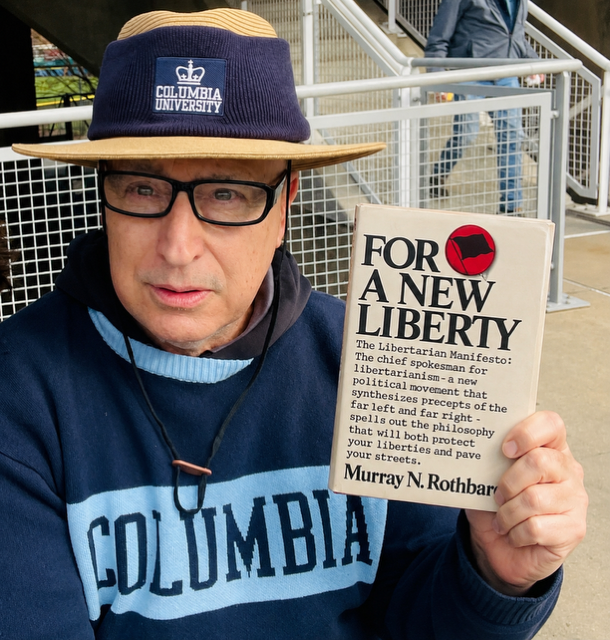
Photo: Tony Senatore: all rights reserved
Do we owe anything to the society that made our individual freedom possible? As a William F. Buckley-inspired conservative who found libertarianism later in life, I believe we do, and that the late Mr. Buckley would agree. On the other hand, many of my libertarian friends assert that we do not, and they proudly proclaim themselves anarcho-capitalists. Anarcho-capitalism is a political and economic philosophy that advocates abolishing the state in favor of a society governed entirely by the free market and private property. American economist Murray Rothbard is the person most associated with this ideology, which combines the anti-state stance of anarchism with the laissez-faire economic theories of the Austrian School of Economics. In my personal life, I have interacted with ancaps and Marxists. I am usually impressed by their intellect and learn a lot, but I leave my encounters with them feeling that if either group’s ideas became mainstream, they would destroy all I hold sacred and end the United States as we know it. Although it seems counterintuitive, I have always argued that both Marxists and ancaps have much in common. Marxists and anarcho-capitalists share a deep hostility toward the state. Yet, they radically disagree about who the state serves: Marxists see it as an instrument of capitalist class domination.
In contrast, anarcho-capitalists see it as an institution that violates individual property rights and free markets. Both traditions can also inspire a near-messianic devotion to their intellectual prophets—Marx for the revolutionary left and Murray Rothbard for the radical libertarian right. In a curious ideological symmetry, they agree that the state is the problem, but disagree profoundly over whether the villains are capitalists who control it or the state itself, which they believe enables coercion against capitalists and individuals. Libertarianism also varies and can be separated into five categories: anarcho-capitalism, minarchism, constitutionalism, classical liberalism, and thick libertarianism. Beginning with anarcho-capitalism, which seeks to abolish the centralized state in favor of a stateless society in which private institutions would provide services normally performed by government, each category permits progressively greater government authority, culminating in thick libertarianism. What unites these diverse forms is their commitment to the non-aggression principle (NAP), individual liberty, the rule of law, and free enterprise, but their differences are substantial. Anarcho-capitalism, in my view, is impractical in a world of sovereign states, national borders, armies, courts, and other institutions that require some form of centralized authority, while thick libertarianism risks moving in the opposite direction by expanding libertarianism beyond individual liberty and limited government into issues such as racism and LGBTQIA+ concerns. At that point, libertarianism can begin to resemble the progressive politics I oppose, in which society is increasingly understood through competing categories of oppressed and oppressor groups. As a moderate conservative, I’m more attracted to the traditions in the middle—particularly constitutionalism and classical liberalism—which recognize the necessity of government while insisting that its power remain firmly constrained by individual rights, the rule of law, private property, and human freedom. For this blog, in these times of nascent democratic socialism, I will focus on anarcho-capitalism and its prospects for becoming a viable political ideology in the United States, why I believe it will not, and why I hope it does not.
Capitalists and American corporations don’t want a more libertarian government.
Capitalism arises from decentralized voluntary exchange, whereas socialism—especially when it seeks to replace private ownership with collective or state ownership—generally requires a political authority to impose that transformation. Capitalists emphasize the organic nature of capitalism, but the historical record is clear: part of the process was an organic and symbiotic relationship between businesspeople and politicians. Once government possesses the power to confer economic advantages, businesses have an incentive to capture that power. The United States has never been a pure laissez-faire society. From the earliest days of our republic, businesses sought government assistance and protection through lobbying, subsidies, tariffs, regulations, and political connections. Thus, economic power becomes political power. While anarcho-capitalism may be philosophically attractive, it is politically unrealistic. The system we have now did not happen by accident, and was not imposed via the barrel of a gun. This is what the individuals who built America wanted. America’s biggest problem is not socialism; it is crony capitalism. This was accomplished through regulatory capture, as described by economist George Stigler. To describe this phenomenon in layman’s terms, imagine Al Capone responding to criticism by creating a special task force to fight organized crime—then appointing his own lieutenants to run it, letting them write the rules, and proudly announcing that crime is now being “properly regulated.” That is roughly what regulatory capture can look like: the fox doesn’t abolish the henhouse; he gets appointed chairman of the Henhouse Regulatory Commission. Also worth mentioning is American economist James Buchanan’s public-choice theory. Politicians and bureaucrats aren’t magically transformed into selfless public servants merely because they work for the government.
I would rather work within the enormous government that actually exists to make it more efficient, less corrupt, less intrusive, and more accountable than see politicians promise to abolish institutions that American citizens and businesses have demonstrated repeatedly that they want. That is a much more pragmatic argument.
Freedom is essential, but freedom is not sufficient for American citizens.
Americans want more than government to leave them alone. They want freedom, but after seeing banks and Wall Street bailed out, American citizens want help and are demanding expanded safety nets. As a conservative, I distinguish between legal freedom and social order. A society can legally permit enormous personal freedoms while still depending on cultural norms that government itself cannot manufacture: marriage, family, work, education, religion, and civic responsibility. A civilization cannot survive on individual freedom and rights alone. It also requires responsibilities. Whereas my friends like legendary anarcho-capitalist Walter Block might ask ” Is this institution coercively imposed?” and make that the focus of their critique of the status quo, my Burkeian sentiments, as well as my friend Paul Gottfried, ask, “Do our American institutions perform a necessary function for civilization?” Civilization is not something we consciously invent from scratch, but rather something we inherit from previous generations and transmit through institutions, customs, and traditions. Libertarianism places individual liberty at the center of political life, and I feel this is a shortcoming. Americans want freedom, but they also want security, healthcare, education, retirement security, and protection from economic catastrophe. America’s freedoms cannot be separated from the institutions that protect them; liberty is not merely sustained by lofty philosophical ideals, but by the constitutional structures, laws, and traditions that make those ideals a reality.
The truth is that freedom and liberty are both legitimate social goods. If a person in Denmark, Sweden, or the Netherlands can choose his career, marry whom he wants, practice his religion, express his political opinions, start a business, travel freely, and generally live according to his own values, why should we assume that the larger social safety nets the individuals who live in these countries have made them less free? I do not believe Americans must choose between freedom and security. Western Europe demonstrates that a society can provide extensive social protection while preserving a remarkably high degree of personal liberty. I am not anti-freedom. I simply reject the idea that maximizing individual economic freedom must be the government’s primary focus. Moreover, I will concede that some traditions are unjust and should be changed. Still, I would argue that destroying an institution without understanding the social function it performed can have detrimental consequences for society.
The United States cannot afford to ignore the world as it is.
Libertarians ask why government should interfere with the individual, but a nation must also ask what happens when someone outside the nation refuses to respect the individual’s freedom. Libertarianism works best when individuals voluntarily respect each other’s rights. International politics are much different. Nations have competing interests, and some governments are authoritarian and willing to use military, economic, and cyber power to achieve their objectives. The United States cannot organize its foreign policy around the assumption that every other nation will respect its libertarian principles. Anarcho-capitalists advocate radical decentralization and have argued that Americans should have the right to peacefully separate into smaller, more autonomous political units rather than remain under a powerful centralized government. This vision would allow different regions to adopt radically different political and economic systems, encouraging people to “vote with their feet” by moving to jurisdictions that better reflect their preferences.
For anarcho-capitalists, this fragmentation could ultimately create the conditions for some jurisdictions to move beyond limited government toward a stateless society based on private property and voluntary association. I argue that this could weaken America significantly because liberty requires a political structure capable of defending it. The United States has enormous advantages because it possesses a unified military, intelligence agencies, diplomatic institutions, economic power, and a national identity that allows Americans from different states and regions to understand an attack on one part of the country as an attack on the whole. Of course, a sophisticated ancap would assert that anarcho-capitalism does not mean abolishing national defense, and that private contractors will defend the nation more formidably and only when necessary. That notwithstanding, a nation is fundamentally different from a collection of individuals making private contracts. The United States is not merely 340 million people who happen to live inside the same borders. It is a political community with common institutions, common obligations, and a common defense. The anarcho-capitalist vision of privatizing national defense creates tremendous problems. Imagine competing private defense companies operating independently. What happens when different private security organizations disagree? Who has authority over them, and determines national strategy? Who negotiates with foreign governments or decides whether an attack on California is an attack on America?
The nation state solves these problems through legitimate political authority, which is recognized worldwide. Perhaps the greatest example of the shortcomings of anarcho-capitalism is the war between Israel and Hamas. When Walter Block defended Israel, he faced a complicated real-world conflict. He had to temporarily step outside the anarcho-capitalist framework he’s championed his entire life to argue as a classical liberal in his effort to make a meaningful moral distinction between competing societies. The irony of Block’s defense of Israel is that the anarcho-capitalist had to become a classical liberal. To defend Israel, he and Alan Futerman could not simply say that all states are coercive institutions and therefore equally illegitimate. They had to distiguigh between governments, compare the societies they govern, defend the right of their citizens, establish competing claims to property and territory, and recognise a government’s legitimate function in defending these citizens against aggression. In short, they had to do precisely what classical liberalism permits and ancho capitalism makes extraordinary difficult: distinguish between a flawed government that protects a relatively free society and a oppressive organization that threatens it. If Block, one of the most prominent intellectual defenders of anarcho-capitalism, found himself compelled to adopt classical liberal reasoning when confronted with a genuine complex problem, that is something to note.
Ultimately, my disagreement with anarcho-capitalism comes down to a different understanding of what freedom requires. I believe individual liberty is one of the great achievements of Western civilization, but I do not believe liberty exists in a vacuum. It depends upon courts that enforce contracts, police that protect citizens, institutions that defend property, a military that protects the nation, and a political system capable of maintaining the constitutional order in which individual freedom can flourish. These institutions can become bloated, corrupt, and abusive—and when they do, they should be reformed. But their imperfections do not prove that they are unnecessary.
The classical liberal therefore does not ask government to disappear. He asks government to remember its proper purpose. Government should be limited, constitutional, accountable, and respectful of individual rights, while still performing those functions that individuals acting separately cannot perform effectively. That is a very different philosophy from anarcho-capitalism. I would rather restrain the power of the state than pretend that the state can simply be wished away.
America was not created as an anarcho-capitalist experiment, nor should it become one. It is a constitutional republic built over generations by people who inherited institutions from those who came before them and modified them when they no longer served their purpose. We should do the same. The challenge is not to destroy the institutions that make freedom possible, but to preserve what works, reform what does not, and resist the temptation—whether from the political left or the radical libertarian right—to tear down the entire structure because some parts of it are flawed.
That is why I remain a classical liberal and a conservative at heart. I believe in freedom, private property, free markets, limited government, individual responsibility, and the rule of law. But I also believe that civilization requires institutions, traditions, obligations, and a political community capable of defending them. Freedom is precious, but freedom without order can become chaos; markets without rules can become cronyism; and individual rights without a political community capable of protecting them can become little more than ideals on paper.
The question, then, is not whether government is coercive. Of course it is. The more important question is whether that coercive power is constitutionally limited, democratically accountable, and used to preserve a society in which free people can live together. That is the distinction between the anarcho-capitalist and the classical liberal—and it is why I believe the future of American freedom depends not upon abolishing government, but upon making government worthy of the freedom it exists to protect.
This blog is dedicated with love and respect to Walter Block and Paul Gottfried; two men whose ideas have had a profound impact on me.
Related Topics