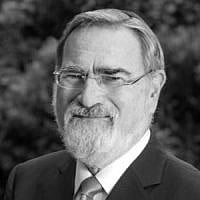
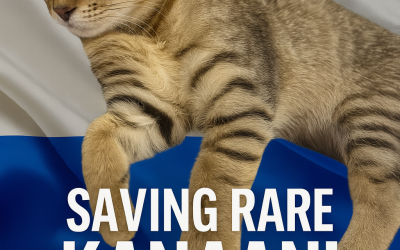
 I am a rabbi. And long before I received my ordination, I was given a mission.
Not from a school or a teacher — but from Above.
It came quietly, not as a command, but as a deep knowing: I was to find and help save a disappearing breed of cat, native to the Land of Israel. Not a designer breed or a laboratory product, but a living soul shaped by the dust of the Negev and the alleyways of Jerusalem. A cat of presence and silence, of spirit and memory.
The breed is called Kanaani.
I received this task not as a metaphor, but as a real mission — one rooted in kindness, care, and connection to the Land and all its creations.
With God’s help, I found a female Kanaani — a true one. She is graceful, alert, and carries in her gaze something ancient. But my work is only half done. I am still searching for a male, pure and unblended, to continue the line without dilution.
Why Kanaani? Because its story is more than zoological. It’s spiritual.
Unlike most modern breeds, the Kanaani is not the product of commercial breeders or genetic manipulation. It was born from an act of mercy.
In Jerusalem, Israeli artist Doris Polachek lived in a modest home where she took care of rescued street cats. One day, she found an injured wild desert cat — Felis lybica, the ancient Middle Eastern ancestor of domestic cats. She brought him home not to tame him, but to heal him.
In her home, already full of ordinary Israeli street cats, something unexpected happened. The wild cat stayed — and chose to mate. It wasn’t planned. No one engineered it. But kittens were born, and with them, a new kind of cat: rooted in Israel, shaped by the wilderness, and nurtured by compassion.
This is how the Kanaani was born. Not through profit, but through kindness.
Not in a lab, but in a household of mercy.
In Jewish tradition, that matters. Our sages taught that a righteous person cares for their animals. The Talmud tells us that Moses was chosen to lead because he had compassion for a single lost sheep. In Tractate Bava Kamma (16b), it says: “In a house with a cat, there are no snakes or scorpions.”
And in Tractate Eruvin (100b), it states: “Had the Torah not been given, we would have learned modesty from the cat.”
Kabbalists taught that cats sense spiritual imbalance and protect the home.
They see what we do not. They respond to what we only feel.
The Kanaani is more than a cat. It is a reminder.
Of the desert. Of Jerusalem. Of the quiet bond between creation and Creator.
Today, the Jewish people are walking a new path — no longer only surviving, but rebuilding. Reclaiming our language, our land, our stories — and even the silent lives that have lived beside us for generations.
Some will say: “It’s just a cat.”
But I say: this is a living parable.
This is memory on four feet.
This is a blessing that moves quietly through the house.
And if I was given this mission, I must fulfill it.
Not only to preserve a breed — but to make the world a little more compassionate.
Rabbi Moshe (Mikhail) Salita is a Brooklyn-based rabbi, legal scholar, and emerging animal chaplain whose work unites Jewish spirituality, international law, and compassion for all living beings.
He holds a Master’s in International Law (with honors) from the National University “Odesa Law Academy,” where he is currently a PhD student researching the restitution of unlawfully confiscated Jewish communal property in Soviet Ukraine. He also earned a Master’s in Library and Information Science from Pratt Institute (New York) and a Master’s in Education and Special Education from Touro University, with graduate certificates in Applied Behavior Analysis (ABA) and Bilingual Education.
Rabbi Salita is an ordained rabbi of the Jewish Spiritual Leaders Institute (JSLI), a Doctor of Ministry student in Jewish Spirituality at the Graduate Theological Foundation, and an Animal Chaplain-in-Training with the Compassion Consortium in New York. His mission is to weave together justice, mercy, and creation care into one sacred path of Tikkun Olam — healing the moral and spiritual wounds of the world.
He serves as Executive Director of the Salita Foundation, originally founded by his brother, Dmitriy Salita — former WBF World Champion boxer, and inductee of both the New York Boxing Hall of Fame and the Jewish Sports Hall of Fame. Today, Rabbi Salita leads the Foundation toward a broader vision — uniting humanitarian ethics, environmental awareness, and cultural restitution.
Through the Foundation, he has launched the “Eco-Kosher Initiative,” a global program encouraging support for businesses and individuals who respect the environment, animals, and their communities. For him, “eco-kosher” is not limited to food — it is a moral philosophy of living in balance with creation, where sustainability and holiness walk hand in hand.
He is also devoted to preserving and gaining international recognition for the rare Israeli cat breed Kanaani — a living symbol of harmony between Jewish heritage and the natural world.
A descendant of Sruel ben Aharon Lekhtman, a Ruzhiner Hasid and brick-factory owner in Kitai-Gorod, Kamianets-Podilskyi — once a spiritual heart of the Ruzhin Hasidic movement in Tsarist-era Ukraine — Rabbi Salita continues his ancestor’s legacy of faith, integrity, and bridge-building. Sruel Lekhtman served as a close friend and estate manager for Pan Dembitsky, a Polish landowner remembered with respect in both Jewish and Ukrainian memory. Their friendship, crossing lines of faith and culture, remains a profound symbol of coexistence — especially meaningful for Ukraine today.
Although Rabbi Salita received Reform rabbinic education in the spirit of Jewish Universalism, he maintains a deep spiritual connection with Chabad, whose living Hasidic tradition unites intellect, compassion, and joy.
Following the example of the prophets — from Adam, the first caretaker of creation, to King Solomon, who understood the language of animals, and to Rav Papa, the sage who spoke kindly of cats — Rabbi Salita teaches that true holiness is revealed through compassion for all living beings. His life’s work is to show that caring for animals and serving God are one and the same sacred breath.