
An Engineer’s Perspective on Israel and Jewish Life
Why Is Antisemitism Still Socially Acceptable?
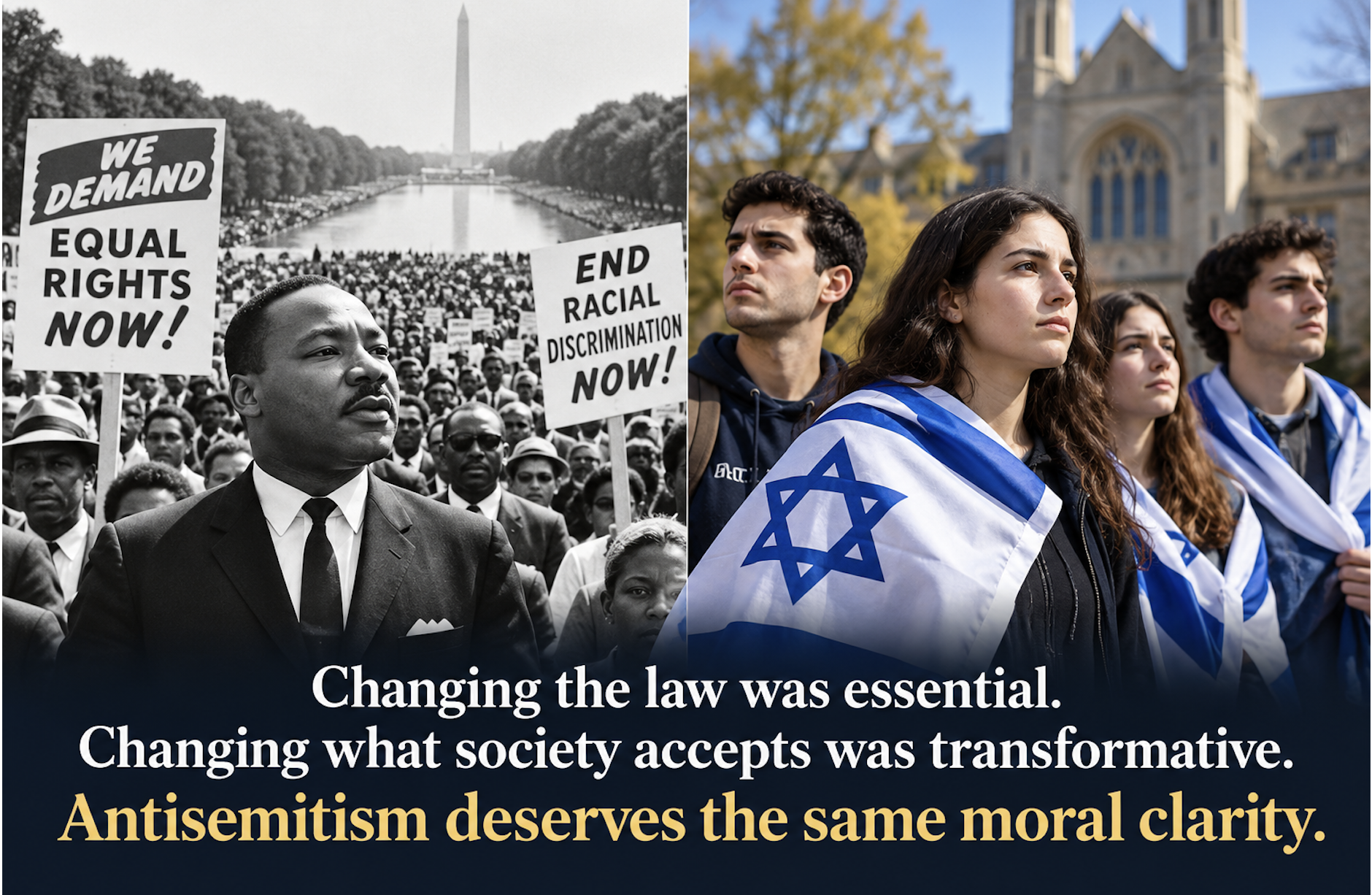
In September, I wrote in The Times of Israel about how American Jews arrived at our present predicament. We failed to recognize how profoundly our environment had changed. Now comes the harder question. What can we do about it? [1]
Part of the answer may lie in one of America’s great achievements. Over several generations, African Americans and their allies changed the country’s laws, institutions, and expectations about racism. Open expressions of anti-Black racism, once tolerated across much of American life, became unacceptable in mainstream society.
Why has antisemitism not undergone a comparable transformation?
Consider the difference. A credible finding of racism can carry serious social and professional consequences. Yet antisemitic rhetoric, especially when dressed up as anti-Zionism, is sometimes defended as ordinary political expression. Jewish students may be excluded because they support Israel, or are presumed to, while those excluding them claim to be fighting oppression.
America does not universally tolerate antisemitism, and racism has certainly not disappeared. Still, the difference in how these prejudices are sometimes treated demands an explanation.
Our objective should be to make antisemitism as morally and socially unacceptable as racism.
What the Civil-Rights Movement Teaches Us
American attitudes toward racism did not change on their own. No single leader, law, organization, or publicity campaign brought about that change.
It emerged from decades of mutually reinforcing efforts involving the NAACP, Southern Christian Leadership Conference, churches, civil-rights lawyers, educators, journalists, writers, artists, political leaders, and countless ordinary Americans.
Court victories challenged segregation. Congress enacted enforceable protections. Television brought the brutality of racial injustice into American living rooms. Writers, filmmakers, and musicians gave those experiences a human face. Churches and civic leaders made equality a responsibility shared by Americans of every background.
Racism did not disappear. But a powerful expectation took hold: racial discrimination is not merely illegal. It is wrong.
Jews have a special connection to this history. American Jews joined African Americans in civil-rights organizations, legal campaigns, and religious coalitions. Some lost their lives. Rabbis marched with Martin Luther King Jr. Jewish activists helped challenge segregation and advance landmark civil-rights legislation.
We helped advance the principle that prejudice against one minority threatens the rights and dignity of all Americans. Today, we need to apply that principle with equal determination to antisemitism.
In an August 2026 Tablet essay, Michael S. Tobin recalls volunteering as an 18-year-old Jewish civil-rights worker in Tennessee in 1965. A Black woman welcomed him into her home and treated him like family. Decades later, he worries that the once-powerful alliance between Black and Jewish Americans has weakened. His experience reminds us that the civil-rights movement succeeded not only through laws and court victories, but through personal relationships built on trust and shared convictions. We need to rebuild those relationships today. [7]
Why Has Antisemitism Been Different?
The histories of antisemitism and anti-Black racism are different. So are the prejudices themselves.
Antisemitism has persisted for centuries while repeatedly changing its “justification.” Jews have been condemned as religious outsiders, racial inferiors, capitalist exploiters, communist revolutionaries, and, more recently, powerful colonial oppressors. These accusations are often mutually contradictory, yet they share a recurring tendency to portray Jews as a dangerous collective. This is often accepted and repeated by a cohort of young Americans whose K-12 education has not included civics and is replete with the destructive work concepts of identity politics, intersectionality, and the Marxist victim-oppressor class warfare paradigm. This travesty often extends to college “education” in the liberal arts.
Today, Israel adds another dimension. Criticism of Israeli governments and policies is legitimate, just as criticism of any government is legitimate. But holding Jews collectively responsible for Israel’s actions, excluding Jewish students because of their Zionist beliefs, or denying Jews rights of national self-determination that one recognizes for other peoples raises fundamentally different questions and is clearly antisemitic behavior.
Not every opponent of Zionism is motivated by hatred of Jews. But anti-Zionist language can become a cover for antisemitism when it relies on old stereotypes, spreads blood libel, blames Jews collectively, or justifies discriminatory treatment.
We must be precise about that distinction. Otherwise, we risk either excusing antisemitism or weakening the credibility of the accusation.
As I said in a recent blog: [2]
For American Jews, the consequences can reach far beyond an argument about Israeli policy. Criticizing Israel is not automatically antisemitic. And I don’t assume that everyone who alleges genocide is prejudiced. But when criticism turns into blaming Jews as a group, or draws on antisemitic stereotypes, we need to say so clearly.
I am also deeply concerned about anti-Zionism, particularly when it denies the Jewish people’s right to national self-determination in their ancestral homeland. Criticizing Israeli policies is one thing. Denying Jews a right that we recognize for other peoples is quite another.
Another difficulty is that Jews are often perceived as successful, influential, privileged and in control. Within an increasingly popular framework that divides society into oppressors and oppressed, Jewish achievement can obscure Jewish vulnerability. The extraordinary history of Jewish persecution, including the Holocaust, does not fit neatly into such simplistic categories.
The result is a disturbing paradox: a minority with a long history of persecution can be portrayed as an oppressor whose claims of discrimination deserve less sympathy.
France Offers a Warning
The convergence of elements of the radical left and Islamist political movements around hostility to Israel has a history. After the 1967 Six-Day War, the Soviet Union promoted anti-Zionist propaganda that portrayed Israel as a colonial, racist, and even Nazi-like state. Historian Robert Wistrich documented the communist campaign against Zionism, while researcher Izabella Tabarovsky has traced the persistence of its themes in contemporary political discourse. The Soviet campaign reached Arab audiences through publications, political relationships, and state-sponsored messaging. These ideas did not remain confined to communist circles. [3]
Former Romanian intelligence chief Ion Mihai Pacepa described a Soviet disinformation operation he called Operation SIG, which he said sought to spread anti-Israel and anti-American hostility in the Muslim world. His account includes claims about agents of influence and the distribution of antisemitic material. Those operational details should be attributed to Pacepa, but the larger historical record leaves little doubt that Soviet anti-Zionist propaganda reached the Middle East. The notorious Protocols of the Elders of Zion, an antisemitic forgery that long predates the Soviet campaign, also appears in Article 32 of Hamas’s 1988 charter. That is a concrete example of how older antisemitic conspiracy theories survived within a modern Islamist movement. [4] [5]
France offers a warning of what can happen when hostility toward Jews draws support from more than one political direction. The October 2026 unrest illustrates a Red-Green convergence: revolutionary-left and communist organizations mobilized alongside a broader protest movement that included Palestinian-solidarity groups and Muslim student advocates. Fox News identified 54 organizations and movements involved in organizing, participating in, supporting, or amplifying the protests, while Simone Rodan-Benzaquen described how radical-left leaders connect otherwise separate grievances through a common enemy. Meanwhile, antisemitism on the far right has not disappeared. The United States is not France, but we should recognize the danger when anti-Jewish hostility is excused by movements that claim to champion equality and human rights. Opposing antisemitism requires confronting it wherever it appears, not only among our customary political adversaries. The overlapping causes and participants illustrate a Red-Green convergence, and strongly suggest that these groups jointly organized the violence. [6] [8]
Changing the Culture, Not Merely Responding to Incidents. American Jewish organizations perform essential work. They monitor antisemitism, defend civil rights, protect Jewish institutions, support students, educate the public, and advocate for Israel.
Too often, however, the response is reactive in that it begins after an incident. An organization issues a statement. Lawyers intervene. Security is tightened. Sometimes those steps are indispensable. But they do not necessarily change the beliefs that gave rise to the incident.
The civil-rights experience suggests a more ambitious goal: proactively change the culture that permits antisemitism to take root.
Several approaches deserve sustained attention.
Education must begin well before college. Students should encounter Jewish history, the changing forms of antisemitism, Jewish contributions to civilization, the Holocaust, and the historical origins of Zionism. They should also learn to question the simplistic division of people into victims and oppressors. The answer to one political orthodoxy is not another. It is sound history, competing evidence, and the habit of thinking critically.
Culture matters, too. Reports and press releases rarely reach people who have stopped listening. Films, novels, television, music, and digital media can. Americans should encounter Jews as people with varied histories, beliefs, accomplishments, and vulnerabilities, not only as victims of the Holocaust or protagonists in arguments about the Middle East.
Non-Jewish Americans must own this cause as well. The civil-rights movement helped make racial equality an American responsibility, not only an African American concern. Antisemitism should be understood in the same civic terms. Clergy, educators, business leaders, university presidents, and other public figures should band together and confront it because they believe it is wrong, not because Jewish organizations have asked them to.
Law must back up the moral standard. Civil-rights protections should apply consistently to Jewish students and employees. Schools, universities, and employers should act against threats, exclusion, and discriminatory harassment while protecting peaceful protest and legitimate criticism of Israel.
None of these efforts is sufficient alone. Together, they can reinforce changes in what Americans know, what institutions permit, and what ordinary people will accept.
We Must Measure Whether Attitudes Actually Change
My years in engineering and technology taught me that it is critical to distinguish activity from accomplishment.
We can count conferences, statements, educational programs, social-media impressions, and dollars spent. Those figures tell us how busy we are. They do not tell us whether we are succeeding.
Metrics of success might include the following. Do younger Americans understand Jewish history more accurately? Are antisemitic stereotypes becoming less acceptable? Are Jewish students safer and more welcome? Do institutions respond fairly and consistently when discrimination occurs? Those are the questions worth measuring.
Start with credible baseline data. Repeat the measurements. Have independent evaluators assess the results, and change course when an approach fails. A program should not survive simply because it has always existed.
Our measure of success must be changes in knowledge, attitudes, institutional conduct, and Jewish security, not the volume of our activity.
A Lesson Worth Learning
The African American civil-rights experience offers a powerful lesson. Deeply rooted prejudices can lose their social legitimacy. That achievement took courage, persistence, legal reform, education, cultural influence, and alliances across racial and religious lines.
The work is unfinished. Yet the change in American norms is unmistakable.
American Jews should draw inspiration from that achievement without assuming that our histories or challenges are identical.
American Jews have the talent, resources, professional experience, and historical memory to pursue a comparable long-term goal. But we must stop measuring our response chiefly by how vigorously we react to the latest outrage.
That leaves a larger question. Can the institutions we built for a different era accomplish this transformation? Or must we create something fundamentally new?
We should be prepared to ask it.
Condemning antisemitism after every incident is not enough. Our goal must be an America in which antisemitism is no longer socially acceptable in the first place.
Author’s Note
I used ChatGPT to help develop and edit this essay, identify and check sources, and create the accompanying graphic. The ideas, judgments, and conclusions are mine. I take full responsibility for what appears here.
References and source notes
[1] Richard D. Gitlin, “American Jews Ask: How Did We Get Here?”, The Times of Israel (September 2026). https://blogs.timesofisrael.com/american-jews-ask-how-did-we-get-here/
[2] Richard D. Gitlin, “Genocide: When Accusation Replaces Evidence,” The Times of Israel (2026). https://blogs.timesofisrael.com/genocide-when-accusation-replaces-evidence/
[3] Robert S. Wistrich, The Left Against Zion: Communism, Israel and the Middle East (1979); Izabella Tabarovsky, “Soviet Anti-Zionism and Contemporary Left Antisemitism,” Fathom (2019). https://fathomjournal.org/soviet-anti-zionism-and-contemporary-left-antisemitism/
[4] Ion Mihai Pacepa and Ronald J. Rychlak, Disinformation (2013). Pacepa’s account of Operation SIG, discussed by Radio Free Europe/Radio Liberty. The operational details are attributed to Pacepa. https://www.rferl.org/a/soviet-islamist-terrorism-israel-america-disinformation-pacepa/25034290.html
[5] Hamas Covenant (1988), Article 32, referring to The Protocols of the Elders of Zion. See also ADL, “Contemporary Anti-Zionism’s Connections to Soviet Propaganda.” https://www.adl.org/resources/article/contemporary-anti-zionisms-connections-soviet-propaganda
[6] Simone Rodan-Benzaquen, “The French Republic Is Under Attack,” The Free Press (October 18, 2026). https://www.thefp.com/p/the-french-republic-is-under-attack-democracy-tyranny-unrest
[7] Michael S. Tobin, “The Dream We Let Fade,” Tablet (August 2026). https://www.tabletmag.com/sections/community/articles/dream-we-let-fade
[8] Asra Q. Nomani, “WHO’S WHO: Inside France’s ‘Chaos Inc’ Franchise of Communist Groups, Labor Unions and Global Activists,” Fox News (October 19, 2026). https://www.foxnews.com/world/whos-who-inside-frances-chaos-inc-franchise-communist-groups-labor-unions-global-activists
Related Topics