
A Moroccan Journalist
Why Israel might be better off without the Abraham Accords
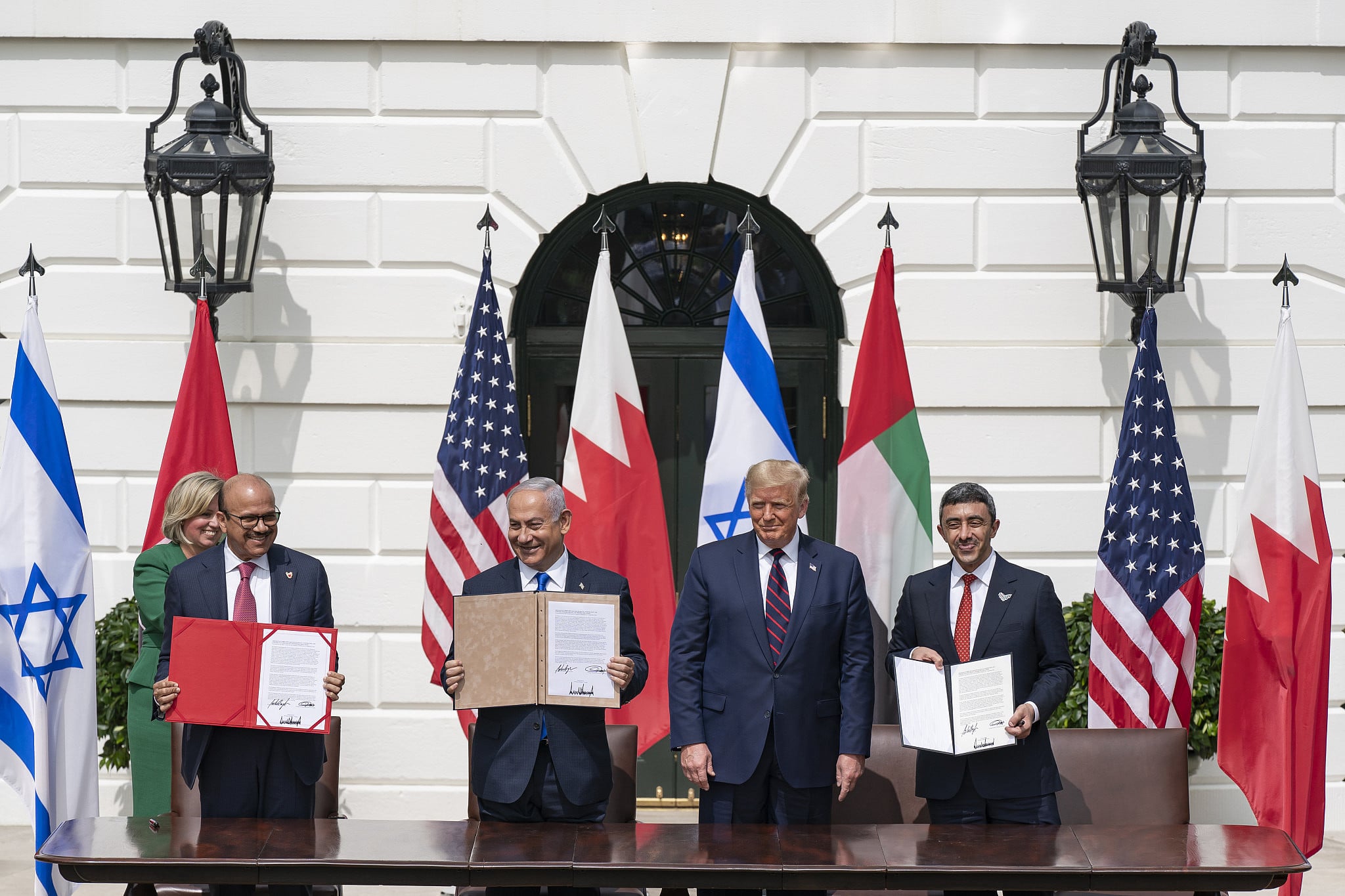
President Donald J. Trump, Minister of Foreign Affairs of Bahrain Dr. Abdullatif bin Rashid Al-Zayani, Israeli Prime Minister Benjamin Netanyahu and Minister of Foreign Affairs for the United Arab Emirates Abdullah bin Zayed Al Nahyan signs the Abraham Accords Tuesday, Sept. 15, 2020, on the South Lawn of the White House. (Official White House Photo by Shealah Craighead)
There are two maps of the Middle East. One is drawn for television: flags, ambassadors, handshakes, denunciations, and summits. The other is drawn in rooms that do not appear on any floor plan: intelligence exchanges, defense coordination, commercial understandings, and messages passed through intermediaries whose names will never be published.
Israel has spent years trying to make the second map look like the first – converting covert relationships into public ceremonies, quiet cooperation into White House lawn spectacles – and it may be making the most consequential strategic error of its diplomatic history: mistaking visibility for substance.
Consider Qatar – not as an ally or an enemy, but as perhaps the clearest case study of the region’s real operating system, exposed by a disclosure so stark that it is almost comically self-incriminating. On August 17, Channel 12 reported that Israel is halting all defense exports to Qatar, which Jerusalem now officially views as “an evil state that works against Israel.” The decision, the report noted, covers future sales and terminates all maintenance and support for previous deliveries.
But buried inside this gesture of rupture was an admission of the practical existence of a defense relationship that had long operated outside the diplomatic relationship and whose scale had previously emerged largely through investigative reporting. Israel had been selling Qatar hundreds of millions of dollars’ worth of defense equipment – air defense systems, night-vision technology, advanced avionics – embedded within larger American-delivered platforms, approved by the prime minister and the Foreign Ministry’s export-licensing body. You cannot halt something that did not exist.
And the very act of announcing the end of defense exports to a state you now call evil is, by definition, a confession that you were arming it while calling it evil – or, more precisely, that the relationship you maintained in private bore no resemblance whatsoever to the relationship you performed in public.
The mirror image is equally damning: no official in Doha ever acknowledged – not once, not to its own public, not to the Arab world whose grievances it claims to champion – that Qatar was purchasing defense technology from the very state whose actions it denounces at the United Nations, whose wars it funds mediation to end, and whose principal enemy it houses, feeds, and platforms.
Both governments maintained the fiction. Both governments knew it was a fiction. And both governments understood that the fiction was the price of the relationship – because the relationship, conducted in silence, served interests that the rhetoric, performed in public, was designed to obscure.
Naftali Bennett, the former prime minister now campaigning to return to office, has promised to designate Doha an “enemy state.” Yet a Channel 13 investigation this month revealed classified documents from Bennett’s own premiership showing that his government approved a mechanism through which Qatari-funded Egyptian fuel entered Gaza and generated revenue for the Hamas-run administration – this after Bennett had publicly vowed to end the old system of Qatari cash delivered in suitcases to the Strip.
The contradiction is less surprising than it looks, because the Israel-Qatar relationship has operated on precisely this kind of productive incoherence for three decades. In other words, they have been simultaneously adversarial and useful to each other. Shimon Peres visited Doha in 1996, and Israel maintained a trade office there; Qatar later became Hamas’s political host and, simultaneously, one of Israel’s indispensable intermediaries with the group; Israeli governments across the political spectrum approved Qatari financial assistance to Gaza because they believed that economic relief could buy stability.
Then came an extraordinary demonstration of how durable functional diplomacy can be even when it is punctuated by acts of war. On September 9, 2025, Israel bombed a compound in Doha’s West Bay Lagoon neighborhood targeting Hamas’s senior political leadership, killing five lower-ranking Hamas members and a Qatari security officer in what Doha called a “cowardly Israeli attack” that violated its sovereignty.
Less than three weeks later – three weeks – Benjamin Netanyahu apologized to Qatar’s prime minister on a call arranged by Donald Trump at the White House, admitted that Israel had violated Qatari sovereignty, and pledged it would not happen again. By August 2026, Qatar was once again mediating between Israel and Hamas alongside Egypt and Türkiye, as though the bombing of its capital were a regrettable but ultimately manageable disruption in a relationship that both sides understood could not be permanently severed because both sides needed it too much.
This is not friendship. It is statecraft. International relations rarely obeys the moral clarity of public rhetoric. Governments cooperate with states they distrust, negotiate with movements they condemn and preserve channels with actors they attack. Qatar has made an art of this hedging: maintaining access to the US, Iran, Hamas and Israel not because those relationships are ideologically coherent, but because access itself is power. And it is the actual operating logic of almost every significant relationship Israel maintains in the Arab and Muslim world – a logic that the Abraham Accords tried to override and that the Gaza war has brutally reasserted.
The Abraham Accords did not create relationships from diplomatic emptiness. In several of their most important cases, they legalized, expanded and publicized an architecture that had already existed quietly for years. Morocco had decades of intelligence contacts with Israel. Bahrain acknowledged security-level contacts long before 2020. The UAE had cultivated an increasingly consequential covert relationship with Israel since the 1990s. Research documents security contacts, economic cooperation, an Israeli Foreign Ministry office in Dubai beginning in 2005, and secret senior-level meetings before 2020. Saudi Arabia and Israel likewise developed quiet channels around shared strategic concerns.
Five US CENTCOM presentations obtained by the International Consortium of Investigative Journalists (ICIJ) revealed a regional defense framework known as the “Regional Security Construct,” bringing Israel together with six Arab states – Saudi Arabia, Egypt, Jordan, the UAE, Bahrain, and Qatar – in planning meetings, military exercises, intelligence sharing, and regional air-defense coordination. Kuwait and Oman were listed as “potential partners” and were briefed on the meetings.
The documents, written between 2022 and 2025, were marked unclassified but reflected the political sensitivity surrounding the cooperation. They specified that the partnership did not constitute a new alliance and that meetings would be “held in confidence.” At a May 2024 conference at Qatar’s Al Udeid Air Base, participants were explicitly told not to take photographs or give media access, while logistical instructions also noted dietary restrictions for Jewish and Muslim attendees, including bans on pork and crustaceans. These are not aberrations. They are the system. And the system works precisely because it does not require anyone to pose for a photograph.
This is the second map – the one that actually works – and its distinguishing feature is not secrecy for secrecy’s sake but the strategic recognition that, in societies where public opinion overwhelmingly opposes normalization with Israel, making a relationship visible does not strengthen it. It makes it fragile. The Abraham Accords turned quiet, sustainable, low-friction cooperation into a public performance, and the moment that performance encountered the stress test of the Gaza war – tens of thousands of Palestinian civilian deaths broadcast in real time to billions of screens – the public dimension collapsed.
The Gaza war did not destroy the new relationships; it changed their visibility. Moroccan, Bahraini, and Emirati diplomats and their Israeli counterparts largely disappeared from public events, even as officials on both sides continued working behind the scenes. High-profile visits and ceremonies were suspended, while trade persisted and, in several cases, grew. Morocco’s defense relationship with Israel continued despite mass protests and the freezing of much of the public-facing relationship. The result was not denormalization so much as a partial return to the quieter statecraft that had preceded normalization. Put differently, commerce continued, intelligence sharing continued, defense cooperation continued – but all of it retreated behind the curtain from which the Abraham Accords had prematurely dragged it, because the curtain was the only environment in which it could survive.
The lesson is not that normalization was a mistake. It is that premature publicity was. Once a relationship becomes a spectacle, every meeting becomes a referendum, every contract an accusation, every crisis a test of whether the relationship should survive at all. Watchdog organizations start tracking every shipment. Protest movements form around every diplomatic visit. Public opinion, which was never consulted when the relationship was quiet, suddenly acquires veto power over its continuation. The Accords did not produce regional acceptance of Israel; they produced regional scrutiny of Israel – and in the political environment created by the Gaza war, scrutiny is the one thing these relationships cannot withstand.
The war made the distinction impossible to ignore. Government-to-government ties survived even as the politics around them became toxic. Israeli-Emirati commerce, for instance, continued, though businesses became quieter about their relationships. Leaders who still saw strategic value in Israel discovered that being photographed with Israeli officials carried a far higher domestic price.
The “Qatargate” scandal – in which three of Netanyahu’s closest advisers, Eli Feldstein, Jonatan Urich, and Yisrael Einhorn, stand accused of functioning as paid Qatari agents while working inside the Prime Minister’s Office during wartime, coordinating pro-Qatar media messaging, leaking classified intelligence about Israel-Egypt relations, and, in Einhorn’s reported words, “manufacturing reality” – is instructive not because of its corruption, which is considerable, but because of what it reveals about the actual texture of Israel-Qatar relations beneath the rhetorical hostility.
Netanyahu’s own defense, when his aides were arrested, was revealing in its casualness: “Qatar is not an enemy,” he said – a statement that contradicted everything his government had publicly claimed but that accurately described the functional reality that both governments had maintained for decades.
No serious analyst believes that any Arab or Muslim government – with the possible exceptions of Iran and its direct military proxies – is genuinely committed to Israel’s destruction. The anti-Israel rhetoric that fills Arab airwaves and Friday sermons is real, and the public sentiment behind it is real, but it operates on a different plane from the strategic calculations that govern actual state behavior.
Again, governments cooperate with states they distrust, negotiate with movements they condemn, and preserve channels with actors they attack – not because they are hypocritical, though they often are, but because the alternative is strategic blindness in a region where the next crisis is always one misfire away.
Embassies, direct flights, and open investment can deepen relationships in ways clandestine channels cannot. Public recognition has strategic value. But Israel has too often treated the ceremony of normalization as proof of regional acceptance. They are not the same thing.
Israel’s wisest objective, then, is not the relentless pursuit of public normalization – more flags, more summits, more handshakes staged for cameras that create audience costs neither side can afford – but strategic patience: build substance first, demonstrate value through intelligence cooperation and economic benefit and crisis management, and let recognition follow, if it follows at all, only when political conditions can sustain it without generating the backlash that forces the entire relationship back underground.
The Middle East’s hidden diplomatic map has, in nearly every case, proved more durable than its public one. This is where Israeli strategy should become more realistic. Public legitimacy cannot simply be manufactured by another summit on the White House lawn. Nor should Israel assume that an Arab government’s harsh public language means functional relations have disappeared. Leaders bargain abroad and survive at home; those imperatives frequently point in different directions.
That does not mean every anti-Israel government secretly behaves like an ally. Some states have little or no meaningful cooperation with Israel, and public opposition is often genuine rather than theatrical. But the binary categories – friend or enemy, normalized or hostile – obscure the more useful question: Can two governments exchange intelligence, manage crises, trade, deter common threats or deliver messages when it matters?
If the answer is yes, a relationship exists, whatever the flags say.
The lesson from Qatar is larger than Qatar. Israel should stop treating public normalization as the only gold standard of regional integration. Quiet relations are not necessarily a diplomatic embarrassment waiting to be upgraded. Sometimes they are the equilibrium that makes cooperation politically sustainable.
Sometimes the most consequential sign of normalization is that nobody is talking about it.
Related Topics
Related Posts