
Why Israel Needs Non-Jewish Voices
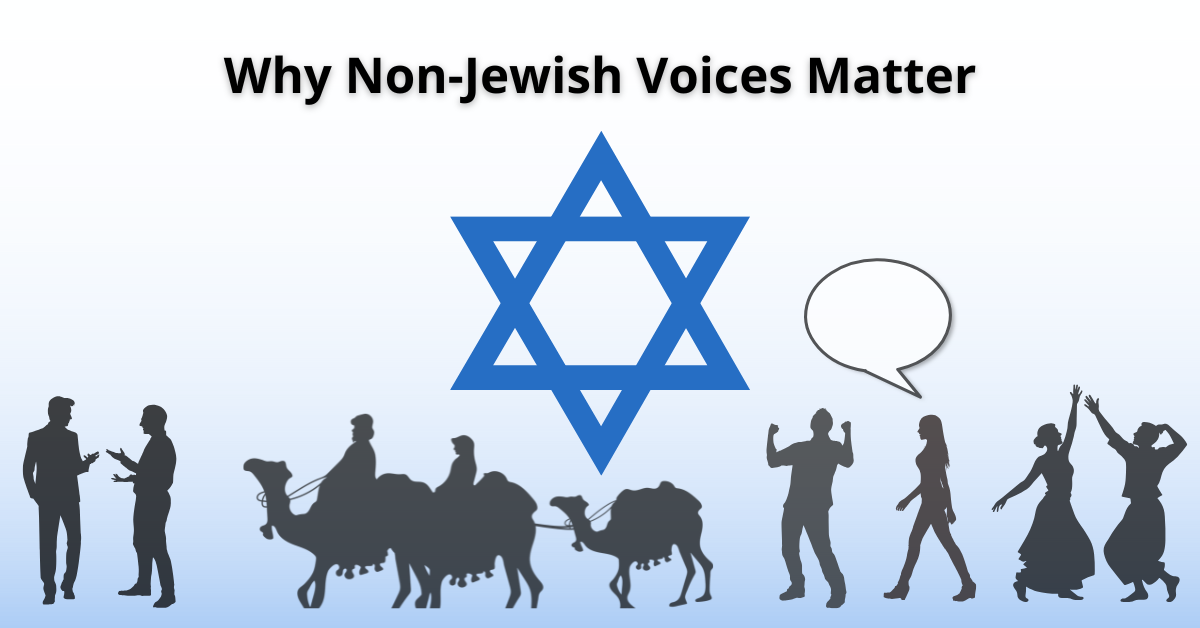
I am not Jewish. In fact, I grew up in countries under Islamic Sharia law, where Jews were often spoken ill of.
Interestingly, one of my names has Jewish origins, and through some unfortunate catcalling incidents (as a schoolboy) and other experiences, I became curious about this general hatred for the Jewish people in those countries.
Later, I lived on a kibbutz in Israel in 2014.
These experiences shaped my life especially in showing me why Israel needs non-Jewish defenders. Because as a Brown Christian (a minority who lived in these places), I learned firsthand how narratives are formed.
And too often, Jewish voices defending their own country are written off as being based on self-interest.
That is where non-Jews should come in, if you ask me.
Our words can push back against narratives because we are not speaking to protect “our tribe”; we are speaking because the truth demands it.
When Church Fathers Got It Wrong About the Jews
Let me start with my own faith. I’m a non-denominational Christian.
But I readily acknowledge Christianity has a long and ugly history of antisemitism, and anyone honest must admit this.
The poison was poured pretty early on, even from the time of the earliest church fathers. In fact I’ve made a 5-min plus video on Youtube explaining exactly this!
Marcion of Sinope threw out the Hebrew Bible, claiming the God of the Old Testament was vengeful compared to the “loving” God of the New Testament.
Ignatius of Antioch warned Christians not to “Judaize,” pushing Sunday worship as a rejection of Jewish customs (which was never theologically backed).
Justin Martyr argued that Christians were the “True Israel,” dismissing Jewish interpretations of the very scriptures that were written by the Hebrew people.
It went even further downhill from there. Melito of Sardis accused Jews of deicide, charging them with killing Jesus which still some fringe denominations hold on too. Tertullian painted Judaism as obsolete.
Centuries later, Martin Luther, who is famous for sparking the Protestant Reformation, ended up writing some of the most disgusting rants against Jews ever penned by a Christian.
His pamphlet On the Jews and Their Lies called for burning synagogues and seizing Jewish homes. The Nazis weaponized those writings to justify their own hatred.
Why is this important? Because this legacy matters.
Too many Christians today act as though antisemitism is just a problem in Islam or on the political left.
But our own house is not clean and for Christians reading this, we need to address that issue first before anything else. Our theologians and reformers set the stage that poisoned Jewish-Christian relations for centuries.
There’s one important distinction between Christianity and Islam, though, that should be brought up in Christendom’s defense.
Unlike Islam, where ordinary believers were expected to recite and engage with the Qur’an directly, ordinary Christians in medieval Europe rarely had direct access to the Bible.
Vernacular translations were often forbidden, and if you owned or read one, you could be charged with heresy. This was a serious crime, and the punishment could be severe, even death.
So while holy texts in Islam have long been used as a reason for violence by Jihadist groups (even their famous warrior kings like Sultan Mehmet II), most Christians didn’t kill Jews based on what they read in scripture. They did it because corrupt leaders told them to.
That doesn’t excuse the crimes.
But it explains why today you do not see mainstream Christians committing terrorism in the name of scripture, while in parts of Islam, violence in God’s name is still par for the course.
I’ve spent a lot of time thinking about this myself. Just a couple of decades ago, Christians from many different backgrounds supported Israel firmly, a stance that wasn’t limited to Evangelicals, who have historically been among its staunchest allies.
They were taught in church about God’s promises to the Jewish people and felt as if they were watching those very promises unfold.
Now, though, Gen Z tends to avoid services and leave the scriptures untouched, making them easy targets to pro-Palestinian narratives that disregard that foundation. This shift is impossible to miss.
That’s why I feel we have to get these insights out there. Whether it’s an Instagram post or a conversation with a friend, we need to share them to build a deeper appreciation and hold on to the solidarity that history demands of us.
How Islamic History Was Whitewashed for Public Consumption
Now let’s talk about the other side. In the West, Islam’s record is often whitewashed.
Academia teaches about the “Golden Age” of Al-Andalus, as if Muslim Spain was some tolerant paradise.
But historians like Raymond Ibrahim have unearthed the ugly truth: Christians were boiled alive, nuns were defiled on crucifixes, and 30,000 churches destroyed in a single year (1009 AD).
That brutality makes groups like ISIS or Hamas look less like deviations and more like a continuation of an old pattern.
The Spanish Inquisition is always taught as one of history’s great Catholic crimes. It was harsh, particularly for Jews.
But what’s rarely mentioned is that it followed centuries of Christian slaughter under Muslim rule.
The Inquisition wasn’t something that just appeared out of thin air. It was a reaction to years of domination and humiliation, and Muslims were the primary target for revenge. Sadly and tragically, Jews also got caught in the middle.
I am not defending the Inquisition. It was evil.
But I am pointing out that history is being told selectively.
Muslim crimes are downplayed or overlooked, Christian crimes are usually exaggerated, and Jewish suffering is acknowledged only when it serves a particular agenda.
Sound familiar? That is exactly how the story of Israel since 1948 is told.
Israel After 1948: What the World Chose to Forget
As many already know, Israel’s Declaration of Independence was met with an immediate invasion by 5 Arab armies.
At the time, Arab leaders urged many local residents to evacuate for the time being, with guarantees of return once the Jewish state was defeated.
It didn’t go their way. Israel survived.
But when those refugees could not return (for obvious reasons), the story was reframed: they had been “forcibly removed.”
Meanwhile, the fact that Arab countries expelled close to 850,000 Jews during the same era is brushed aside.
The fact that Jordan illegally occupied the West Bank and Egypt occupied Gaza after 1948 is swept under the rug in modern teaching.
These territories were lost in 1967, which aligns with a simple historical truth: defeated nations have historically surrendered land, a principle seen with Germany and Japan after World War II.
And yet, Israel is somehow singled out as illegitimate for holding onto land won in defensive wars.
The pattern is the same as the way the history of Christianity and Islam is told. One side’s crimes are highlighted, the other side’s erased.
Think about the Armenian Genocide by the Muslim Ottomans. A whole people group was almost entirely wiped out. It would have been buried entirely if not for a few brave reporters.
History works that way, doesn’t it? One side’s pain gets remembered, and the other’s just vanishes.
Lessons From Sharia, Truths From Israel
As I said earlier I grew up in Sharia countries where antisemitism was not a fringe idea. It was normal.
Teachers, clerics, and even my school friends spoke about Jews with contempt. No one questioned it. It was considered part of being a good Muslim in that society.
Later, I lived in Israel. Where ironically one of my best friends was a Muslim. I was there when the kidnapping of 3 Israeli teens escalated into Operation Protective Edge, a conflict that brought to light underground tunnels in Gaza.
Life was tense, but the tough people of Israel carried on.
What I saw there was nothing like the propaganda I had grown up with from major news networks. Israelis were not plotting conquest; they were just trying to live and be human.
They were planting crops, raising children, making discoveries that can change the world for the better, and protecting each other.
The biggest contrast was not military might but mindset. One side glorified death, the other clung to life.
That is why reducing this conflict to “land” is so wrong!
It never was about land. It is about honor, shame that stems from a 7th Century tribal mindset and a refusal to accept Jewish dignity.
The very existence of Israel is an offense to an ideology that cannot stomach Jews standing proud after ages of being persecuted.
Why non-Jewish voices matter
This is why people like me, and many others, have to speak up for Israel’s rights. Its case is not only just but also grounded in historical facts.
When a Jewish person defends Israel, critics have an easy way out. They just smirk and say, “Well, of course they would.” But when a non-Jew, like a Christian, Hindu, Buddhist, or even a Muslim who knows better, speaks up, that lazy dismissal simply doesn’t work.
I have no personal stake in this. While my faith plays a role in my support, I’m not Jewish and I’m not Israeli.
I get plenty of pushback from Christians who know very little about the conflict from either a secular or spiritual perspective, as well as from Muslims who clearly have an agenda.
I speak because I know what happens when lies go unchallenged. I speak because, in a very small way, I can relate to being an underdog like Israel. Above all, I love what Israel has accomplished and continues to achieve.
Christians especially must learn from our history. We can’t erase the antisemitism of the past, but we sure can refuse to repeat it.
We can, and should, admit that some Church fathers had an agenda and twisted scripture. By doing that, we can stand alongside the Jewish people and reject the Replacement Theology that would have us pretend we’ve replaced them.
When we do, we’ll see that Israel’s survival isn’t a threat to our faith; it’s proof that God’s promises are being fulfilled.
Supporting Israel doesn’t mean we should ignore those in the Arab population who want peace. A lot of them simply want to live alongside Israelis without conflict.
But what it does mean is rejecting the lies about Israel’s legitimacy and refusing to put it in the same category as colonial empires (such as Great Britain) that have nothing to do with Jewish history.
And it certainly means that to fix the problem, we have to address the ideology, not sugarcoat the truth just to sound politically correct and get approval from our peers.
It also means reminding the world that Jews are indigenous to the land where their ancestors lived, prayed, and died.
Silence Is Not an Option
When you get past all the distractions, the choice becomes simple. You either defend Israel’s right to exist, or you align yourself with those who want to see it erased. You either confront the whole of history, or you let myths win.
As I’ve said before, I am not Jewish. But I have lived enough of this history to say plainly.: non-Jews cannot stay quiet.
If we do, we allow the same lies that fueled centuries of violence against the Jewish people to resurface once more, something that’s already happening in much of the world.
It’s our job to make sure those lies never take hold again.