
CEO of Time to Stand Up for Israel
Why Israeli and Diaspora Jewish Mentalities Differ
The Same Roots, a Different Soul: Why Israeli and Diaspora Jewish Mentalities Differ
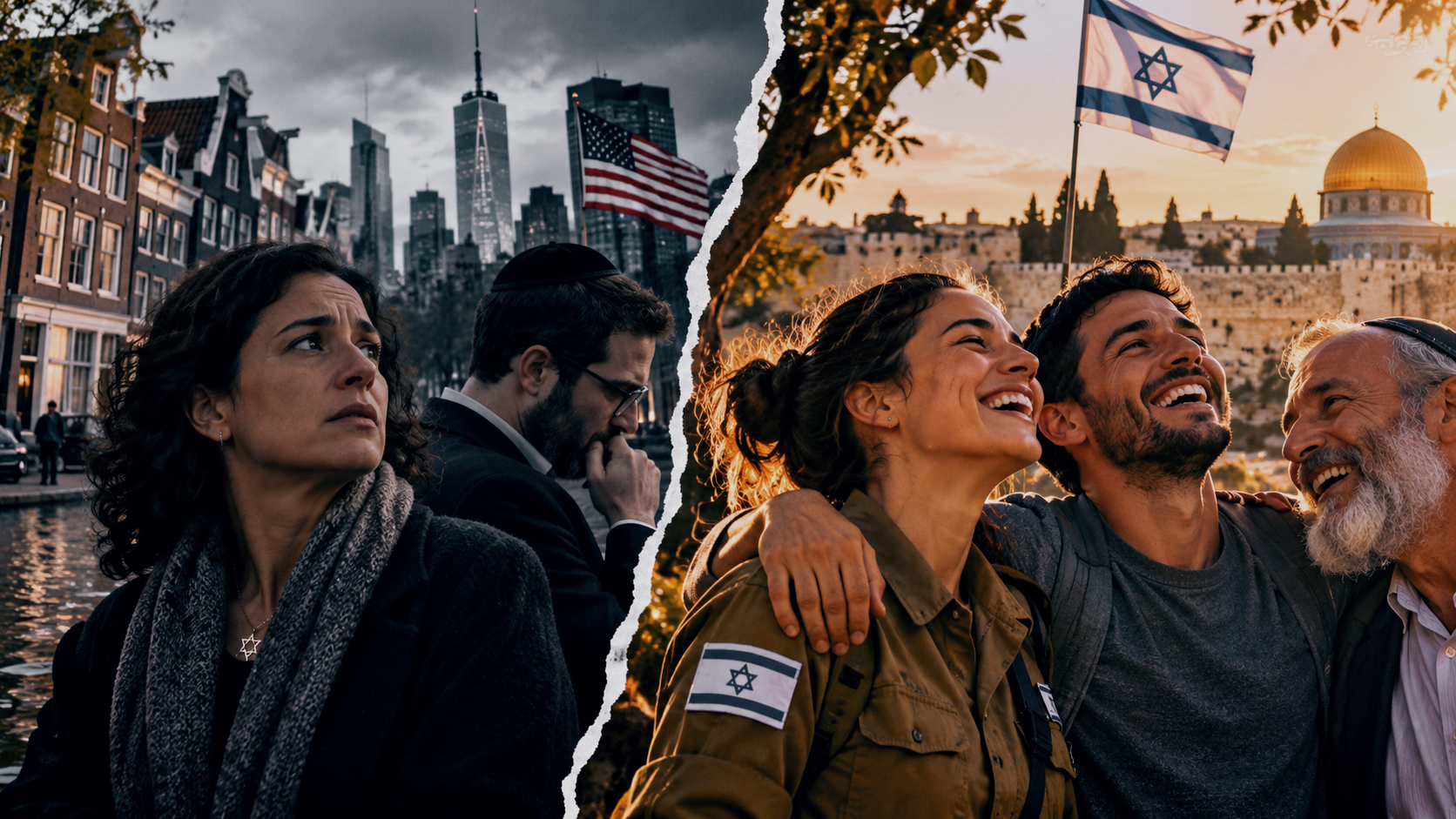
Photo Credits: Sabine Sterk(AI)
After more than a decade of advocating for Israel, countless conversations with Jews from all over the world and my own experiences of living in and frequently visiting Israel, something continues to strike me. How is it possible that people who share the same historical roots, the same collective memories and essentially the same cultural heritage can develop such profoundly different mentalities? What fascinates me most is the contrast between the resilience, optimism and warmth I frequently encounter among Israelis and the negativity, apprehension and sometimes even hostility I encounter among Jews living in the diaspora, particularly in the United States and the Netherlands.
In my advocacy work, I regularly use satire to expose the absurdities surrounding the Israeli and “Palestinian” conflict. Humour is a powerful instrument because it allows us to expose contradictions without necessarily becoming consumed by anger. Yet I sometimes encounter American Jews who respond with profound negativity, interpreting everything through the lens of confrontation, occasionally even suggesting that every problem should be solved with weapons. What strikes me about these encounters is that some of the most uncompromising reactions come from people living thousands of kilometres away from the conflict, while Israelis, who actually live with its consequences, often retain an extraordinary ability to laugh, celebrate life and look towards the future.
This is not a scientific assessment of entire populations, nor do I pretend that every Israeli is optimistic or every diaspora Jew pessimistic. These are personal observations accumulated over many years, but they raise a legitimate question about the psychological and cultural consequences of living as a sovereign people rather than as a minority.
The difference between belonging and seeking acceptance
For centuries, Jewish communities in the diaspora had to navigate societies in which their acceptance was never entirely guaranteed. They learned to adapt, integrate and sometimes conceal aspects of their identity. The historical experience of persecution, exclusion and antisemitism inevitably influenced the development of Jewish communities outside Israel.
In the Netherlands, I have frequently encountered Jews who prefer to remain invisible, who avoid publicly expressing their connection to Israel and who remain silent when Israel is being demonised. Sometimes I experience that silence as opportunism, although I recognise that fear, personal safety and professional consequences can also play a significant role. Nevertheless, as someone who has repeatedly paid a personal and professional price for openly supporting Israel, I find that silence particularly painful.
Israel fundamentally changed the Jewish experience. Jewish people no longer had to depend exclusively on the goodwill of others to determine their collective future. They could speak their own language, celebrate their traditions openly, defend themselves and develop a society in which their identity was not an exception requiring explanation.
That transformation from minority existence to national sovereignty has profound psychological consequences.
The extraordinary Israeli appetite for life
Israelis have every conceivable reason to be pessimistic. Generations have experienced wars, terrorism, bereavement, military service and uncertainty. Almost everyone knows someone whose life has been affected by conflict. Yet what I repeatedly encounter in Israel is an extraordinary appetite for life, a determination to celebrate, to build, to innovate, to love and to continue.
There is something deeply moving about a society that refuses to allow its enemies or its circumstances to determine its happiness. Israelis argue passionately, criticise their government, challenge authority and disagree with one another about almost everything imaginable, yet beneath those disagreements I frequently recognise a profound attachment to life itself.
Perhaps this is precisely what makes Israeli humour so distinctive. Humour is not necessarily the absence of pain, but a mechanism for surviving it. Being able to laugh in the face of adversity can be an expression of psychological resilience rather than indifference.
Gratitude that cannot be manufactured
Another difference I have personally experienced is the response to genuine friendship and support. In Israel, when you demonstrate even a little sincere love for the country and its people, you can encounter a level of gratitude that is almost overwhelming. A stranger can become a friend for life, a conversation can become a meaningful connection and a simple gesture of solidarity can open doors that no professional introduction ever could.
I have experienced this warmth repeatedly. It is one of the reasons my connection to Israel has become so deeply emotional. There is a directness, an authenticity and a willingness to express affection that I find particularly moving.
It does not mean that Israelis are inherently kinder or that diaspora Jews are incapable of the same warmth. It means that the cultural environment in which people develop influences how they express their emotions, their fears, their gratitude and their sense of belonging.
When fear becomes a mentality
What concerns me is that fear, even when historically justified, can eventually become a mentality that prevents people from recognising the beauty of life. Constantly anticipating hostility, interpreting every disagreement as an attack and responding to every provocation with anger can become emotionally exhausting.
Israel was established not merely to protect Jewish people from persecution, but also to enable them to live freely, to develop their talents, to raise their families and to determine their own future. Jewish sovereignty was never intended to be exclusively about survival. It was also about living.
Perhaps that is the most significant difference I experience between Israeli society and parts of the diaspora. The historical memory of persecution remains present in both, but the experience of sovereignty offers a different relationship with that history.
Israelis are not immune to fear, but their country represents the possibility of building something beyond it.
After all these years of advocating for Israel, I do not want hatred to become the driving force behind my work. I do not want to become consumed by anger, bitterness or the desire for revenge. My advocacy originated from love, and I want love to remain its foundation.
What I admire so profoundly about Israel is not merely its ability to defend itself, but its ability to remain alive in the fullest meaning of that word. Its ability to laugh through tears, to celebrate despite uncertainty, to create despite destruction and to welcome genuine friendship despite repeated betrayal.
Israel has taught me that survival is a necessity, but living is a choice.
And perhaps the greatest victory over those who wish to destroy you is refusing to allow them to destroy your joy.
Related Topics
Related Posts