
Urban Sociologist and Global Affairs Commentator
Why Israel’s ‘Disunity’ is a Local Form of a Global Condition
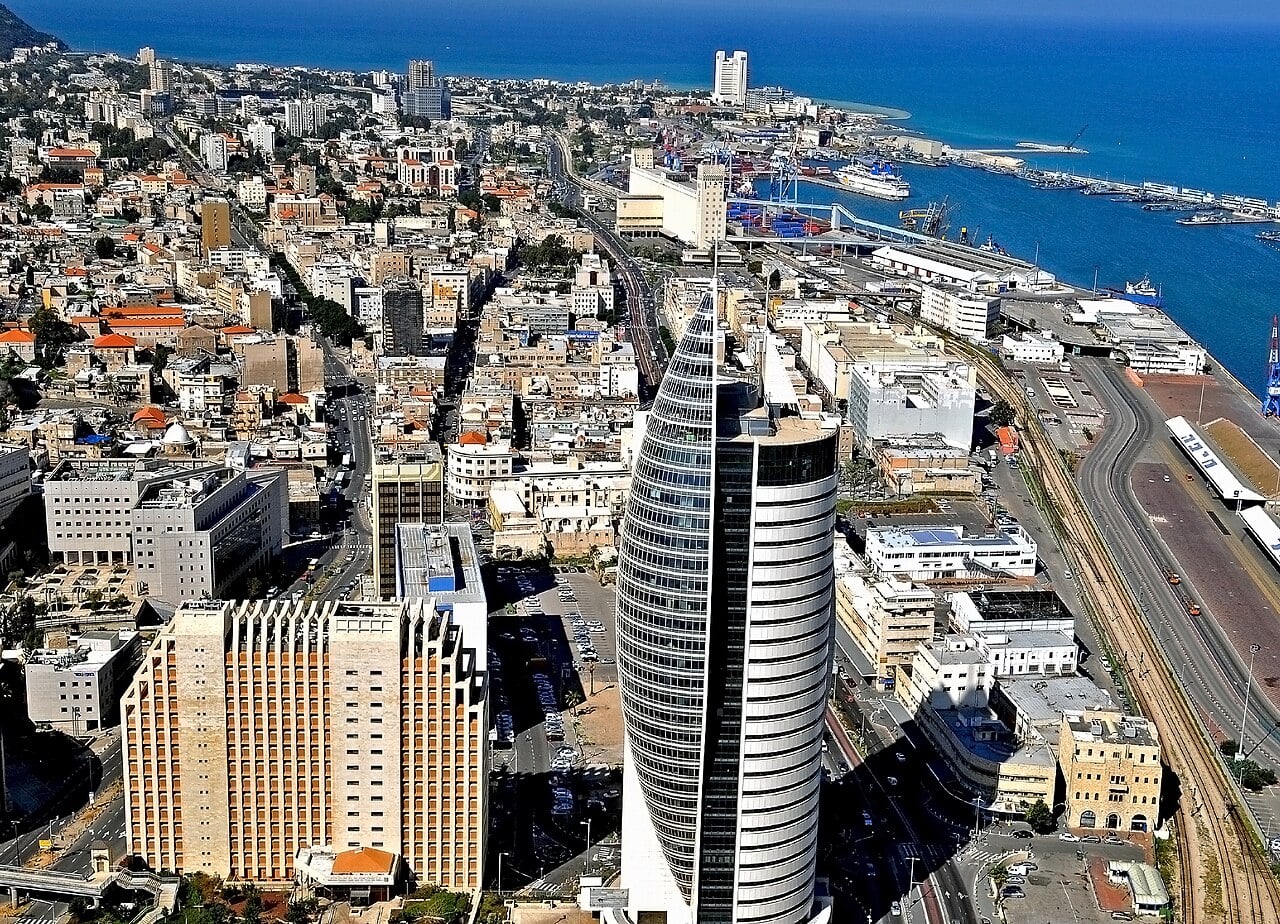
The lower town of Haifa, an area where Arabs, both Christians and Muslims, comprise around 70% of the residents. February 13, 2009. (Credit: Zvi Roger/Wikimedia Commons)
The 27 October vote left both blocs short of a majority. Netanyahu’s coalition won 53 seats and Eisenkot’s bloc 48, against the 61 needed to govern. Two Arab-led alliances took a combined 19 seats, their strongest showing to date, helped by higher Arab turnout. After consultations, President Herzog tasked Eisenkot with forming a government, citing recommendations from factions totalling 67 members against 46 for Netanyahu. Eisenkot has 28 days, extendable by up to 14. Effectively that runs to early December, or mid-month with the extension. Netanyahu remains prime minister until a new government wins a confidence vote.
A majority on paper has not become a coalition. Eisenkot’s four-party alliance needs at least 13 more seats, and there are three routes: outside support from Arab parties, a deal with the ultra-Orthodox parties, or a government including Likud. Each carries a cost. Eisenkot cancelled talks with Likud, which called the cancellation incomprehensible/ “puzzling”. Liberman has signalled openness to the ultra-Orthodox parties, but Eisenkot insists on universal national service, which those parties bitterly oppose. Jewish members of his bloc say they will not join a government that depends on Arab-party support. The Joint List says it does not accept his four principles. Right-wing protesters outside the Knesset have warned of civil war if a government forms with Arab-party backing. Since this is moving daily, I’d treat all of it as provisional.
Unity as a contested signifier
The word “unity” itself has split. Netanyahu urges a unity government but on the condition that his whole bloc joins. Yashar answers that Likud is welcome only if it breaks with the extremists, accepts Eisenkot’s four principles and serves under him. Each side offers “unity” as an invitation to accept its own terms. The word has become a weapon in the dispute it was meant to resolve. That is a symptom of a society that no longer shares a grammar of legitimacy.
Why this is symptomatic of wider change
Israel’s particularities are real: the “occupation”, the Jewish-democratic formula, the proportional system. But the underlying pattern resembles what many democracies are experiencing. I would point to five mechanisms, offered as interpretation rather than settled fact.
- The erosion of a common epistemic ground. Habermas (in his Theory of Communication Action) described the life-world as the background of shared meanings that lets people argue without first having to agree on what counts as real. Where that background thins, even procedures become contestable. Herzog’s acceptance of the certified results was a blow to Netanyahu’s effort to “discredit the vote”. Disputing the vote itself is not unique to Israel, since the same move appears in the United States, Brazil and elsewhere. Algorithmic, segmented media makes it easier for communities to inhabit different factual worlds, and a government cannot be formed across worlds that do not overlap.
- Recognition displacing redistribution. The campaign touched cost of living, but conscription and national security were key issues alongside it. Conscription is a dispute about who belongs and what they owe, not about money. Globally, as material security has become uncertain and economies less able to deliver shared prosperity, politics has shifted toward questions of identity, dignity and status. Such disputes are hard to split in the middle, which is the core of what bargaining does.
- The permanent emergency. Both sides invoke emergency. Eisenkot calls for a “national emergency government” and says unconventional steps are needed. In Ulrich Beck’s sense, risk society produces a politics of exception, in which threats such as war, pandemic, climate and economic shock are always imminent. Emergency politics can briefly suspend division, but it can also legitimise ever more drastic moves, and it makes ordinary compromise look like negligence. The paradox is that the condition that should compel cooperation also makes concession seem too dangerous.
- Liquid organisation. Castells’s network society and Bauman’s liquid modernity suggest that stable mass institutions are giving way to flexible, personalised vehicles. Israel’s election fits: several new parties competed, notably Yashar and Together, led by Eisenkot and Bennett. Lists that form, merge and dissolve reflect the pattern seen in France, Italy and elsewhere, where parties are less durable carriers of interest and more temporary alliances around personalities. That makes durable coalition commitments harder to sustain.
- The cordon sanitaire and the arithmetic of exclusion. Much of the deadlock comes from a taboo. Arab-led parties remain largely excluded from coalition calculations, as most Jewish opposition leaders reject cooperation with them. Comparable cordons exist against far-right parties across Europe. When a sizeable bloc is treated as unusable, the majority arithmetic shrinks and governments become either fragile minorities or grand coalitions of opponents. In both cases the system reflects its divisions instead of resolving them.
What follows, and what doesn’t
None of this makes Israel’s trajectory predetermined. Some things worked: the results were certified, the president acted on precedent, and turnout was high among communities that are often disengaged. Those are signs of institutional resilience.
The deeper analysis points elsewhere. If these are structural forces rather than personal failings, then replacing one prime minister, or even forming a broad coalition, addresses the symptom. Cohesion is built in life-worlds, in schools, workplaces, media ecosystems and shared obligations, and no cabinet agreement produces it. A government that functions through 2027 would be a procedural success, and it would leave unresolved the question of whether Israelis still inhabit overlapping worlds.
Israel may, therefore, be best read as an intensified case rather than an exception: a place where demographic change, security trauma, religious and secular claims and institutional distrust compress into one small electorate. What happens there deserves attention elsewhere because the same pressures are present, only less concentrated.
Related Topics
Related Posts