
Why Israel’s Flag Still Matters
How a simple symbol became a global marker of resilience, renewal, and unity
Every nation has a flag, but for Israel, it has never been “just” a piece of fabric. It is identity. It is survival. It is hope. The blue and white of the Magen David, the Star of David, has flown through wars, through rebirth, through tragedy, and through triumph. At 78 years old, the Israeli flag represents more than a state; it embodies a story thousands of years in the making.
I have seen this personally. I remember walking through the streets of Tel Aviv not long after the horrors of October 7. The city was quieter, but everywhere – on balconies, street corners, car windows – the flag waved. Not defiantly, but faithfully. There was grief in the air, yes, but also strength. I found myself stopping at one corner, taking the flag in my hands, and wrapping it gently around my shoulders. It felt like a hug from history. A reminder that resilience and renewal are not slogans here, they are lifelines.
The Israeli flag’s Star of David is not just symbolic; it is ancestral. David, the shepherd turned king, ruled a united Israel over 3,000 years ago. From his lineage came generations of Jewish leaders and prophets – and yes, Jesus of Nazareth himself, Christ the King. That single emblem has traveled across centuries of exile, persecution, and survival, carried on Torah covers, synagogue walls, and the hearts of millions who dreamed of coming home.
And today, that same star marks the flag flying over Tel Aviv, Jerusalem, Haifa, and beyond. It is a banner of continuity. When Israeli athletes stand on a global stage, the blue and white rises behind them. When IDF soldiers return from defending Israel’s borders, the flag is there to greet them.

But more than anything, it is a reminder that the story of the Jewish people, ancient and modern, cannot be erased.
One of the things that struck me most this year was how far beyond Israel’s borders this flag travels – and how often it is celebrated by others.
In Sweida, Syria, where brutal sectarian violence erupted earlier this summer, thousands of Druze protesters waved Israeli flags in defiance of their regime and in gratitude for Israeli aid. “Thank you for help against the terrorists,” one banner read. I kid you not: in the heart of Syria, once an implacable enemy of Israel, the blue and white became a symbol of hope.
In London, Indian protesters raised Israeli flags outside the Pakistani embassy after a deadly terror attack in Kashmir, standing shoulder to shoulder with Jewish groups. The message was clear: terror is terror, and free nations must stand together.
Even across Europe and South America, from Buenos Aires to Berlin, I have watched demonstrations where non-Jews hoist the flag of Israel as an act of solidarity, a quiet recognition that the Jewish story has become part of the world’s story.
This is not about politics. It is about something far deeper: the shared human understanding that freedom is fragile and must be defended.
And yet, that same flag has become a target in parts of the West – desecrated, ripped down, even criminalized in ways that make no sense.
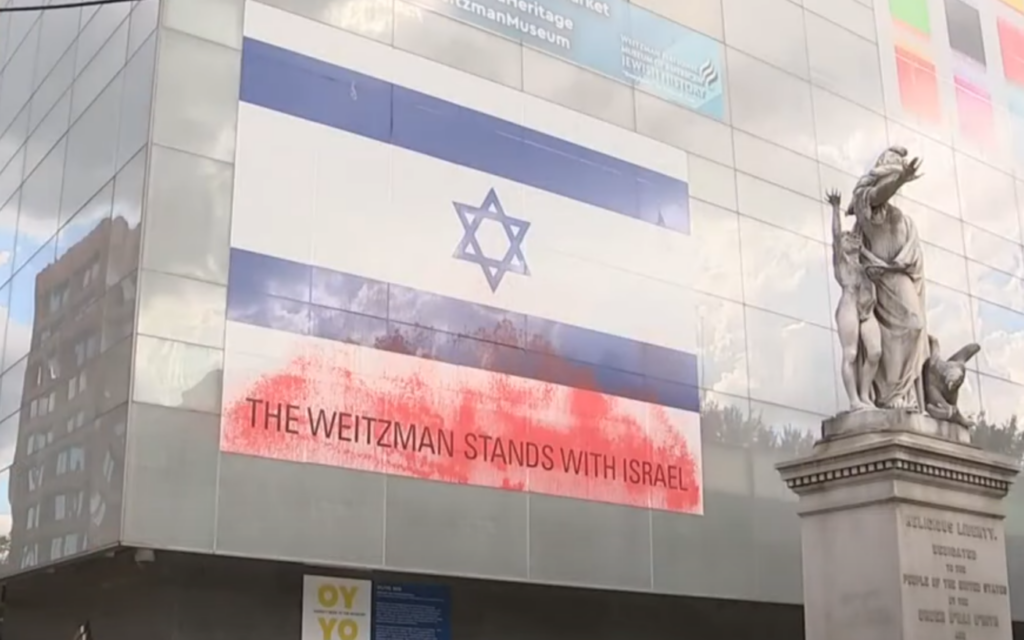
In Philadelphia, the Weitzman National Museum of American Jewish History hung an Israeli flag proudly on its facade after October 7, with the words: “The Weitzman stands with Israel.” Twice in two weeks, vandals splashed it with red paint. Initially, the museum considered replacing it with a neutral “hostage-focused” sign, but after outrage from Jewish and non-Jewish communities alike, they reversed course. The flag stayed.
As the museum’s director Dan Tadmor said, “There can never be any misunderstanding as to our identity and positions: we are a proudly Jewish and proudly Zionist institution.”
But elsewhere, the retreat has been quicker. In Beverly Hills, a school district voted to display Israeli flags in classrooms to mark Jewish American Heritage Month – only for the superintendent to overrule it, citing “safety concerns.” Flying the Jewish state’s flag might make students unsafe… in a district home to one of America’s largest Jewish communities? Seriously?
I cannot hide my disappointment here. These are not protests about policy. They are assaults on identity – on the right of Jews to exist proudly, visibly, and without fear.
Something changed after October 7.
For Israelis, the flag became heavier, carrying grief alongside pride. For Jews around the world, it became a way to say: We are here. We are one. That is why we saw 1,200 Israeli flags planted on the quad at Duke University, one for each life stolen that day. It was not a political display; it was a memorial.
And yet, even there, counter-protests erupted. Students shouting “genocide” over a display meant to mourn murdered civilians. Others ripping flags out of the ground. These are the moments when I feel the deepest ache. Because if there was ever a time for the world to stand with the victims of terror, surely this was it.
And yet, too often, silence. Or worse, anger misdirected at the victims themselves.
Here is the thing about flags: you can burn them, rip them, trample them, but you cannot destroy what they represent.
The Israeli flag has endured darker storms than this. From 1948’s War of Independence to 1967’s Six-Day War, from the Yom Kippur War to the trauma of October 7, the blue and white keeps rising again. Because at its heart is an idea that cannot be erased: That the Jewish people have a home; that this home will defend itself; and that from trauma comes renewal.
So when I see an Israeli flag waving – in Tel Aviv, in Sweida, in London, in Philadelphia – I see resilience stitched into every thread. I see a reminder of what it takes to survive, innovate, and thrive in a world that sometimes misunderstands Israel – and sometimes wants her gone.
Israel is often called the Startup Nation, and rightly so. But beneath the cutting-edge tech, cybersecurity, and Nobel Prizes, there is a deeper innovation at work – the ability to endure, to rebuild, to believe in tomorrow even when yesterday broke us.
That is what the flag represents to me. Not just who Israelis are, but what they refuse to stop becoming.

So yes, when I wrap myself in that blue and white, I feel the weight of exile (as foretold), the miracle of return, and the responsibility to carry this story forward. And when I see others celebrating it – from Druze villages to university quads – I feel a quiet hope that the world, too, can see what some of us see: A symbol not of division, but of survival, creativity, and renewal.
A flag cannot change the world on its own. But it can call us to remember who we are. And when I see the blue and white waving – tattered or pristine, battered or proud – I see the story of a people who refuse to vanish.
And that, to me, is the most beautiful story of all.