Why Jewish High School Students Are Building A Satellite
When I tell people that our high school students are building a satellite to launch into orbit, I usually get the same response. A smile. A pause. And then, “Wait, seriously?”
Yes. Seriously.
This is happening at The Leffell School, a K–12 Jewish independent school in Westchester County, New York. Most people assume this kind of work belongs in elite university labs. They picture graduate students in specialized programs, not teenagers in a Jewish day school.
That assumption is exactly what we want to challenge.
The Leffell Space Program is a multi-year sequence within our Engineering and Entrepreneurship (E2) curriculum in which students study physics, astronomy, and engineering, complete a series of preparatory launches, and ultimately design and build a CubeSat, a shoebox-sized satellite used by universities and research institutions for space-based experiments. This work is supported by a grant from the Amateur Radio Digital Communications Foundation (ARDC), which will allow us to construct a professional-grade satellite ground station on campus. Once built, this ground station will serve as the command center for everything our students design and fly.
This ambitious project is a natural outgrowth of The Leffell School’s core values. We believe that learning should be bold, curiosity carries responsibility, and students should feel connected to something larger than themselves. Jewish tradition challenges us to question and explore. Science at its best captures the same spirit: a dialogue built on inquiry and the courage to wonder. A schoolwide space program fits naturally into that spirit.
This work is also rooted in our school value of Ahavat Yisrael, love of Israel. Our students are inspired by TEVEL, the remarkable high school satellite initiative based in Herzliya, Israel and led by Tel Aviv University and the Israel Space Agency. TEVEL shows what is possible when young people pursue science with ambition and purpose. Once operational, our ground station could also extend TEVEL schools’ ability to communicate with their satellites by linking with ours as they pass over North American airspace. As our ground station comes online and our mission advances, we hope to join that community of young Israeli space explorers as active partners, collaborating and learning alongside them, and seeing Israel as a source of innovation, shared purpose, and aspiration.
“When students realize this isn’t a classroom exercise and that real outcomes depend on their work, they take ownership in a way few projects ever demand,” says Raz Idan, space education coordinator for the Leffell Space Program and an M.Sc. candidate in Space Systems Engineering at Johns Hopkins University.
Our space program did not appear overnight.
How We Got Here
Long before we envisioned a space program, our students were already building for impact. More than ten years ago, we created the first makerspace in any Jewish day school because we wanted students to design and build, not only read about ideas. That space became the home to our E2 program, a four-year journey through which students master coding, electronics, fabrication, and product design. They also learn public speaking, teamwork, and human-centered design, using technology to help real people.
As members of the TOM (Tikkun Olam Makers) community for eight years, our students cap their learning by designing assistive-technology solutions for community members who face disabilities or mobility challenges. That work gives students a clear message: engineering is not just about what you can build, but whom you build it for.
Over the years, the program gained national recognition and produced hundreds of graduates. Many went on to study engineering or computer science in college and beyond. Some filed for patents based on work they completed in high school. Most importantly, they learned to see themselves as capable, creative problem-solvers who can take on complex, open-ended challenges.
Supported by partners such as the Center for Initiatives in Jewish Education (CIJE), our program reflects a growing movement in Jewish schools toward ambitious, real-world STEM learning rooted in values and purpose.
Eventually we asked what might push our students even further. What challenge would require deeper systems thinking, longer timelines, and higher stakes? The answer was space.
Space forces students to think differently. It demands precision, planning, systems thinking, and the ability to integrate many fields at once. There are no shortcuts. That is exactly the kind of learning we wanted for them.
With university-level fabrication equipment, the soon-to-be-constructed ARDC-funded ground station, and the leadership of Raz Idan, the Leffell Space Program took shape.
Looking Up
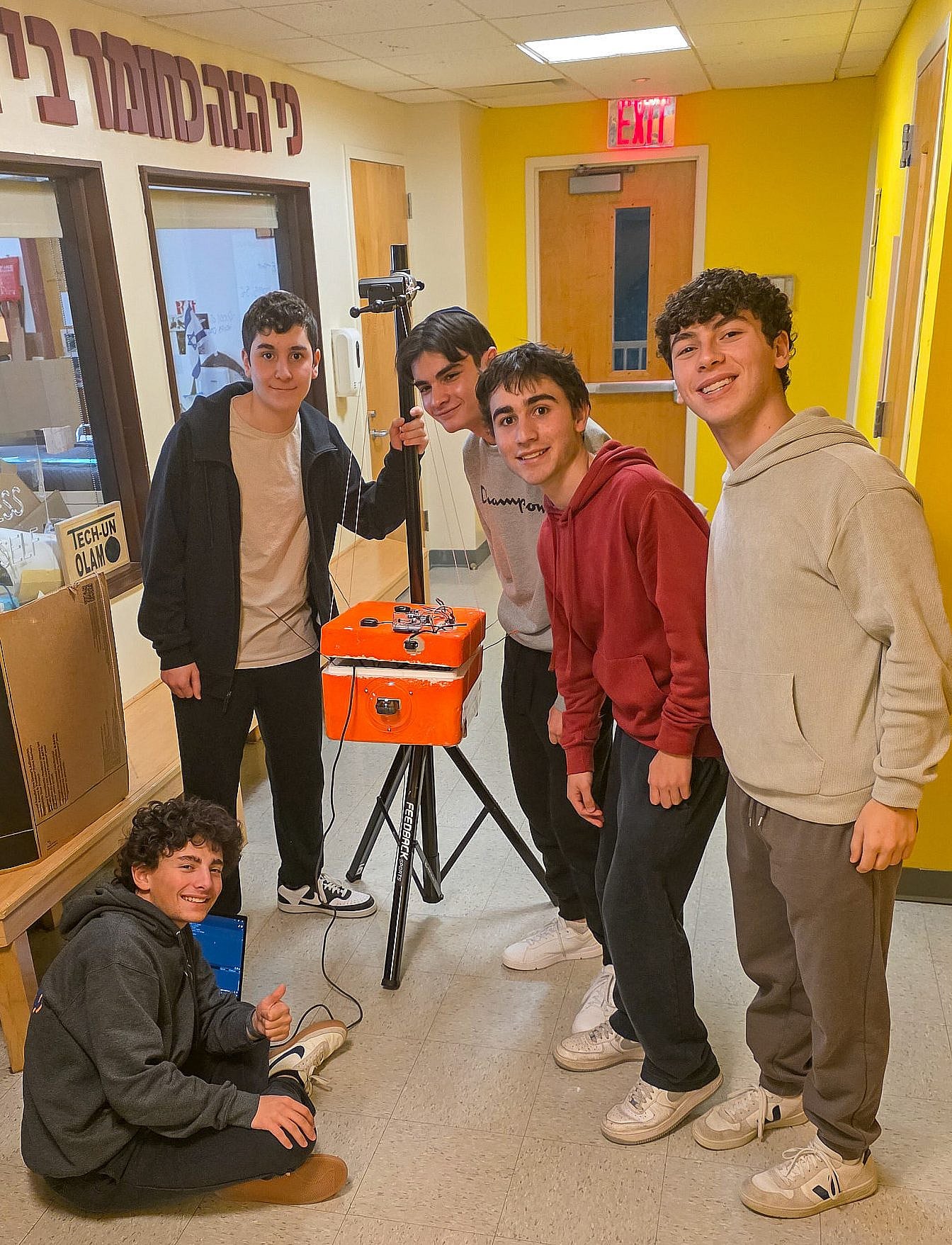
Every time I watch students “geek-out” over space news, debate payload options for the satellite, or model the high-altitude weather balloon’s flight path, I feel both awe and gratitude: awe for what these teenagers can accomplish and gratitude that I get to witness it firsthand. Twelfth-grade student Spencer Kolodny, who serves as both technology lead in the space program and student council president, shares my excitement:
“Collaborating with fellow students to build a high-altitude weather balloon has been the most gratifying experience of my four years at Leffell. What began as a few loosely wired sensors grew into a sophisticated system with 3D-printed components, hundreds of carefully routed wires, and a custom-built payload box. As launch day approaches, my excitement keeps growing. Leffell gave me an opportunity few schools in the country can match.”
When our satellite finally sends its first signal home, our students will look up and know that something they built is orbiting Earth. They will know that Jewish values, Ahavat Yisrael, partnership with Israel’s TEVEL program, and support from organizations like ARDC helped make that moment possible. This is the kind of learning that lasts, and it is why we reached for space in the first place.