
Middle East Analyst
Why Middle Eastern States Oppose US Military Intervention in Iran
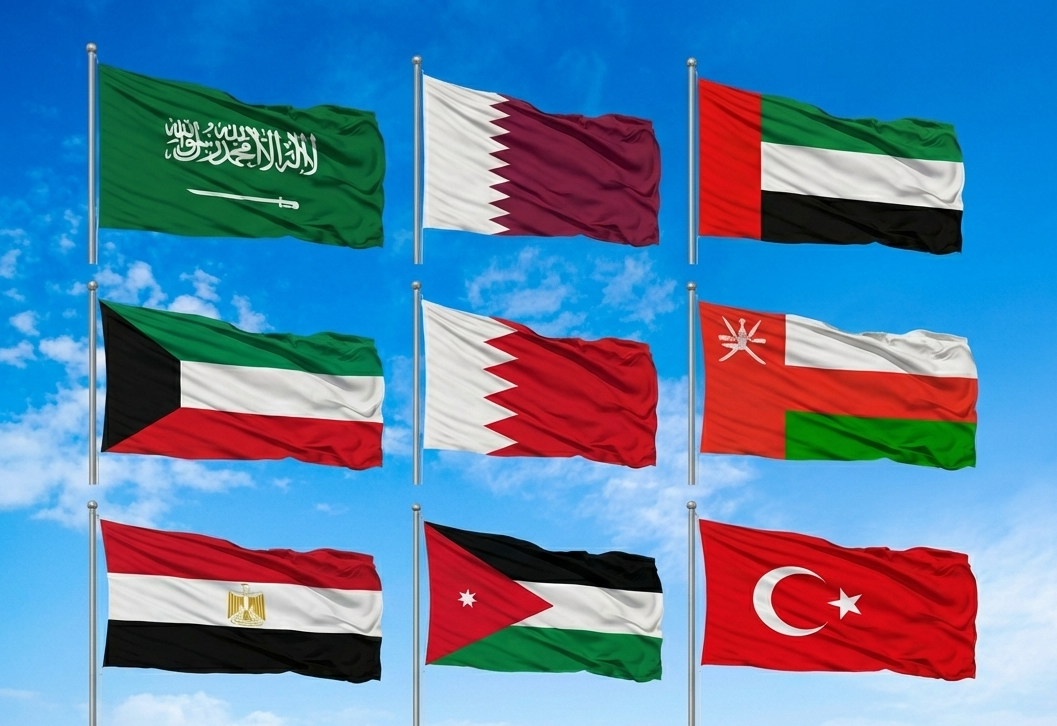
Graphic by author
In early 2026, the strategic landscape of the Middle East is shaped by a striking convergence: while many regional governments remain deeply distrustful of Iran’s intentions and regional behavior, there is a near-universal assessment that a US military intervention would be profoundly destabilizing. Across the Gulf, the Levant, and Turkey, leaders increasingly view war with Iran not as a solution to regional insecurity, but as a catalyst for economic shock, domestic unrest, and long-term strategic degradation. The following assessment outlines why key regional actors now see intervention as an unacceptable risk.
Saudi Arabia
Saudi Arabia’s position reflects a decisive shift from confrontation toward risk management. Riyadh has signaled a refusal to facilitate US strikes, including denying the use of its airspace, driven primarily by vulnerability rather than sympathy for Tehran. Iran retains the capability to disrupt shipping through the Strait of Hormuz, and to target Saudi Arabia’s energy infrastructure—most notably Abqaiq, Khurais, and Ras Tanura—with missiles and drones, as demonstrated in 2019. Even limited retaliation would disrupt global energy markets and severely undermine Vision 2030, which depends on foreign investment, tourism, and the perception of internal stability. Saudi leadership also assesses that a regional war would divert financial and political capital from other priorities, including regional diplomacy and post-Gaza reconstruction efforts that Riyadh increasingly frames as part of its leadership role rather than a purely humanitarian endeavor.
Qatar
For Qatar, the risks are existential. Doha shares the world’s largest natural gas field with Iran, making sustained stability in the Gulf essential to its economic model. Any conflict that disrupts production, shipping, or joint field management would directly threaten state revenues. Compounding this exposure is Qatar’s hosting of Al Udeid Air Base, which would almost certainly be viewed by Iran as a legitimate retaliation target. Qatari strategy has long relied on diplomatic mediation as a form of deterrence; a US intervention would collapse this posture and force Doha into a conflict it has consistently sought to avoid.
United Arab Emirates
The UAE maintains a public stance of strategic neutrality, but this reflects calculated self-interest rather than ambiguity. Abu Dhabi’s leadership is acutely aware that its global financial hub status, logistics networks, and tourism economy are predicated on regional calm. A conflict with Iran would endanger shipping through the Strait of Hormuz, threaten port infrastructure, and likely trigger capital flight from Dubai. Despite ongoing tensions with Tehran and security coordination with Israel, Emirati planners judge that the economic costs of war would far exceed any prospective strategic benefit from weakening Iran.
Kuwait, Bahrain, and Oman
These smaller Gulf states view intervention primarily through the lens of exposure. Kuwait faces strong parliamentary and public resistance to involvement in another regional conflict. Bahrain, home to the US Fifth Fleet, recognizes that its territory would be among the first targets in any Iranian response. Oman, which has long positioned itself as a neutral intermediary, sees military escalation as incompatible with its foreign policy identity and economic resilience. All three states fear that war would inflame sectarian tensions, disrupt trade, and undermine already fragile domestic social contracts.
Egypt
Egypt’s opposition is rooted in regime security and economic fragility. The Suez Canal remains Cairo’s most critical source of foreign currency, and any regional conflict that disrupts Red Sea or Gulf shipping would have immediate fiscal consequences. Egyptian leadership also fears that war with Iran would energize domestic protest movements and Islamist networks, exploiting anti-US sentiment amid existing economic hardship. For Cairo, a US–Iran conflict represents a high-impact destabilizing event rather than a distant strategic concern.
Jordan
Jordan’s position reflects chronic vulnerability. The kingdom is already under severe economic strain and hosts a large refugee population relative to its size. Regional war would disrupt trade routes, risk spillover violence, and inflame public opposition to both the United States and Israel. Jordanian authorities assess that even limited escalation could translate into disproportionate domestic instability, undermining the monarchy’s balancing act between external alignment and internal legitimacy.
Turkey
Turkey’s concerns center on displacement and strategic autonomy. Ankara fears that conflict in Iran could generate large-scale refugee flows toward its eastern border, exacerbating domestic backlash against existing refugee populations. Turkey also depends on Iranian energy imports and has invested heavily in maintaining a flexible posture between NATO, Iran, and Russia. A US intervention would collapse this balancing strategy, impose economic costs, and complicate Ankara’s efforts to position itself as a regional diplomatic actor, including in post-Gaza reconstruction initiatives.
Israel
Israel remains the sole regional actor publicly supportive of weakening or dismantling the Iranian regime. Privately, however, Israeli security assessments are more cautious. After prolonged operations across multiple fronts, the IDF faces resource constraints, personnel fatigue, and growing concerns about air defense sustainability. Israeli planners increasingly judge that a US intervention would be unlikely to produce rapid regime collapse and more likely to trigger a prolonged multi-front conflict involving Hezbollah, Iraqi militias, and other Iranian-aligned actors. There is also recognition that external attack could consolidate Iranian domestic support for the regime rather than fracture it.
Conclusion
By 2026, a broad regional consensus has emerged: security through external military intervention has become a losing proposition. Middle Eastern governments increasingly prioritize economic stability, domestic resilience, and managed de-escalation over maximalist strategies toward Iran. Opposition to US intervention is not an endorsement of Tehran, but a reflection of hard-earned lessons about asymmetrical risk, regional interconnectedness, and the high domestic costs of war.
Related Topics
Related Posts