
Why Must Peace Require a Jew-Free West Bank?
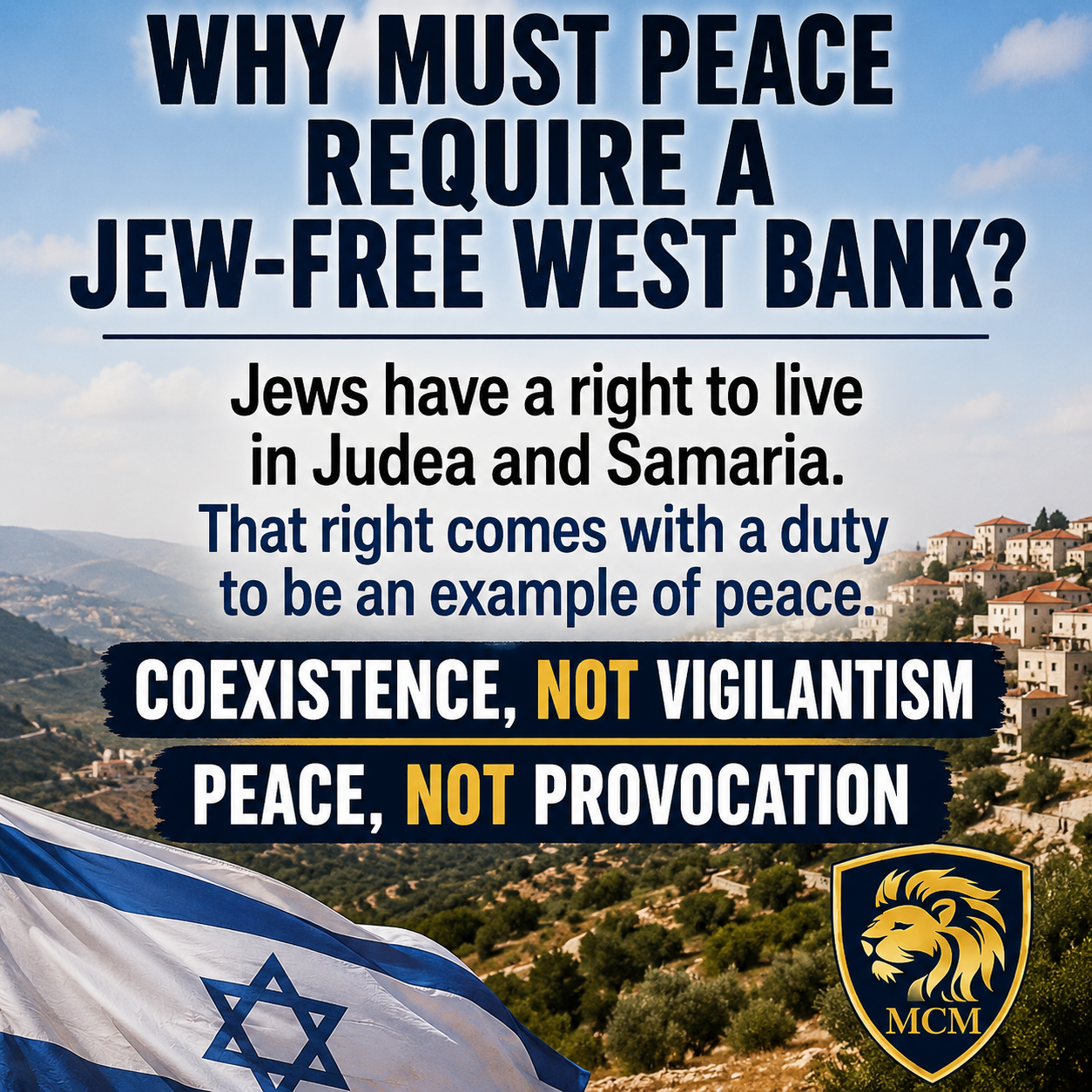
Jews have a right to live in Judea and Samaria. But that right comes with a responsibility to live peacefully, reject vigilantism, respect Palestinian rights, and protect holy sites for everyone.
Peace should not require a Jew-free West Bank.
It should require coexistence.
I once believed that Jewish settlement in the West Bank was an obstacle to peace and should be reversed. After October 7, and after reconsidering decades of rejected peace proposals, I no longer believe that Jewish presence in Judea and Samaria is the central obstacle.
Since 1967, and especially since Egypt made peace with Israel in 1978, there have been repeated attempts to reach an agreement with the Palestinians. During the Clinton administration, Israel accepted the possibility of painful territorial concessions that many Israelis strongly opposed but were prepared to consider in exchange for real peace. Yasser Arafat rejected that opportunity, and later proposals also failed.
Those refusals matter.
Palestinian leaders have been offered frameworks that would have created a state in Gaza and most of the West Bank, often with territorial exchanges. Israel also withdrew completely from Gaza more than twenty years ago. What followed was not peace, but the construction of an underground military infrastructure designed to attack Israel.
That history changes the argument. Settlements alone do not explain why there is still no peace.
Judea and Samaria are not random pieces of foreign territory in Jewish history. They are part of the heartland of the ancient Jewish homeland. That history does not settle every modern legal or political question, but it cannot simply be erased.
International courts and much of the world consider Israeli settlements unlawful. That position should be acknowledged, but I do not regard it as the final word on the moral or political reality. In my view, it reflects an international approach that too often ignores the facts on the ground, treats Israel as the only party responsible for creating peace, and gives too little weight to repeated Palestinian rejectionism.
Israel is not demanding that its roughly two million Arab citizens be removed. Arab citizens live, work, vote, hold public office, and participate in Israeli society. Over generations, many have embraced the freedoms and opportunities Israeli society offers.
So why should any future Palestinian state automatically require Judea and Samaria to be emptied of Jews?
There has also been an interim framework under which different parts of the West Bank remain under different levels of Palestinian and Israeli authority while final-status negotiations remain unresolved. That does not resolve every legal dispute, but it does mean the situation is more complicated than simply declaring any Jewish presence there illegitimate.
That does not mean every settlement decision is wise.
Expansion intended to prevent any future political agreement can be destructive. Unauthorized land seizures, intimidation, vigilantism, and violence against Palestinian civilians are indefensible. The distinction must be made between peaceful Jewish residence and policies intended to dispossess Palestinians or make coexistence impossible.
Settler violence may involve only a small minority, but even a small minority can cause enormous harm. I have written before that Prime Minister Netanyahu bears responsibility when his government allows that lawlessness to continue. Any government that tolerates vigilante violence must answer for it.
I addressed this directly in my Times of Israel article, “For the Love of Israel, Netanyahu Must End ‘Settler Violence,’” where I argued that supporting Jewish life in Judea and Samaria does not mean tolerating lawlessness. On the contrary, those who choose to live there carry a special responsibility to protect Israel’s moral standing by rejecting vigilantism and treating Palestinian neighbors with dignity and respect.
https://blogs.timesofisrael.com/for-the-love-of-israel-netanyahu-must-end-settler-violence/
Jews who choose to live in Judea and Samaria should understand that living there carries a special responsibility. They should be examples of lawful conduct, peaceful coexistence, and good neighborliness—not provocateurs trying to make coexistence impossible.
Israel should prosecute vigilante violence, protect Palestinian property, apply the law consistently, encourage economic cooperation, and support local Jewish-Arab initiatives. Palestinians must likewise reject terrorism and accept that Jews have the right to live safely in the land of their ancestors.
There should be a serious, organized effort to promote peaceful relations between Jewish and Arab residents of the West Bank. If Arabs and Jews can live together within Israel, then we should not assume that coexistence is impossible in Judea and Samaria.
The question is not only where people may live. It is also whether peace will protect the sacred history and religious rights of both peoples.
Muslims rightly insist on continued access to Islamic holy places under Israeli authority, including Al-Aqsa Mosque. Jews are entitled to the same principle.
Why should a future Palestinian state preserve Muslim access to holy places in Israel while denying Jews safe access to sacred sites in Judea and Samaria?
The West Bank contains some of Judaism’s most important religious and historical sites: the Cave of the Patriarchs in Hebron, associated with Abraham, Sarah, Isaac, Rebecca, Jacob, and Leah; Rachel’s Tomb near Bethlehem; Joseph’s Tomb in Nablus; the traditional Tomb of Samuel at Nabi Samwil; ancient Shiloh, where the Tabernacle and Ark of the Covenant were said to have stood; ancient Shechem; Bethel; Sebastia, the ancient city of Samaria; and other sites woven deeply into Jewish history and worship.
These places are not political inventions. They are part of the religious memory and historical identity of the Jewish people.
A peace agreement should guarantee freedom of worship, safe access, preservation of archaeological sites, and equal respect for the religious heritage of Jews, Muslims, and Christians.
Peace should expand religious freedom, not create territory where one faith is welcome and another is forbidden.
I support peaceful Jewish settlement. But that support comes with a clear condition: Palestinian residents must be treated as neighbors with rights, dignity, property, and security. Jewish residents should not view themselves as conquerors, and Palestinians should not be expected to accept violence, humiliation, or displacement.
I no longer accept the argument that Jewish presence in Judea and Samaria is inherently madness or indefensible.
I do accept that violence and vigilantism are indefensible, regardless of who commits them.
We should be capable of holding both positions at once: Jews have a deep historical and religious connection to this land, and Palestinians have rights, dignity, and legitimate national aspirations.
After decades of rejected peace offers, Israel should not be expected to erase Jewish history, surrender Jewish holy sites, or remove Jews from Judea and Samaria simply to satisfy a world that condemns Israel no matter what it does.
The offer has been made again and again for peace and a Jew free West Bank. They had their chance and now it is gone.
Peace cannot require the erasure of Jewish history, Jewish worship, or Jewish life. Nor can Jewish residence excuse violence or abuse of Palestinian neighbors.
The standard must be the same for everyone: safety, dignity, freedom of worship, and equal protection under the law.