
Why Negotiation Cannot End a Holy War – God Doesn’t Sign the Accord
Calling for a negotiated settlement to end the Middle East conflict at this moment in history carries roughly the same practical weight as a candlelight vigil and a collective prayer for peace — sincere in impulse, ceremonially satisfying, and utterly disconnected from the structural realities on the ground.
The persistent faith in negotiation as the universal solvent of human conflict runs aground most completely on a single category of dispute: the religious war, where one or both parties believe they are fighting not for territory, resources, or political power, but for God. Here, the failure of negotiation is not incidental — it is structural.
The Fundamental Problem: God Doesn’t Sign the Accord
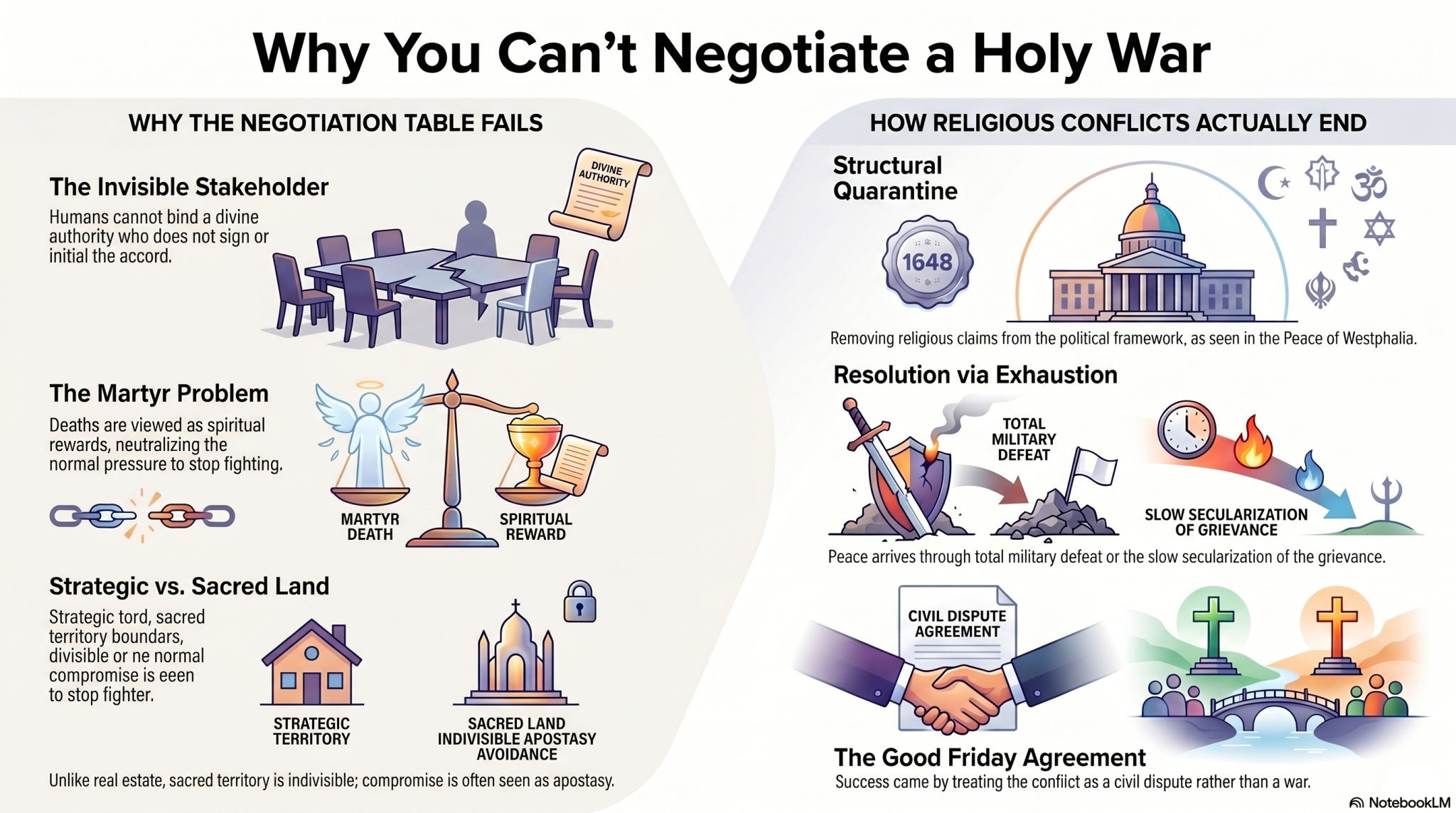
Negotiation presupposes that the parties at the table are the relevant decision-makers — that they can bind themselves and their constituencies to an agreement. In a religious war, this assumption collapses. The combatant fighting under divine mandate is not the relevant decision-maker. God is. And God does not show up at the table, does not initial the draft terms, and cannot be held to the resulting agreement.
Any human leader who claims to negotiate on God’s behalf faces an inescapable dilemma: either he has the authority to reinterpret divine will to suit circumstances — in which case the religious framing was always a political instrument — or he does not, in which case no agreement he signs is binding on the cause he claims to represent. This is not a theoretical problem in the Middle East — it is the explicit, codified position of the principal actors arrayed against Israel.
Hamas’s founding charter frames all of Palestine as an Islamic waqf, a religious endowment that no human authority can alienate. Hezbollah’s founding manifesto, rooted in Khomeinist theology, frames the destruction of Israel as a religious obligation — not a political goal subject to revision, but a sacred duty owed to God. Iran’s theocratic state, governed under the doctrine of Wilayat al-Faqih — the guardianship of the Islamic jurist — institutionalizes this further: the Supreme Leader does not merely represent a government with negotiable interests, he claims to act as the deputy of the Hidden Imam, deriving authority from divine succession itself. When three interlocking actors — state, proxy, and militia — share a religiously mandated charter for Israel’s elimination, the question of negotiation becomes not merely difficult but incoherent. You cannot horse-trade a divine trust.
The Israeli settler movement, in its most religious expression, holds the biblical Land of Israel as a covenant that no elected government has the standing to surrender — adding a mirror-image absolutism on the other side of the line. When God holds the title deed on both sides of the border, no human conveyance is valid, and no agreement survives contact with the theology that produced the conflict.
The Martyr Problem: Costs That Aren’t Costs
In conventional conflicts, sustained casualties eventually create internal pressure toward settlement. Soldiers, families, and taxpayers have finite tolerance for sacrifice. This is the mechanism that brings rational adversaries to the table — the accumulating cost of continued war against the prospective benefit of an acceptable deal.
Religious war systematically disrupts this mechanism. Death in God’s service is not simply a loss — it is martyrdom, which reframes the primary cost of war as spiritual reward. The normal feedback loop between suffering and the desire for peace is severed. This is why casualty figures that would end a conventional conflict can be absorbed almost indefinitely by a movement that sacramentalizes its dead. The Crusades bled for nearly two centuries. The Thirty Years’ War killed perhaps a third of the German population before exhaustion — not negotiation — finally ended it.
Sacred Territory Cannot Be Compromised
In secular conflicts, territory is strategic real estate. It can be partitioned, exchanged, leased, or administered jointly. These are the normal currencies of diplomatic settlement.
Sacred territory is categorically different. Jerusalem is not valuable because of its port access or agricultural productivity — it is the axis mundi of three faiths simultaneously. The Temple Mount is, depending on who you ask, the site of the binding of Isaac, the location of the Prophet’s night journey, or the future site of the Third Temple. No partition formula has ever satisfied all three claims, because the claims are not territorial in the ordinary sense — they are ontological. The land’s sacred meaning is precisely its indivisibility. Camp David 2000 failed in significant part because no Palestinian leader could surrender Muslim sovereignty over the Haram al-Sharif and survive politically — not because the territorial math was wrong, but because the religious math made compromise indistinguishable from apostasy.
The One Partial Solution: Remove Religion from the Framework
The rare religious conflicts that do end tend not to resolve through negotiation of the religious claims — they end when those claims are structurally removed from the dispute. The Peace of Westphalia (1648) did not settle the question of whether Catholicism or Protestantism was true. It constitutionally quarantined the question — codifying the principle that a ruler’s religion was his own affair and not a legitimate cause for interstate war. It inaugurated the modern secular state system not by negotiating religion but by declaring it out of bounds as a political instrument.
Northern Ireland followed a similar arc. The Good Friday Agreement became possible only after decades of attrition persuaded both communities that maximalist aims were unachievable, and when leadership emerged willing to treat the conflict as a civil and political dispute rather than a holy war. The religious identities remained entirely intact. What was quietly abandoned — not negotiated away, but gradually retired under the pressure of lived reality — was the sacred mandate to keep fighting.
The Conclusion the Diplomats Resist
Holy wars end through exhaustion, military defeat, or the slow secularization of the grievance. They do not end through negotiation, because negotiation requires parties who can make binding commitments, trade commensurable interests, and prefer a stable settlement to continued conflict. When the authorizing party is divine, commitments cannot be made binding, interests are not commensurable with the adversary’s, and continued conflict may be preferable to the sin of compromise.