Why Other Religions Are Confidently Wrong About Us
A Muslim friend recently told me that “middah k’neged middah,” which means measure for measure, was proof that Judaism is evil. He had translated it as “an eye for an eye” and presented it as the ethical core of Jewish law. He was confident. He was wrong on every level.
“Middah k’neged middah” is not “ayin tachat ayin.” They are different phrases doing different work. The first is a rabbinic principle of divine proportionate justice. The Mishnah teaches that “in the measure a person measures, they are measured” (Sotah 1:7). It runs through the stories of Samson, Miriam, and Absalom. It is a theology of consequence, not a code of revenge. “Ayin tachat ayin,” the eye-for-an-eye verse, does appear in the Torah, but the Talmud (Bava Kamma 83b–84a) explicitly rules out literal retaliation and reads it as monetary compensation. Jewish law has not endorsed taking out anyone’s eye in two thousand years. The friend who declared Jews evil on the basis of this argument was citing two phrases he didn’t understand, in a language he couldn’t read, on the basis of an interpretation his own tradition had handed him.
This is not a one-off encounter. It is structural. And the structure is worth understanding, because it explains a great deal about how Judaism gets talked about by people who have never opened a page of it.
- The Access Problem
Judaism does not proselytize. It does not produce missionary literature. It does not stand on street corners or knock on doors. It does not run satellite networks aimed at conversion. Its educational structures are interior: yeshivas, day schools, family transmission, study within the community. There is no Jewish equivalent to evangelical Protestantism’s outreach apparatus or to the global infrastructure of Islamic dawah.
This produces an information asymmetry with predictable consequences. The loudest public interpreters of Jewish texts in Christian and Muslim societies have been, for two thousand years, Christians and Muslims. Their interpretations were not produced by access to Jewish learning. They were produced by religions that needed to replace or correct Judaism in order to justify their own existence. Christianity required the claim that the Jews were chosen and then forfeited that status through corruption or the rejection of Jesus. Islam required the claim that the Jews and Christians had distorted the original revelation, which the Quran restored. Both of those narratives have a structural interest in misreading Judaism, and both of them have nearly two thousand years of momentum behind that misreading.
What fills the vacuum is confident projection. Millions of Christians and Muslims grow up believing they understand Judaism, not as a foreign tradition that has to be approached carefully, but as a known quantity that their own religion has already explained to them. They do not know what they do not know.
- The Language They Cannot Read
Hebrew is not a language Christians and Muslims usually learn. The Torah is a layered text. The rabbinic framework called PaRDeS identifies four levels of interpretation: peshat (the plain meaning), remez (allusion), derash (the interpretive layer), and sod (the mystical layer). To read the Torah only at the level of peshat, in translation, and then announce its meaning, is to do something close to reading sheet music as a list of dots and declaring you know how Bach sounds.
This is not gatekeeping for its own sake. Hebrew carries numerical, structural, and intertextual weight that translation strips out. Whether or not you accept the traditional theological claim that Hebrew is the language of revelation, the linguistic point holds. A translation of a translation of an interpretation is not the original, and it is not a position from which to declare what the tradition means.
- The Frozen Frame
Christian polemic has a particular fondness for the period of Roman occupation, when the Beit HaMikdash priesthood had been corrupted by Rome’s client kings and a Hellenized aristocracy (one heavily influenced by Greek culture). Internal Jewish sources from that same period, the Pharisees, the Essenes, the early rabbinic movement, were also denouncing that corruption. It was a moment in time. Rome installed compromised authorities. Jewish reformers opposed them. Eventually the Temple fell, and the rabbinic tradition that built post-Temple Judaism broke explicitly with the corrupt priestly model.
Christian theology froze that moment and projected it across all of Jewish history. “The Jews were corrupt” became a permanent thesis instead of a description of one specific institutional failure under occupation. This is a familiar move when one religion needs another’s history as its origin myth. You collapse the temporal frame, you lift out the worst snapshot, and you present that snapshot as the essence of the thing.
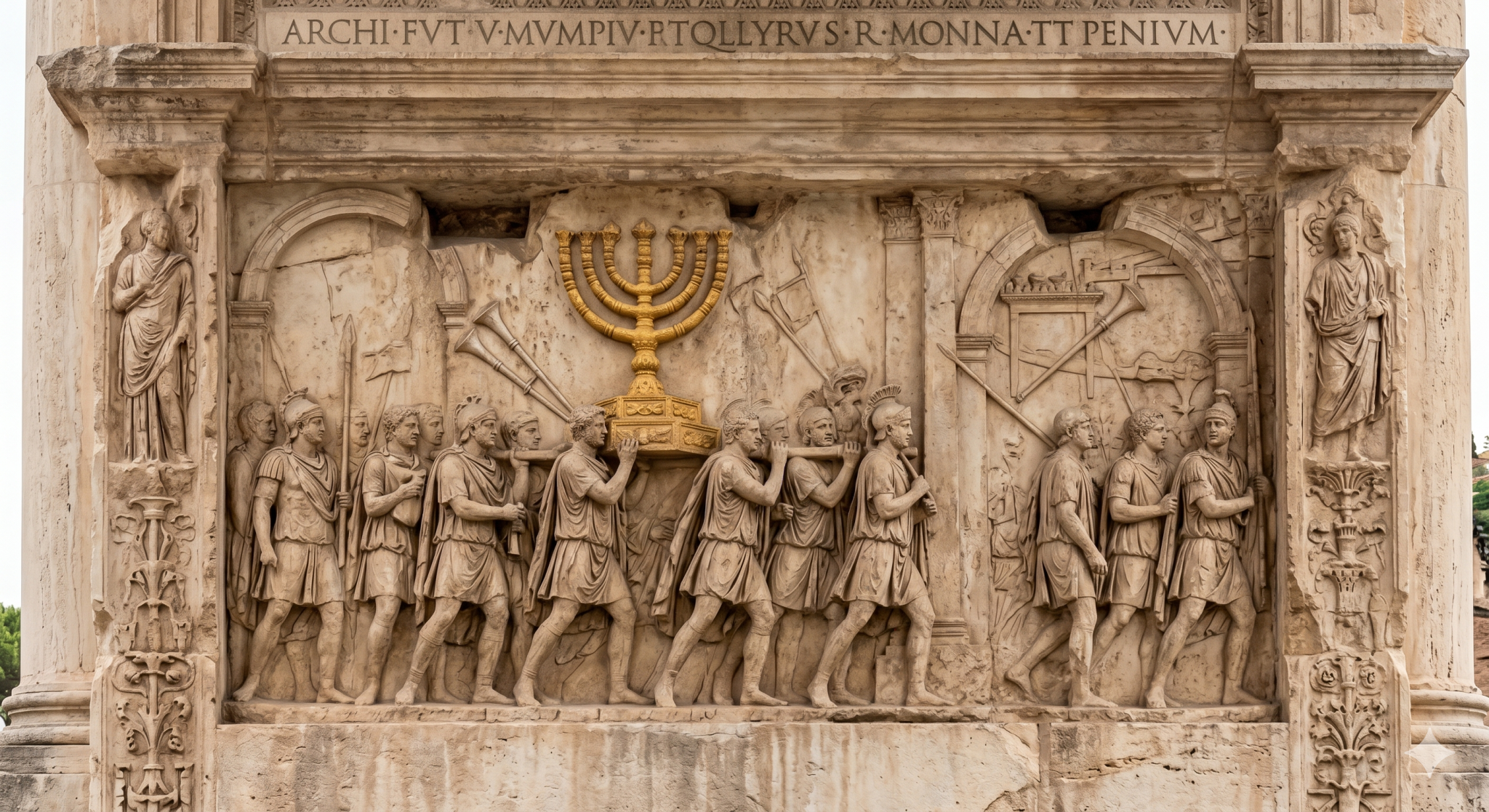
There is a piece of this story most readers don’t know, including most Jews. When Rome destroyed the Temple in 70 CE, the looted gold and silver and sacred objects were carried off to Rome. The Arch of Titus, still standing today, depicts Roman soldiers parading the Menorah through the streets. Those spoils funded a building project. The Colosseum, that massive amphitheater that millions of tourists photograph every year, was built from the wealth of the Jewish Temple. The dedicatory inscription, reconstructed from the original stone in 1995, makes this explicit. The treasures of a place of worship became the construction budget for a place where people watched other people get killed for entertainment. The architecture of one of humanity’s most sacred sites was liquefied into the architecture of one of humanity’s most brutal spectacles. That is the story behind the famous photo. Christianity later inherited Rome and inherited Rome’s framing of what had happened.
- The Light and the Wall
Here the argument becomes more uncomfortable, including for Jews.
The Jewish tradition contains two commandments that look like they pull in opposite directions. The first is to be or lagoyim, a light unto the nations. The second is the prohibition on intermarriage and the broader structure of distinctness that has kept Jewish identity intact across thousands of years. How can a people commanded to illuminate the world also be commanded to maintain rigid boundaries against being absorbed into it?
The classical resolution is that these are not contradictory. They are architectural. The light is meant to be exemplary, not viral. The boundary is what allows the light to remain visible. A tradition that fully assimilates stops being something to learn from. A tradition that proselytizes turns its truth into a weapon. Judaism’s bet is that you can be a light without trying to set anything on fire.
Christianity and Islam took the universalizing impulse from Judaism and rejected the boundary that was meant to channel it. They inherited the mandate to spread truth, but they cut loose the dampening mechanism that prevented universalism from turning into imperialism. The result was the Crusades, the Inquisition, forced conversion, and centuries of expansionist warfare. Religion as memetic infection without the cell wall.
This is not anti-Christian or anti-Muslim polemic. It is structural observation. The proselytizing religions inherited a partial architecture and acted on it. Judaism kept the whole architecture and accepted the cost: invisibility, slander, and the persistent confidence of outsiders explaining us to ourselves.
- Chosen for What
The Jewish concept of chosenness gets misunderstood as a claim of superiority. In the tradition’s own framing, it is a claim of obligation. The 613 mitzvot are described as a yoke. To be chosen is to be conscripted into a transmission, not awarded a privilege. The tradition is explicit, in Tosefta Sanhedrin 13:2 and codified by Maimonides in Hilkhot Melakhim 8:11, that “the righteous of all nations have a portion in the World to Come.” Non-Jews who observe the seven Noahide laws are considered righteous. There is no salvation pressure. There is no soul to save through conversion. There is only the question of whether you, in your own life, are living rightly.
Compare this to Christianity and Islam, where conversion is what saves you and not converting damns you, and the absence of Jewish missionary work begins to look less like withholding and more like respect.
This is also why the historical record on religious conquest looks the way it does. Jewish history contains no Crusades, no Inquisition, no global colonial project of conversion. The Hasmoneans expanded territorially and forcibly converted the Idumeans in the second century BCE. That exception exists, and should be named honestly. But there is nothing in Jewish history remotely comparable in scale to what Christianity and Islam each did across continents, over centuries. A religion that does not believe non-members are damned has no theological engine for that kind of expansion.
- What Jews Are Not Saying
It would be dishonest to write only about non-Jewish failures of understanding. Jews participate in this dynamic too, and not always well.
The boundary that protects Jewish transmission is also experienced by non-Jews as rejection. We rarely acknowledge this directly. Because Jewish learning is interior by design, there is no developed pedagogy of explanation for outsiders. We have not built the bridges. Partly out of historical fear of having our texts weaponized against us (which has been earned), partly out of habit. When non-Jews ask sincere questions, we often respond with deflection or with assumed bad faith, because so many questions across history have actually been bad faith.
The word goy simply means “nation,” and is used in the Torah to refer to Israel itself, goy gadol, a great nation. It is not a slur. But the way it lives in some Jewish communities, the in-group warmth and the out-group caution, is real and visible to the people on the outside. They feel the asymmetry even when nothing hostile is said.
There is also a tendency in Jewish self-presentation to position the tradition’s non-violence and non-proselytism as moral high ground in a way that becomes its own form of distance. “We don’t try to convert you” is true. It is also, sometimes, said in a way that closes a conversation instead of opening one.
External pressure has, across thousands of years, produced internal cohesion. Sociologists have documented this clearly: persecution pulls a group inward. The bond Jews feel with other Jews they have never met, across communities, across continents, is partly the product of shared ritual and partly the product of shared external hatred. It is not a conspiracy. It is what any minority group does under sustained pressure. The fact that it gets read as conspiratorial when Jews do it, and as cultural solidarity when other groups do it, is itself part of the problem we are trying to describe.
The honest version is this. The wall is necessary. But a wall is still a wall, and the people on the other side feel it. Acknowledging that they feel it is not a concession. It is the precondition of any real conversation.
- What Comes Next Is Not Conversion
The way forward is not for Jews to become a proselytizing religion. The whole point of the architecture is that we don’t do that. The way forward is for Jews to be more deliberate about creating accessible explanation that does not require conversion to access, and for non-Jews to do the harder work of asking where their inherited interpretations of Judaism actually came from, and whether the people who handed those interpretations down had any direct access to the tradition they were describing.
The misunderstanding between Judaism and the religions that came out of it is not personal, and it is not new. But it is structural, and structural problems can be addressed once they are named. The first step is to stop pretending the misunderstanding is a matter of opinion. It is a matter of access, training, and history, and on each of those axes, the asymmetry is real.
We were not meant to be a hidden people. We were meant to be a visible one. The hiddenness is what happens when the visibility becomes dangerous, and the visibility became dangerous in part because the people looking at us never learned how to read.