
A Moroccan Journalist
Why ‘Palestinian’ Never Meant Arab – Until It Did [1/3]
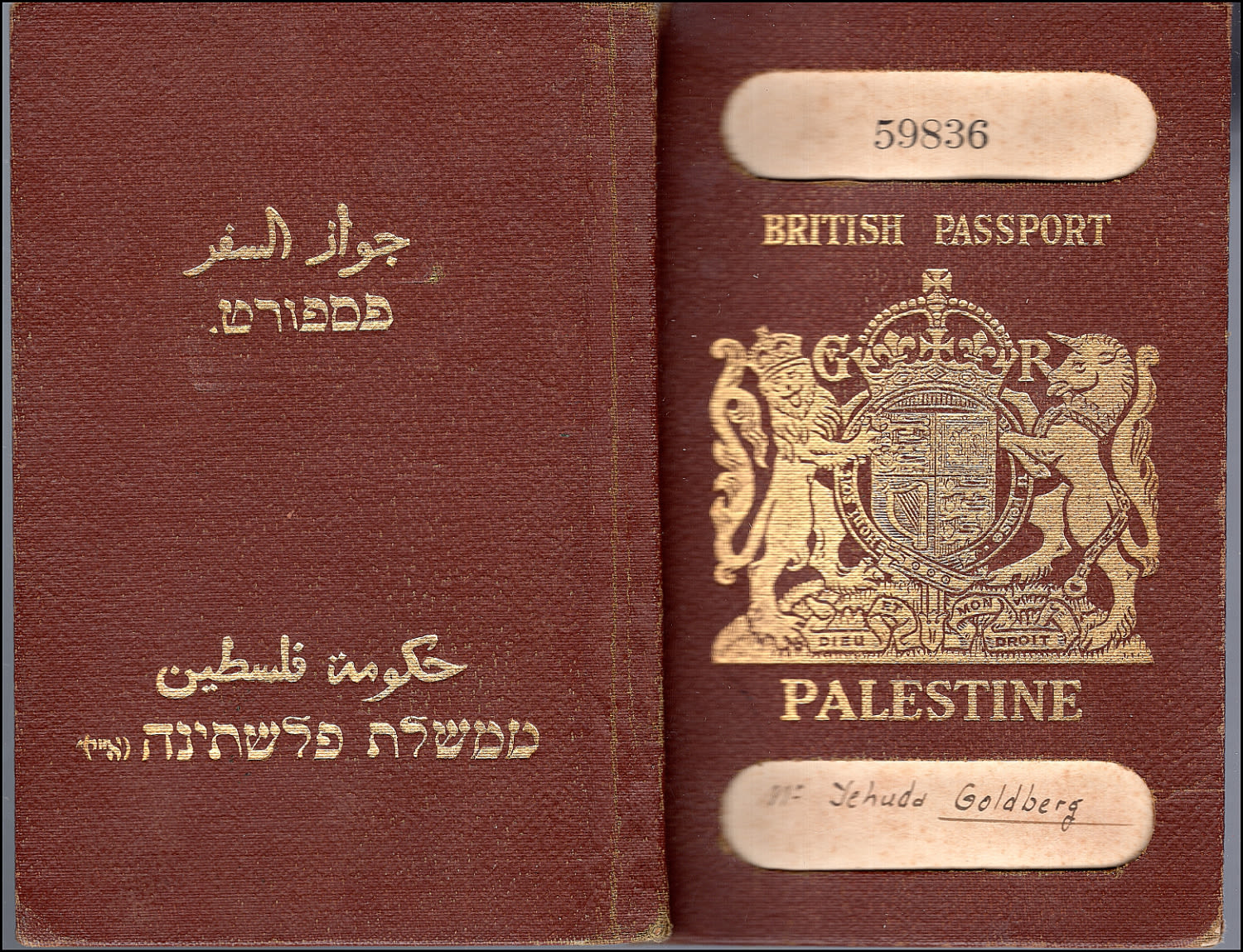
Under the British Mandate, passports carried a Hebrew inscription reading “ממשלת פלשתינה (א״י)”, which translates as “Government of Palestine (E.I.)”. The term פלשתינה reflects the historical spelling of “Palestine,” while (א״י) is the Hebrew abbreviation for “Eretz Israel” (Land of Israel).
The title at first might provoke a reaction. Someone will see it and mutter, “Ah, so he’s writing for Israel.” Another will snarl, “He’s denying Palestine itself.” Neither is true. What follows is not a partisan catechism but a disciplined walk through the record, tracing how a word moved from geography to citizenship, from citizenship to politics, and from politics to nationhood. If you came for slogans, you will be disappointed. If you came for sequence and evidence, lean in.
The term Palestine is ancient – but its origins have little to do with Arab identity. The name is believed to derive from peleshet, a word used for the Philistines – an Aegean people who settled along the coast in biblical times, with no ethnic or historical connection to Arabia.
After crushing the Jewish Bar-Kokhba revolt in 135 C.E., the Roman Empire renamed the province of Judea as “Syria Palaestina”, deliberately evoking the long-vanished Philistines in order to erase Jewish ties to the land.
This Latin name was later absorbed into Arabic as Filastin, but notably the word “Palestine” never appears in the Qur’an, nor in the original text of the Bible. In fact, the name “Israel,” referenced in the Qur’an as “Bani Isra’il” (Children of Israel), appears approximately 40-47 times, often referring to an ancient people rather than a modern state, while the specific name “Palestine” (Filastin) is mentioned zero times, neither as an ancient people nor as a modern political entity.
It was a geographic designation from classical antiquity – one largely forgotten in the Muslim world for centuries. Under the Ottoman Empire (1517-1917), this land sat inside Bilād al-Shām, Greater Syria. There was no single Ottoman province named “Palestine.”
Instead, administrative life ran through the Mutasarrifate of Jerusalem (given special status in 1872 and reporting directly to Istanbul) alongside the sanjaks of Nablus and Acre, themselves tied to the vilayets of Damascus and Beirut. That is not pedantry – it’s the scaffolding of identity.
The area was simply part of Ottoman Syria, divided among districts; locals generally identified themselves as Ottomans, as Arabs, or by their city or clan, not as “Palestinians.” People’s first loyalties ran through parish and waqf, lodge and guild, hamula and quarter.
They called themselves people of Jaffa or Nablus, Hebron or Jerusalem; they were Muslims, Christians, Jews; they were Damascene in aspiration or “Southern Syrian” in petition. In fact, many Ottoman-era Arabs referred to the region as southern Syria, not as a distinct country.
The term “Filastin” certainly appeared – in devotional literature, in cartographers’ captions, in the title of an Arabic newspaper founded in Jaffa in 1911 – but it was a place-name accruing meaning, not yet a sealed national container.
No independent Arab state of “Palestine” ever existed in history. The very concept of Palestine as a standalone territorial entity only re-emerged in the 20th century – and when it did, it was primarily associated with the Jewish people and their historical homeland.
Imperial dissolution and European engineering sharpened the edges. Sykes-Picot was inked in 1916; the Balfour Declaration followed in 1917; Allenby marched into Jerusalem; Faisal’s short-lived Arab Kingdom flickered in Damascus in 1918-1920.
When the Syrian National Congress petitioned the American King-Crane Commission in 1919, elites repeatedly described Palestine as “Southern Syria”, beseeching Washington not to carve it away. They weren’t denying local particularity; they were pleading for a post-Ottoman order that kept Arab lands intact.
London had other plans. San Remo in 1920 and the League of Nations Mandate in 1922 formalized Palestine as an administrative unit with concrete borders and a new legal vocabulary. Article 2 charged Britain with developing the country; Article 4 recognized a Jewish agency to advise the administration; Arabic and Hebrew joined English on official seals; the Palestine Currency Board began issuing the Palestine pound in 1927; Mandatory stamps and coins bore “Palestine” in three scripts. This is what it means to watch a word become a jurisdiction.
Mandate-era “Palestinians”: The Jewish embrace of the name
When the British captured the Holy Land in World War I and received the League of Nations Mandate, they revived “Palestine” as the official name for the territory. As historian Bernard Lewis observed, in 1918 “Palestine for the first time since remote antiquity became a separate entity” – a geopolitical unit under British rule – and “the name adopted to designate this entity was ‘Palestine,’ resuscitated from an almost forgotten antiquity.”
Then came the turning of “Palestinian” into a legal identity. In 1925, the Palestinian Citizenship Order created Palestinian citizenship and the Mandate issued passports marked Palestine. Under the law, a Nazareth Christian, a Hebron Muslim, a Tel Aviv Jew were each Palestinian in the civic sense. The world reflected that usage without anxiety.
The inhabitants of the Mandate – both Jews and Arabs – were dubbed Palestinians in legal terms. Notably, however, it was the Jewish community that eagerly accepted the label. During the 1920-1948 Mandate period, the world spoke of Palestinian Jews and Palestinian Arabs, but locally the Jewish population often proudly used “Palestine” in the names of their institutions, while the Arab population generally identified simply as Arabs.
Before 1948, “Palestinian” typically meant a Jew from Palestine. For example, the leading English-language Jewish newspaper was The Palestine Post (founded by editor Gershon Agron in 1932), and it kept that name until 1950, when – after Israel’s independence – it became The Jerusalem Post. Likewise, the Jewish-founded Anglo-Palestine Bank, which helped finance the Zionist community, was renamed Bank Leumi Le-Israel (National Bank of Israel) after the Jewish state was established.
The renowned Israel Philharmonic Orchestra actually began life in 1936 as the Palestine Symphony Orchestra. As it tuned under Bronisław Huberman’s baton, the orchestra was composed largely of Jewish musicians who had fled Europe. Even future Israeli Prime Minister Golda Meir reminisced that from 1921 to 1948 she “carried a Palestinian passport” under the British Mandate.
Under the British Mandate, passports carried a Hebrew inscription reading “ממשלת פלשתינה (א״י)”, which translates as “Government of Palestine (E.I.)”. The term פלשתינה reflects the historical spelling of “Palestine,” while (א״י) is the Hebrew abbreviation for “Eretz Israel” (Land of Israel).
Another instance is when Shimon Peres, then known as Szymel Perski – who would later serve as Israeli prime minister and president – submitted an application for Palestinian citizenship in 1937 under the British Mandate, signing an oath of loyalty to the Government of Palestine.
While this fact is often politicized retrospectively, at the time it reflected a routine administrative procedure imposed by Mandate authorities on Jewish residents, rather than an expression of national identity as understood in later political debates.
During the war, the British raised the Palestine Regiment and then the Jewish Brigade Group; the demonym “Palestinian” in British military files overwhelmingly signified Jews from the Mandate of Palestine. If that jars the modern ear, it’s only because the word’s center of gravity shifted after 1948. In the Mandate’s own language, there is nothing paradoxical about a Jewish “Palestinian.”
In short, the Jewish inhabitants saw “Palestine” as the name of their land – the historical Land of Israel – and did not shy away from it. They were Palestinians in the sense of being people of the Palestine Mandate, and this usage persisted proudly until 1948.
Meanwhile, the Arab inhabitants for the most part rejected “Palestinian” as a national label during those decades. Arab political leaders in the Mandate era emphatically denied that “Palestine” was a unique country separate from the broader Arab world.
In February 1919, a congress of local Arabs in Jerusalem adopted a resolution declaring, “We consider Palestine nothing but part of Arab Syria, and it has never been separated from it at any stage. We are tied to it by national, religious, linguistic, moral, economic, and geographic bounds. Our district, Southern Syria or Palestine, should not be separated from the Independent Arab Syrian Government and be free from all foreign influence and protection.”
This was affirmed by the American King-Crane Commission that same year, which reported that the Arab inhabitants opposed the creation of a new entity called Palestine – partly because they viewed it as a Zionist scheme. Throughout the Mandate, Arab spokesmen continued to insist that Palestine was not an independent fatherland for a distinct people, but simply part of the Arab nation.
In 1925, for example, Auni Bey Abdul-Hadi, a prominent Arab nationalist, told a British court that “Palestine” was “not an Arab word,” and that the country’s correct name was “Southern Syria.” He later testified to the 1937 Peel Commission that “There is no such country as Palestine! ‘Palestine’ is a term the Zionists invented…Our country was for centuries part of Syria.”
Such statements were typical. The Grand Mufti of Jerusalem, Haj Amin al-Husseini, likewise acknowledged in 1929 that under the League of Nations Mandate, political rights in “Palestine” had been granted to Jews, not Arabs – implicitly recognizing that the Mandate treated the Jews as the ones with a national claim to Palestine.
In 1946, the Princeton historian Philip Hitti, speaking on behalf of the Arab cause, flatly told an Anglo-American inquiry, “There is no such thing as ‘Palestine’ in history, absolutely not.” And in 1947, as the United Nations debated partition, the Arab Higher Committee’s spokesman reminded everyone that Palestine was historically “part of the Province of Syria” and that “the Arabs of Palestine did not constitute a separate political entity.”
Even years later, in 1956, Ahmed Shukeiri – an Arab diplomat who would soon become the PLO’s first chairman – declared to the UN Security Council, “It is common knowledge that Palestine is nothing but southern Syria.”
In sum, prior to the 1960s, the Arab population did not generally identify as a unique Palestinian people – and often explicitly disavowed that idea.
Palestinians often proudly cite and reference the now Qatar-based Arab-Israeli intellectual Azmi Bishara as a leading voice in contemporary Arab political thought. Yet Bishara himself has repeatedly articulated a position that sharply diverges from modern nationalist narratives.
In a televised Channel 2 program during his time as a Knesset member, he stated: “I do not think there is a Palestinian nation at all… No, I think there is an Arab nation. I have always thought this way, and I have not changed my mind.”
“I do not think there is a Palestinian nation; I think it is a colonial invention. When were there Palestinians? Where did this come from? I think there is an Arab nation. Despite my firm struggle against the occupation, I have never become a Palestinian nationalist. Palestine, until the end of the nineteenth century, was part of Greater Southern Syria,” he added.
The name Palestine, far from being an age-old banner of Arab nationhood, was for them a foreign term or a colonial label. Ironically, it was the Jewish inhabitants who had embraced “Palestine” as a designation – while building the foundations of what would become the State of Israel.
Related Topics
Related Posts