
Why Pinchas, Not Moshe?
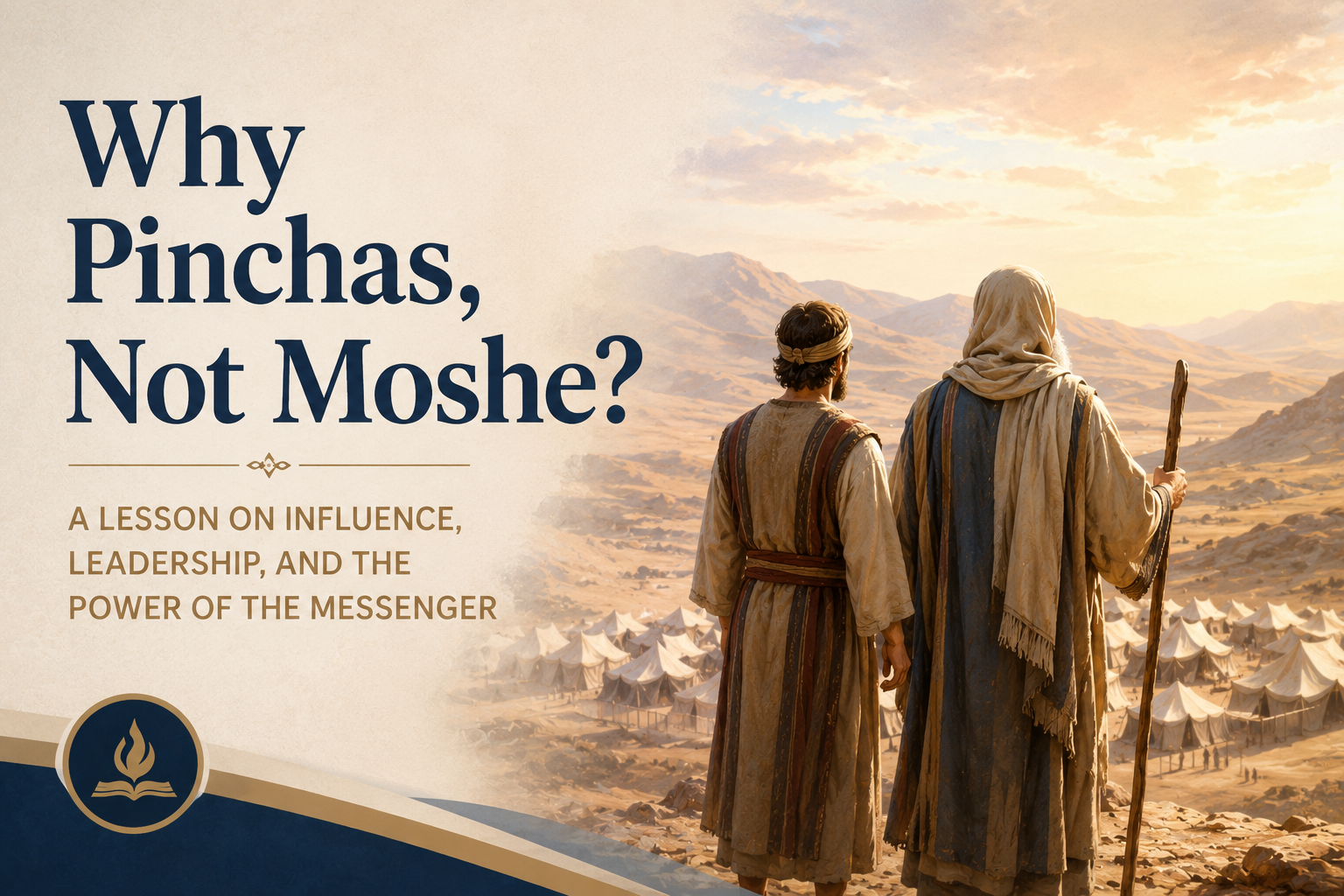
One of the fascinating questions in this week’s parsha is why Pinchas became the one to stop
the public desecration that had brought a plague upon the Jewish people.
Our sages offer a number of explanations, and there is much written about why Divine Providence placed this responsibility in Pinchas’s hands rather than Moshe’s. I’d like to suggest another possibility—not as a definitive interpretation, but as a lesson that may speak to the way people respond to authority.
Consider a scene that plays out in many homes.
Parents establish the rules. They create the boundaries. Yet there are times when a child becomes so defensive that every instruction from a parent feels like another confrontation. The harder the parent pushes, the harder the child resists.
Then something unexpected happens.
A sibling says essentially the same thing, and suddenly the child listens.
The message hasn’t changed. The messenger has.
Perhaps something similar can help us understand what was happening in our parsha.
By the time Zimri openly defied the Torah, the Jewish people were already living under an atmosphere of severe judgment. A plague had broken out. The consequences of their actions were already unfolding before their eyes. Fear, tension, and Divine judgment filled the camp.
In such an atmosphere, people often become defensive. When judgment is already being felt, another rebuke—even if completely justified—can sometimes harden hearts rather than open them.
Moshe Rabbeinu occupied a unique role. He was not only the leader of the nation but also the giver of the Torah and the embodiment of its authority. Had Moshe himself been the one to confront Zimri, it is possible that many would have experienced it simply as another expression of authority at a moment when emotions were already running high.
Pinchas, however, approached the situation differently. Although he was the grandson of Aharon, he was not the nation’s lawgiver. His action did not come from the unique position occupied by Moshe. It came from someone who saw an unbearable wrong and acted.
Perhaps that changed how the people received what happened.
Instead of seeing only authority confronting sin, they witnessed someone acting out of conviction. Perhaps that inspired a different kind of reflection: If Pinchas could recognize so clearly what needed to be done, why hadn’t we?
Sometimes people hear a truth more readily from someone standing beside them than from someone standing above them.
This idea extends far beyond the events of the parsha.
We often assume that if our argument is sound enough or our position is correct enough, people will naturally listen. Yet experience teaches otherwise. The same words spoken by different people can produce entirely different results.
Parents know this. Teachers know this. Employers know this. Friends know this.
Influence is not only about the message. It is also about the relationship between the messenger and the listener.
Perhaps that is one of the enduring lessons of Pinchas. Hashem did not simply choose someone to stop a terrible sin. He chose the person whose actions could reach the hearts of the people at that particular moment.
There are times when leadership comes from above, and there are times when it emerges from beside us.
And sometimes the voice that changes everything is not the one with the greatest authority, but the one we are finally ready to hear.
In Memory of Zev Ben Tzvi Yitzchok. May his Neshama have an Aliya