
Jamaica's Rabbi
Why Study a Building That Doesn’t Exist?
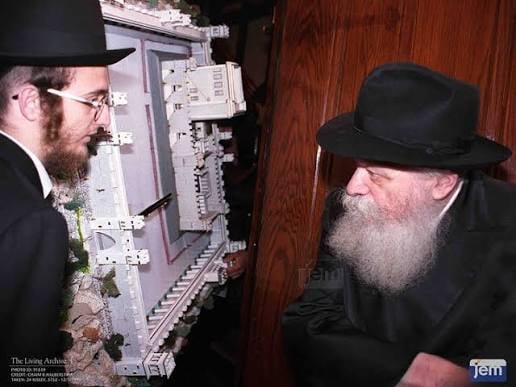
Photo by Jem @Jewish_media The Rebbe is presented with a model of the Beis Hamikdash
Imagine if, in the middle of a national crisis, someone launched a campaign encouraging people to study the architectural plans of a building that had not yet been built.
Most people would think it was strange.
“Shouldn’t we focus on the problems right in front of us?”
“Shouldn’t we deal with today’s challenges before discussing tomorrow’s dreams?”
Yet exactly 50 years ago, that is precisely what the Rebbe, Rabbi Menachem M. Schneerson, did.
And the timing makes the story even more remarkable.
It was the summer of 1976. Just weeks earlier, Jews around the world had been captivated by the miraculous rescue at Entebbe. The Jewish world was talking about courage, danger, uncertainty, and the future of the Jewish people.
Then came the Three Weeks, the period during which we mourn the destruction of the Beis Hamikdash.
At an unexpected farbrengen on the 24th of Tammuz, the Rebbe introduced a new initiative: Jews should study Hilchos Beis HaBechirah, the laws of the Holy Temple.
At first glance, it seemed like an unusual response.
The Beis Hamikdash had been destroyed nearly two thousand years earlier.
Why spend time learning about courtyards, gates, chambers, and measurements?
Why not focus first on bringing Moshiach and worry about the Temple afterward?
The answer lies in a remarkable Midrash.
The prophet Yechezkel was commanded by Hashem to teach the Jewish people the design and structure of the future Beis Hamikdash.
Yechezkel was puzzled.
“Master of the Universe,” he asked, “the Jewish people are in exile. They are scattered among the nations. Is this really the time to teach them about the Beis Hamikdash? They cannot build it now.”
Hashem’s response was powerful.
“Should the building of My House be neglected simply because My children are in exile? Go and teach them. When they study its structure, I consider it as if they are building it.”
The Rebbe often returned to this Midrash, but he saw in it something much deeper than a lesson about architecture.
He saw a lesson about how a Jew is meant to approach life.
Most people define themselves by their present reality. The Rebbe taught us to define ourselves by our future reality.
When circumstances are difficult, it is natural to focus on what is broken. We analyze the damage, discuss the problems, and worry about the obstacles ahead.
But if all we ever see is the rubble, eventually the rubble becomes our identity.
The Rebbe taught the opposite.
Live with the future before it arrives.
Study redemption while still in exile. Learn about the Beis Hamikdash before it is rebuilt. Focus on the destination while you are still traveling.
For half a century, every summer, Jews around the world have opened books and studied the laws of a building that does not yet stand.
Why?
Because the Rebbe understood something fundamental about the Jewish soul.
The greatest danger of exile is not destruction. The greatest danger is becoming comfortable with destruction. The greatest tragedy is when we stop believing it can be repaired.
The Rebbe often illustrated this idea through the story of Mordechai and Esther.
The Jewish people were facing annihilation. Haman’s decree hung over their heads. Yet Mordechai gathered thousands of Jewish children and taught them Torah.
The Midrash relates that Haman encountered the children and asked them what they were learning.
Their answer was astonishing.
They were studying the laws of the Omer offering.
Think about that.
The Jewish people were under threat of destruction, yet these children were discussing how a korban would be brought in the Beis Hamikdash.
In their minds, there was already a Temple. There was already a Kohen. There was already barley waiting to be offered.
Their concern was simply making sure they knew how to perform the mitzvah correctly.
They were not trapped by the reality around them. They were living with a higher reality.
That, the Rebbe explained, is how a Jew is meant to live.
Perhaps that is exactly what the Rebbe was teaching. The Three Weeks are not merely a season of mourning. They are a season of vision. We remember what was lost. We mourn it.
But we refuse to stop there.
While remembering the destruction, we begin preparing for the rebuilding.
That is why the Rebbe took this initiative so seriously.
In the years that followed, he repeatedly encouraged the study of Hilchos Beis HaBechirah during the Three Weeks. On one Erev Tisha B’Av, the Rebbe entered 770 and noticed a group of chassidim standing and waiting for him. He remarked that the time could have been better spent learning Hilchos Beis HaBechirah and thereby helping build the Third Beis Hamikdash.
To the Rebbe, Learning about the Beis Hamikdash was itself an act of building.
Because this was never simply about measurements and walls.
It was about mindset.
The world teaches us to react to reality.
The Rebbe taught us to create reality.
To see beyond the headlines.
To see beyond the challenges.
To see beyond the exile.
Perhaps that is the true miracle of this campaign.
For fifty years, during the saddest days of the Jewish calendar, Jews around the world have opened books describing gates, courtyards, chambers, and walls of a building that has not yet been rebuilt.
To an outsider, it may seem like a lesson in architecture. But it is really a lesson in faith.
Today our world faces no shortage of challenges. Israel faces enemies. Antisemitism is rising. Communities struggle with division, uncertainty, and pain. It is easy to become overwhelmed by what is broken.
The Rebbe’s answer remains the same as it was fifty years ago:
Study the Temple.
Learn about redemption.
Live with the future.
Because A Jew is defined by what he knows tomorrow can become.
And perhaps that is the deepest meaning of the Midrash.
Learning about the Beis Hamikdash is not merely considered building it.
It is building ourselves into the kind of people who can bring it.
May we merit very soon to move from studying its blueprint to walking through its gates, from learning about redemption to living it, and from mourning Jerusalem to celebrating in a rebuilt Jerusalem with the coming of Moshiach, speedily in our days. Amen.
Related Topics
Related Posts