

Learning The Lessons Of History
Why Survivor Testimony Still Matters
Why Survivor Testimony Still Matters
Why Survivor Testimony Still Matters
On June 2, 1944, my mother arrived at Auschwitz-Birkenau in a cattle car from Hungary.
Within minutes, she was separated from her parents.
Her father was separated from her on the ramp. Before he disappeared, he gave his daughters a final blessing. She never saw him again. Her mother was later selected for murder. My mother survived Auschwitz, forced labour, a death march, and the collapse of Nazi Germany. She eventually rebuilt her life in Canada and spent much of the rest of her life trying to move forward rather than live inside the past.
For many years, Holocaust survivors often spoke quietly, if at all. Some believed the world did not want to hear what they had lived through. Others spoke only in fragments because language itself could not fully contain what they had witnessed.
Today, however, survivor testimony matters in a different and increasingly urgent way.
After October 7: Recognition Returns
After October 7, 2023, many Jews around the world experienced something deeply unsettling. Not simply fear, but recognition.
Recognition of how quickly hatred can normalize itself.
Recognition of how rapidly public language can shift from criticism into dehumanization.
Recognition of how easily violence against Jews can be rationalized, minimized, excused, or denied when presented through ideological narratives.
The Holocaust Did Not Begin With Auschwitz
The Holocaust did not begin with gas chambers. It began with exclusion, normalization of hatred, erosion of empathy, and the gradual acceptance that Jews could be treated differently than everyone else. Long before Auschwitz became a killing center, Jews were removed from professions, isolated from society, stripped of legal protections, and increasingly portrayed as dangerous outsiders.
My mother’s experience reminds us that catastrophic danger often becomes irreversible before it becomes fully obvious to the people living through it.
Hungarian Jews did not wake up one morning expecting Auschwitz. Many believed that worsening conditions would stabilize. They believed that Hungary, despite discrimination and antisemitism, would never descend into the kind of destruction already unfolding elsewhere in Europe.
They were wrong.
Germany occupied Hungary on March 19, 1944.
Less than three months later, my mother was standing on the selection ramp at Auschwitz-Birkenau.
More than 437,000 Hungarian Jews were deported to Auschwitz in a matter of weeks. Most were murdered shortly after arrival. One of Europe’s oldest Jewish communities was dismantled with astonishing speed.
When Danger Still Looks Temporary
That history matters today because hatred rarely announces its final destination in advance.
People prefer certainty before recognizing danger. They want reassurance that institutions will hold, that social norms will return, and that extreme rhetoric will remain rhetorical. But history shows that societies often recognize catastrophe only after the machinery producing it is already operating.
After October 7, many Holocaust survivors and their descendants watched public reactions with disbelief.
We saw crowds celebrate or justify mass murder against Jews before the victims had even been buried.
We saw hostage posters torn down.
We saw Jewish students intimidated on university campuses.
We saw slogans openly calling for the elimination of the world’s only Jewish state presented as acceptable political discourse.
And we saw many people who would normally speak against hatred remain silent when Jews were the targets.
None of this is the Holocaust.
Historical comparisons must always be made carefully and responsibly.
But Holocaust history was never only about the past. It was also meant to teach societies how hatred develops, how moral boundaries erode, and how quickly dehumanization can become normalized when people convince themselves that Jews somehow fall outside ordinary standards of empathy and protection.
Why Documentation Matters
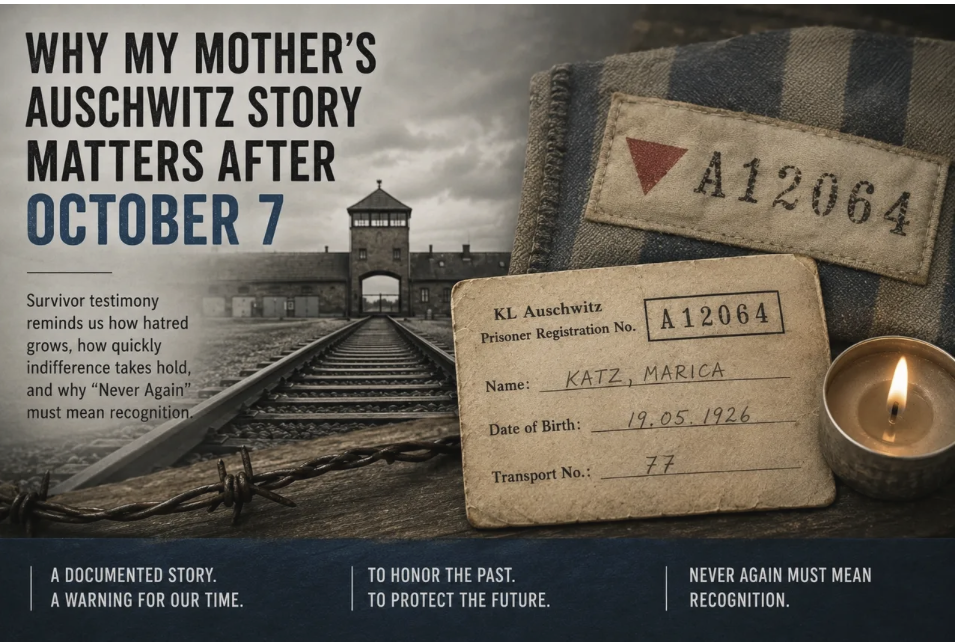
I wrote Taken. Numbered. Survived. because my mother’s testimony could not remain only a family memory.
The book is based on her recorded testimony for the USC Shoah Foundation, together with archival records and historical documentation tracing her path from prewar Hungary, through the Kisvárda ghetto, Auschwitz-Birkenau, forced labour, a death march, liberation, and ultimately rebuilding her life in Canada.
But the book is not only about survival.
It is also about evidence.
At a time when Holocaust denial, distortion, and antisemitism are again becoming more visible, survivor testimony supported by documentation carries renewed importance. My mother’s story stands against forgetting because it is not abstract. It is a documented life. A name. A family. A transport. A number. A survival.
From Living Memory to Contested Memory
As the number of living survivors rapidly declines, preserving these testimonies becomes more important, not less.
Because memory is not self-sustaining.
Historical truth requires witnesses, documentation, and people willing to defend reality against distortion.
The Holocaust is no longer moving from memory into history.
It is moving from living testimony into contested memory.
That transition carries enormous risk.
The further society moves from survivors themselves, the easier it becomes for denial, minimization, inversion, and distortion to grow. Already, we see attempts to detach the Holocaust from Jewish history, reinterpret antisemitism as something politically conditional, or portray Jewish fears as exaggerated or manipulative.
What “Never Again” Requires
My mother survived long enough to see grandchildren carry her legacy forward. She survived long enough to testify.
That testimony now carries responsibilities for those of us who remain.
Because “Never Again” was never meant to mean simply remembering the dead.
It was meant to mean recognizing the warning signs before societies again convince themselves that Jews can be isolated, targeted, or treated as morally expendable.
That is why I believe Taken. Numbered. Survived. matters now.
Not because my mother’s story is unique in suffering, but because it is specific, documented, and human. It reminds us that the Holocaust was not only a catastrophe of numbers. It was the destruction of families, towns, names, homes, and futures.
After October 7, survivor testimony carries a renewed responsibility.
It reminds us that “Never Again” cannot mean memory alone.
It must also mean recognition.
About the Author
Brian Claman is a Toronto-based author and security risk management consultant. He is the son of Maria Katz Claman, a Hungarian Jewish survivor of Auschwitz, forced labor, a death march, and postwar displacement.
His books, Taken. Numbered. Survived.: A Holocaust Survivor’s Journey Through Auschwitz, Forced Labor, and Survival and When Is It Too Late: Holocaust Lessons on Risk, Decision Making, and the Failure to Act, are rooted in survivor testimony, archival records, and careful historical reflection.
His work focuses on Holocaust memory, antisemitism, historical judgment, and the consequences of delayed recognition in the face of escalating danger.
Through his writing, he seeks to preserve his mother’s story while drawing broader lessons about responsibility, remembrance, and the importance of recognizing warning signs before it is too late.
Related Topics
Related Posts
Brian Claman