
Why teaching the next generation matters more than ever
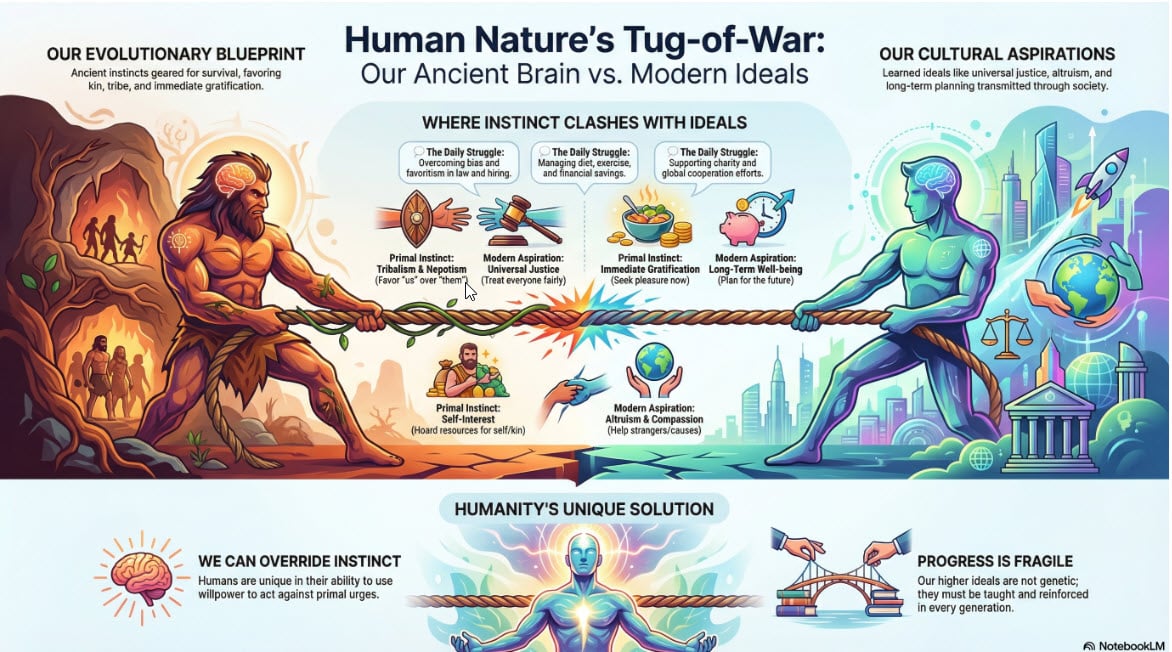
Two Operating Systems, One Species
Why our ancient instincts keep colliding with our moral aspirations—and why teaching the next generation matters more than ever
Human beings are not confused about right and wrong because we are ignorant.
We are conflicted because we are evolved.
Like every other living creature, humanity emerged through evolution—a process driven by survival, reproduction, and the relentless culling of what fails. Evolution is efficient, powerful, and utterly indifferent to justice, harmony, or fairness. It rewards what works, not what is good.
That legacy still lives inside us.
Our instincts—tribal loyalty, fear of outsiders, hunger for status, quick judgment, short-term reward seeking—were not design flaws. They were survival tools forged in small groups under constant threat. They helped our ancestors endure scarcity, danger, and competition.
But then humans did something no other species has ever done.
We began to create worlds radically different from the ones we evolved in.
Cities, markets, laws, religions, technologies, global networks—each layer reshaped the environment faster than biology could keep up. Our genetic wiring remained ancient, while our circumstances became modern, abstract, and interconnected.
And with those new environments came something else: aspiration.
We began to imagine justice beyond the tribe, compassion beyond kin, responsibility beyond the present moment. We invented ethics, moral limits, guardianship, and restraint—not because evolution demanded them, but because civilization required them.
This is the central tension of the human condition:
our instincts were shaped for survival, while our aspirations are shaped for coexistence.
They are not the same thing—and they often pull in opposite directions.
Our instincts whisper: protect your own, strike first, take the advantage, act now.
Our ideals answer: be fair, restrain power, care for the vulnerable, think long-term.
This tension shows up everywhere.
In politics, where tribal loyalty overwhelms truth.
In social media, where outrage outpaces reflection.
In economics, where short-term gain erodes long-term stability.
In environmental collapse, where ancient extraction instincts collide with the moral demand for stewardship.
None of this means human aspiration is artificial or naïve. On the contrary, it is one of our greatest evolutionary achievements. The ability to override impulse, to imagine consequences, to act on principle rather than instinct—that capacity itself evolved.
But it is fragile.
Unlike biological traits, moral behavior is not stored in our genes. There is no genetic memory for justice. No inherited instinct for universal dignity. No automatic transmission of restraint, empathy, or responsibility.
Aspiration does not reproduce itself.
Every generation must learn it anew.
Every generation must practice it.
Every generation must choose it—often against its own impulses.
This is why civilization is not a permanent state but a maintained one. Left unattended, societies do not drift upward toward justice. They revert. They tribalize. They simplify. They scapegoat. The default direction is always backward—to the comfort of instinct and the clarity of “us versus them.”
Judaism has always understood this.
From education as sacred obligation, to law as discipline of desire, to the insistence that memory be taught rather than assumed, the Jewish tradition recognizes a hard truth: what is not taught is lost. What is not practiced fades. What is not reinforced gives way to the louder voice of fear and power.
Morality is not natural. It is cultivated.
Justice is not automatic. It is instructed.
Guardianship is not instinctive. It is learned.
This is not pessimism. It is responsibility.
If we accept that human beings run on two operating systems—one ancient and impulsive, one aspirational and chosen—then the task before us is clear. We must teach the second system deliberately, relentlessly, and without illusion.
Not because humans are broken.
But because humans are human.
The future does not belong to our instincts.
It belongs to what we are willing to pass on.