
Cohost of "Physics to God" podcast
Why the Structure of the Universe Points to God
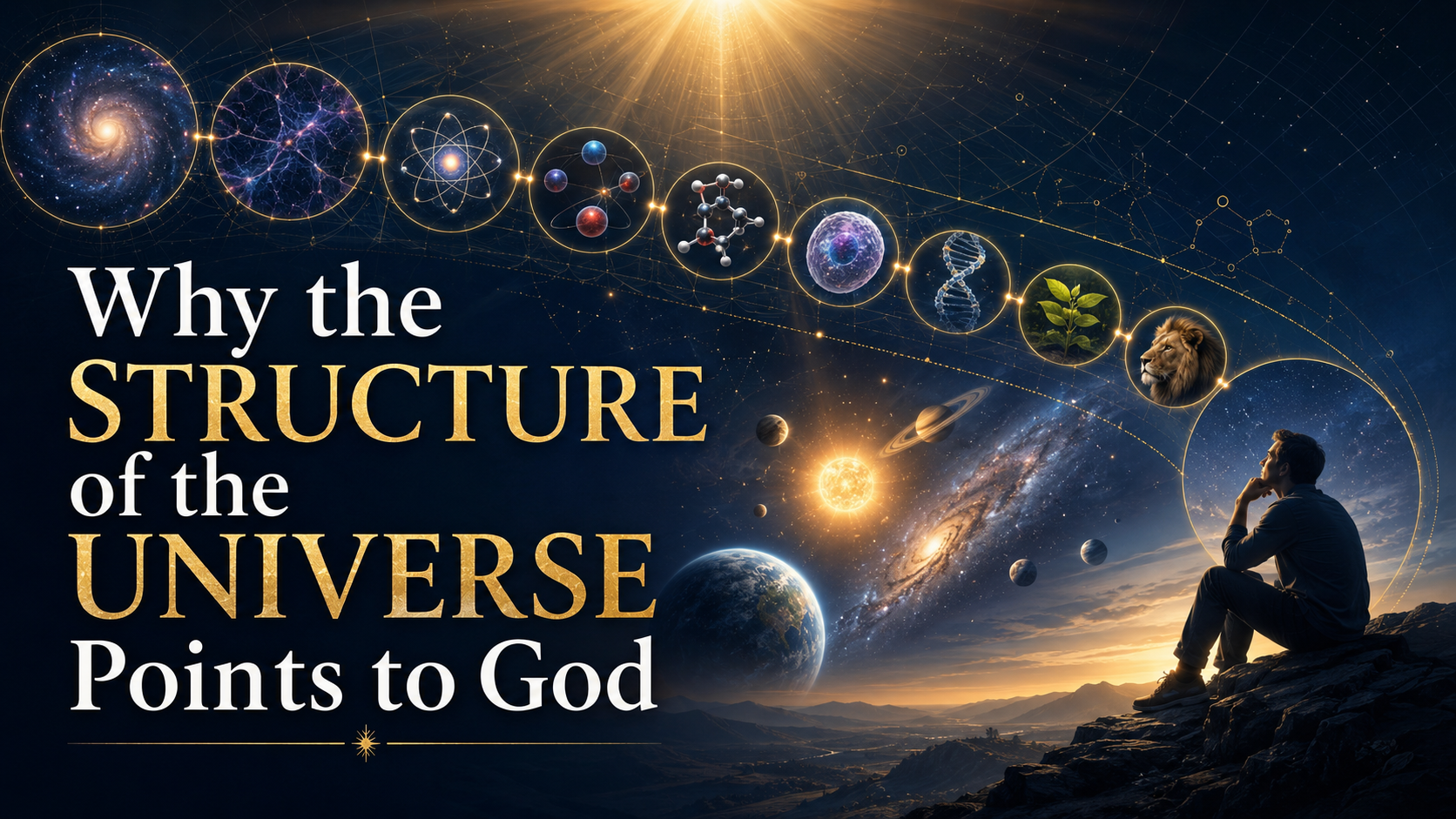
Why does the universe’s deepest structure give rise to stars, chemistry, and consciousness beings capable of understanding it?
Modern science has discovered that the universe is governed by precise laws. These laws determine how matter behaves, how stars form, how atoms combine, and what kinds of things can exist.
The philosopher James Ladyman, in his book “Every Thing Must Go,” argues that the deepest level of reality may not be made up mainly of separate little objects. Instead, reality may be based on a network of laws, relationships, and possibilities. An electron, for example, is understood largely by how it behaves and interacts.
Ladyman also argues that the larger things studied by chemistry, biology, and the other sciences are real. Molecules, cells, animals, minds, and societies are not illusions simply because they are not mentioned in basic particle physics. They are stable and meaningful patterns that arise at higher levels of nature. He calls this rich variety the “rainforest” of reality.
This picture raises an important question: Why is the basic structure of the universe able to produce such a rich world?
The laws of nature could have been different. The strength of gravity, the masses of particles, and the universe’s starting conditions could all have taken other values. Many changes would have prevented stars, complex atoms, chemistry, planets, and life from forming.
The result is not merely that life happens to be possible. The deepest structure of the universe produces layer after layer of organization: particles, atoms, molecules, stars, planets, living cells, animals, and finally beings capable of understanding the universe itself.
Ladyman explains how these higher-level patterns can be real. But he does not explain why the fundamental laws are so well suited to producing them.
Perhaps a future theory will explain them through deeper principles. But unless that deeper theory is the only possible one, the question remains: Why does reality have a structure capable of producing such richness?
Imagine finding a complicated machine whose parts are arranged to produce a valuable outcome. The fact that all the parts cooperate would naturally suggest design. The intended result would help explain why the machine was built in that particular way.
The universe is similar. Its basic structure permits atoms; atoms permit chemistry; chemistry permits life; life permits consciousness and knowledge. Real patterns in the rain forest.
This suggests that the rich world produced by the laws may help explain why those laws were chosen. The idea is not that life somehow reached backward and created physics. It is that an intelligent being selected a physical structure because of the world it would eventually produce.
Everything we understand about the universe indicates that its fundamental structure is purposefully arranged to produce real, complex patterns across all scales. And that purpose points to an intelligent God.
Related Posts