
Israeli-American attorney and Chairman of Republicans Overseas Israel
Why Washington Should Rethink the Falklands
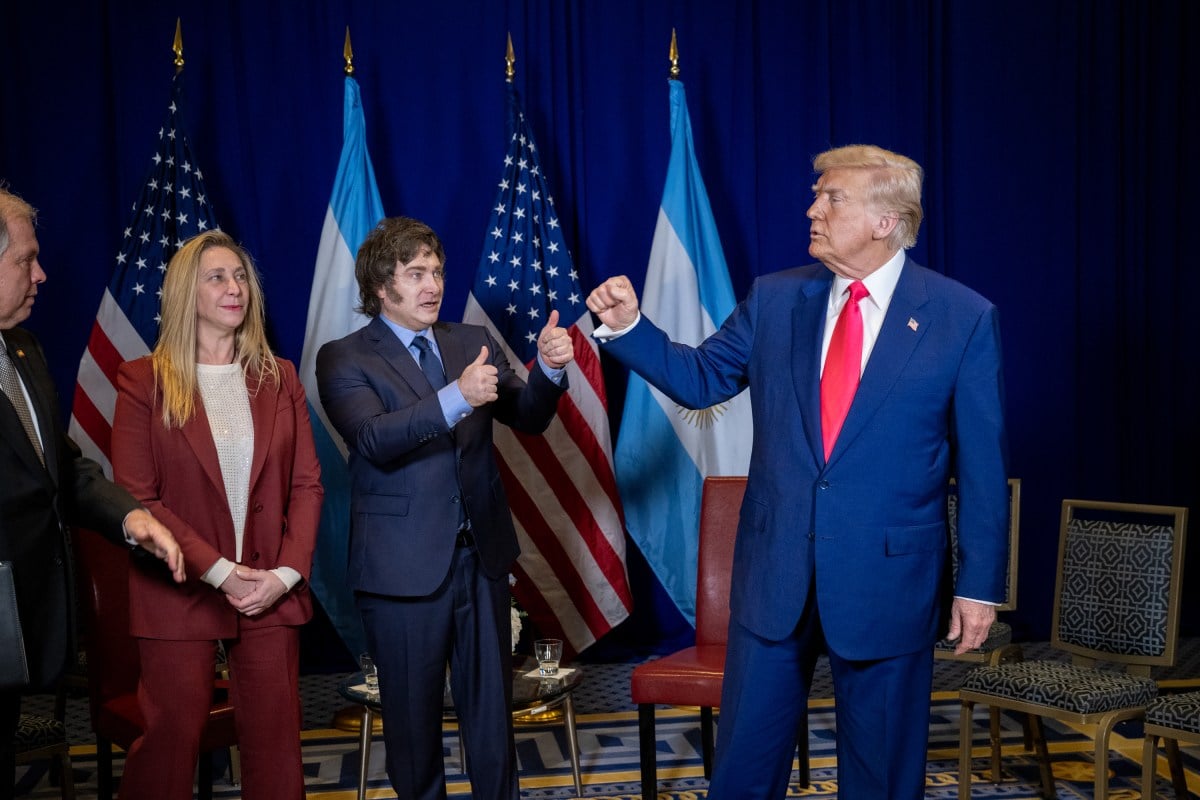
President Donald Trump meets with Argentine President Javier Milei in Oxon Hill, Maryland, February 22, 2025. (Official White House Photo by Molly Riley)
Milei’s Argentina has stood with President Trump and Israel when it mattered, while Britain has chosen a different course. Washington should reconsider a Falklands policy rooted in the alliances and circumstances of 1982.
In March, as President Trump sought international support to protect shipping through the Strait of Hormuz and confront the Iranian threat, Argentina made clear that it stood with the United States while Britain chose a different course. Britain’s cowardly refusal to stand with America provides good reason for the Trump Administration to reconsider Washington’s position on the Falkland Islands, or Malvinas, and Argentina’s claim to sovereignty over them.
The case for reconsideration has only grown stronger. Alliances are not heirlooms, passed automatically from one generation to the next regardless of who shows up when it counts. They are living relationships built on reciprocity, common interests and trust. In 1982, President Reagan backed Prime Minister Margaret Thatcher as Britain fought to retain control of the Falklands. That was a decision based on the circumstances and alliances of its time, not a permanent lien on American foreign policy forty-four years later.
Today, Argentine President Javier Milei has made an extraordinary strategic choice. In a region where anti-American and anti-Israel politics have long been entrenched, Milei has aligned Argentina openly with the United States and Israel, even when doing so carries a political price. In April, he traveled to Israel, met Prime Minister Benjamin Netanyahu and signed the Isaac Accords, modeled on the Abraham Accords to deepen cooperation between Israel, Argentina and like-minded nations across the Americas. This is what friendship between nations should be measured by: not sentimental declarations, but choices.
The Falklands question has now returned to the international agenda, with Milei declaring in recent days that Argentina would “not stand idly by” and announcing measures targeting companies involved in oil development around the islands, alongside a renewed push to assert Argentina’s sovereignty claim. Asked whether the United States might reconsider its position, President Trump did not dismiss the possibility, saying, “I always review every position.” That is precisely the kind of reassessment American foreign policy requires, because the relevant question is not what Washington decided in 1982, but what serves American interests in 2026.
There is also a hard strategic interest behind reconsidering Washington’s approach. The Falklands sit in an important part of the South Atlantic and above substantial energy resources, while the Trump Administration has made clear that it intends to reassert American primacy in the Western Hemisphere. It is therefore reasonable to ask why the United States should continue to defer automatically to a distant European power on a strategic question in this hemisphere, particularly when Argentina is emerging as one of Washington’s strongest partners in the region.
Britain’s own behavior makes that question harder to avoid. London declined to stand with Washington over Iran while becoming increasingly willing to pressure Israel, America’s closest ally in the Middle East. Britain is now targeting Israeli communities in Judea and Samaria and the E1 project near Jerusalem, invoking territorial principles against Israelis living in their ancient homeland while itself administering some 4,700 square miles of territory thousands of miles from Britain and only a few hundred miles from Argentina. That contradiction should be part of Washington’s calculation of what Britain contributes to its relationship with the United States and what it expects in return.
None of this requires hostility toward Britain, nor does every disagreement between allies justify a wholesale realignment of American foreign policy. The point is that alliances must have consequences and cannot survive indefinitely on historical sentiment alone. Friends who stand with America should know that their friendship matters, while allies who take American support for granted should understand that it is not unconditional.
Reagan stood with Britain in 1982 because Britain was the ally who counted, but the circumstances of 1982 cannot determine American policy forever. President Trump has built his foreign policy around the proposition that America’s relationships should serve American interests, and Javier Milei has spent the past months making Argentina’s case through the choices his government has made. Washington should therefore stop treating a forty-four-year-old policy as sacred scripture and reconsider its position on the Falklands. When the bill comes due, what matters is who shows up, and today Argentina is showing up.
Related Topics
Related Posts