
A journalist who wrote for Times of Israel, Jerusalem Post, and other publications
Why we should read another Holocaust memoir now

When I heard about the five-year-old boy who was arrested by ICE (American federal immigration police), I immediately remembered the Diary of Anne Frank. If you recall, Anne’s family went into hiding after Anne’s sister Margot, who was a teenager, received a letter ordering her to go to a German labor camp.
“Margot is sixteen; would they really take girls of that age away alone?” the frightened Anne Frank wrote in her diary.
Anne could not have imagined that not only would they take young girls away alone, but they would murder millions of innocent civilians: babies, children, women, elderly people. The Nazis killed people who had harmed no one and presented no threat to anyone only because they were following orders, rules, and laws. Following their country’s laws was more important to the Nazis than following basic morals: not killing people, not taking children away from their mothers, not separating husbands and wives.
Today is Holocaust Remembrance Day and I am writing this blog to make a connection between the Holocaust and what is happening in America today. My grandparents were Holocaust survivors and I recently wrote a book about my grandfather’s life, called “How My Grandfather Stole a Shoe and Survived the Holocaust in Ukraine.”
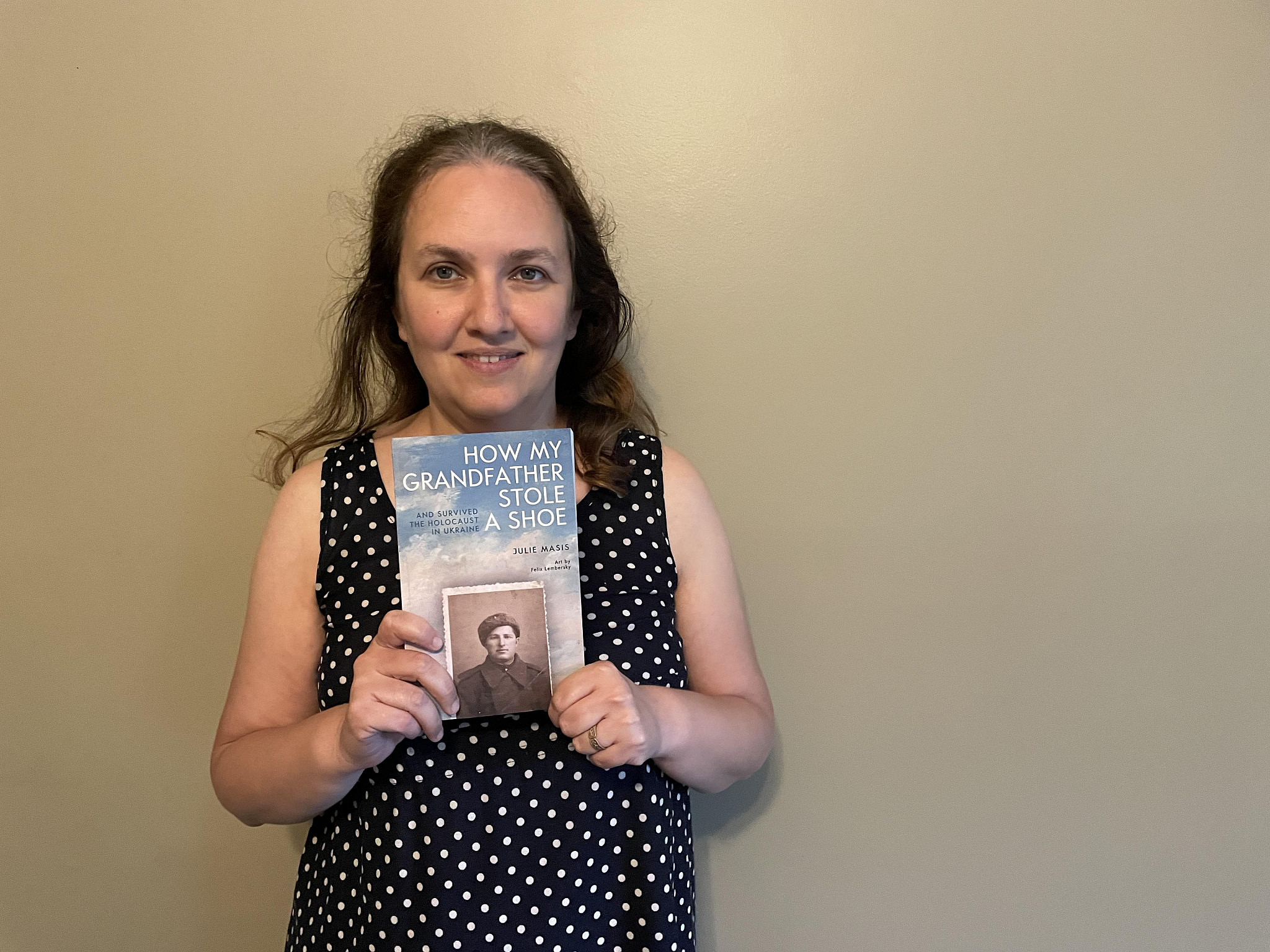
I grew up with nightmares of the Holocaust, but I always reassured myself that nothing similar to that horror would ever happen again.
But I see now that history is repeating itself.
Remember that the Nazi concentration camps did not start out as death camps with gas chambers. They began as detention centers where people were detained indefinitely without being tried in court.
Now in the United States, we have created a group of second-class citizens, who, evidentially, don’t deserve to have a trial prior to being jailed for an indefinite period of time. We have established so-called immigration detention centers (jails for foreigners) where people are imprisoned even though they committed no crime except for making the mistake of coming to the United States.
As part of my journalism work for the Russian Boston Gazette (a newspaper that I publish for Russian-speaking immigrants in the United States), I recently interviewed a man whose wife has been imprisoned in an immigration detention center in Arizona for almost a year . I am not publishing his or her name because of the fear of retaliation against her in the jail and in immigration court.
This is what the woman’s husband told me: In immigration jails, men and women are separated. Guards yell at the inmates. During outdoor walks in the jail yard, the female inmates are forced to walk in a circle in one direction when one guard yells at them, and to stop when another guard says so. Practically no medical care is offered. If a woman asks for a painkiller, she has to submit a request in writing and wait for three days to receive the medicine (why the cruelty?). Breakfast is served at 4 in the morning (why make people eat in the middle of the night?) and the last meal is at 4 pm. The food is barely edible. A detainee may get to eat a chicken wing once a month, the man told me. Dental treatment is offered only after 12 months of imprisonment, and the women are given two options: a temporary filling that has to be changed after one month (why?) or pulling the tooth out.

“My wife is suffering from toothaches. She is afraid that she might lose a quarter of her teeth,” he told me.
(When I heard this, I immediately remembered that my grandparents lost all of their teeth while they were imprisoned in the Obodovka ghetto in Ukraine during the Holocaust.)

The man I spoke with also told me that at an immigration detention center, his wife and other women were forced to take showers and all their clothes were taken away from them. Each was given a towel and a pair of flip-flops. After they got out of the shower, they were left to shiver naked in a cold room (with the temperature at approximately 11 degrees Celsius) for several hours. After this experience, most of the women signed self-deportation papers. (Although even those who wish to be deported have to wait behind bars for months.)
The only activity offered to women at the jail is to work in the laundry for $3 per day. The women are forced to remove scolding hot towels and bedsheets from the dryers, burning their hands, the man told me.
He told me that his wife is depressed and now spends most of her time lying in bed staring at the wall. She is forced to take anti-depressants (which she never needed prior to being detained). However, the immigration jail is full of people who have more serious health issues: some have bladder catheters, others are in wheelchairs, have spinal injuries or cancer. A woman was recently seriously injured after falling from a top bunk, but was returned to the jail after a hospital stay wearing a neck brace.
The man related to me a shocking conversation that his wife recently had with a jail psychologist. The psychologist asked her why she is depressed. She said it is because the guards yell at her and verbally abuse her. The psychologist asked if she needs a higher dose of antidepressants. The jailed woman said to the psychologist: “Wouldn’t it be better to ask the guards not to scream at us?” The psychologist replied that she can’t do anything about that.
So the jailed woman asked, “What if they build ovens to burn people?”
And the jail psychologist said: “Whatever the law says, we will have to follow it.”
Related Topics
Related Posts